
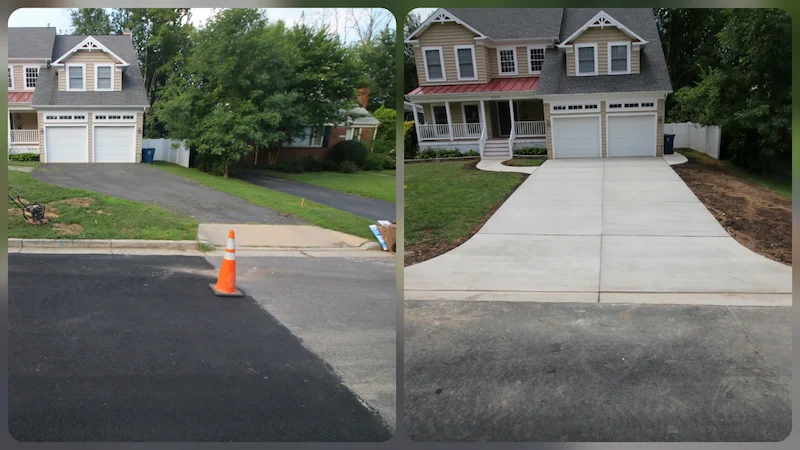
Why Your Asphalt Driveway Failed (The Science)
If you live in Northern Virginia, your asphalt driveway is fighting a losing battle. Asphalt is a flexible pavement, meaning it relies on oil-based binders to maintain its structure. Every summer, UV radiation from the sun evaporates these oils, turning the surface gray and brittle. Every winter, water penetrates the micro-cracks, freezes, expands, and blows the pavement apart.
Most homeowners try to fight this with sealcoating. But sealcoating is just cosmetic paint. It does not restore structural integrity. You are essentially "renting" your driveway from the asphalt company, paying every two years to keep it on life support. The only permanent cure is conversion to rigid pavement: 4,000 PSI Concrete.
The Conversion Protocol: How We Do It Correctly
Removing asphalt and pouring concrete is not a simple swap. The underlying soil mechanics are different. Here is the Tuck Standard procedure for a successful conversion:
- 1. Demolition & Haul Away We use a skid steer to strip the existing asphalt layer. We don't just skim the top; we remove the contaminated sub-base that has mixed with the clay soil underneath. All debris is hauled to a recycling facility.
- 2. Subgrade Proof Rolling Once the asphalt is gone, we "proof roll" the exposed dirt with heavy machinery to identify soft spots. In Fairfax County's marine clay, this is critical. If we find soft clay, we excavate it and replace it with structural fill.
- 3. The Stone Mattress (21A Aggregate) Concrete needs a stable, draining bed. We install 4-6 inches of VDOT-approved 21A Crushed Stone. This layer acts as a capillary break, preventing ground water from wicking up into the concrete slab.
- 4. Wire Mesh Reinforcement We install 6x6 welded wire mesh throughout the entire pour. This steel skeleton holds the concrete together under tension, preventing separation if the ground shifts slightly over decades.
- 5. The Pour (Class A3 Concrete) We pour 4,000 PSI air-entrained concrete. The "air entrainment" creates microscopic bubbles inside the slab that allow internal water to expand during freezing weather without cracking the surface.
Material Science: Asphalt vs. Tuck Concrete
Why is concrete the superior investment for Northern Virginia homes?
| Feature | Standard Asphalt | Tuck Standard Concrete |
|---|---|---|
| Lifespan | 12-15 Years (with maintenance) | 30-40+ Years |
| Maintenance | Sealcoat every 2-3 years | Pressure wash only |
| Summer Heat | Absorbs heat (140°F+), gets soft | Reflects heat, stays rigid |
| Load Bearing | Can rut under heavy trucks/RVs | Supports 4,000 PSI (Heavy Duty) |
| Edge Strength | Crumbles at edges (Aligatoring) | Defined, rigid edge |
The Northern Virginia Factor: Clay & Code
The Clay Problem: Fairfax and Prince William counties sit on "Marine Clay." This soil expands when wet and shrinks when dry. Asphalt flexes with this movement, which eventually tears it apart. Concrete, when installed with a proper stone base and expansion joints, "floats" above this movement as a monolithic slab.
The VDOT Apron Requirement: When we convert your private driveway to concrete, we often need to upgrade the "apron" (the section connecting to the street) to meet current VDOT standards. This usually involves saw-cutting the curb and ensuring the grade does not dump water into the public roadway. We handle all LUP-A permitting required for this transition.
Frequently Asked Questions
Stop Renting Your Driveway
Don't sink another dollar into sealcoating a dying asphalt surface. Invest in a permanent, structural solution that increases your home's appraisal value immediately. A concrete driveway is a "one-and-done" project.
Request a Conversion Estimate