
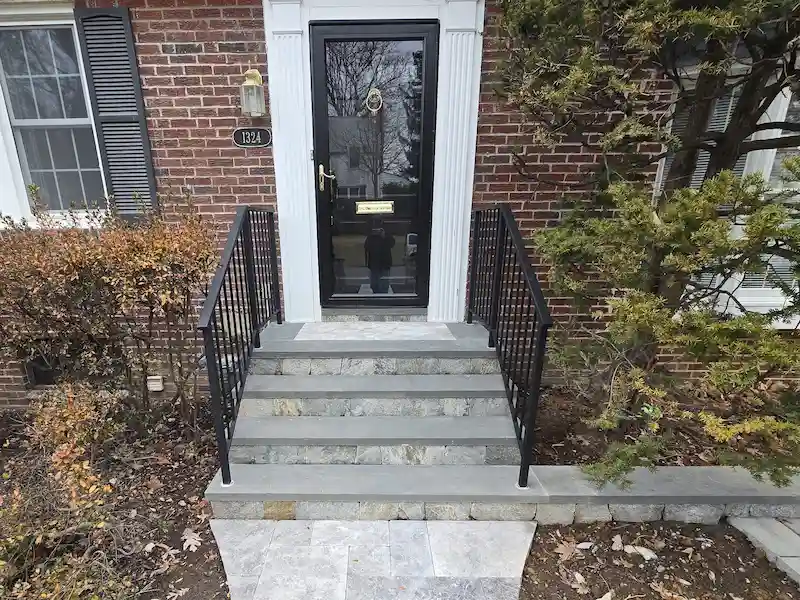
Safety Starts at the Front Door
Your front steps are the literal entry point to your home, bearing the brunt of daily foot traffic, package deliveries, and extreme weather. Crumbling concrete steps or shifting brick stoops are not just ugly; they are a severe liability. Loose bricks, uneven risers, and pitching treads cause dangerous trips and falls. At Tuck GC, we do not perform "band-aid" patches on failing masonry. We demolish dangerous stairs and rebuild them from the footer up, utilizing structural cinder block (CMU), master-laid brick facing, and our signature thick thermal stone treads.
In the historic districts of Alexandria and the premium estates of McLean and Great Falls, a front stoop must reflect the architectural pedigree of the home. Pouring a cheap concrete slab is unacceptable. Our master masons engineer grand, welcoming entryways that perfectly match your home's existing facade while strictly adhering to modern building codes for rise, run, and handrail structural loads.
1. The Diagnostic: The Poured Concrete Trap
Most tract homes in Northern Virginia—especially those built in the 1980s and 90s across Fairfax County and Prince William County—feature pre-cast or hollow-poured concrete front steps. Over time, the soil beneath these heavy concrete blocks inevitably settles. Because the steps were not poured with a deep frost-line footing, the entire stoop pitches forward, pulling away from the front door. This creates a massive, drafty gap at the threshold that allows water and pests directly into your home’s subfloor.
Furthermore, amateur masons frequently try to fix these settling steps by "capping" the old concrete with thin, 1/2-inch slate tiles. Because the concrete substrate is still shifting and cracking beneath the thinset, those thin tiles pop loose within a single winter. Ice gets into the hairline fractures, expands, and shears the stone completely off the riser. True masonry repair requires structural demolition and the use of heavy, monolithic stone.
2. The Tuck Standard Protocol: Solid Thermal Stone Treads
Our approach to building front steps is defined by one core principle: minimizing seams on the horizontal walking surface. Water is the enemy of masonry; fewer seams mean fewer places for water to penetrate. Here is our engineered build protocol:
- Deep Frost-Line Excavation We begin by fully demolishing the failing structure and excavating down to stable subsoil—a minimum of 24 to 30 inches below the frost line. We pour a massive, steel-reinforced concrete footing. This guarantees the new stoop will never pitch, settle, or heave during a freezing Virginia winter.
- CMU Block Core & Structural Fill We build the core of the stoop and stairs using heavy concrete masonry units (cinder blocks). We lock these blocks together with steel rebar and fill the internal voids with solid concrete and gravel aggregate. This creates an immovable, monolithic foundation for the decorative masonry.
- The Signature Thick Thermal Stone Tread This is what separates Tuck GC from standard landscapers. We do not use thin, patchwork flagstone for stair treads. We exclusively install 1.5-inch to 2-inch thick thermal-treated stone slabs (typically Pennsylvania Bluestone or premium Flagstone). We order these pieces custom-cut to span the entire width of your stairs. By using massive, single-piece or two-piece slabs, we eliminate the spiderweb of fragile mortar joints found on cheap steps. The thick stone provides a bold, pronounced architectural edge (or "bullnose") that looks incredibly high-end and is virtually indestructible.
- Custom Brick & Stone Risers To support the heavy thermal treads, we face the vertical risers and the sides of the stoop with premium masonry. Whether it is matching the historic red brick of an Arlington colonial or applying a dry-stacked natural stone veneer to complement a Clifton estate, our masons ensure the vertical facing ties flawlessly into your home's foundation.
- Precision Pitching & Flashing Every tread and landing we lay is pitched at a hyper-precise, nearly invisible angle (typically 1/8th of an inch per foot). This ensures that heavy rain sheets immediately off the front of the steps, preventing water from pooling, freezing, or wicking back toward your front door threshold.
3. Material Science: The Tread Comparison
| Tread Material | Aesthetic Impact | Durability & Longevity | Seam Density |
|---|---|---|---|
| Thick Thermal Slab (Tuck Standard) | Massive, luxurious, clean horizontal lines. | Extreme. 2-inch thick stone resists all impact and frost. | Zero to minimal. Solid pieces span the opening. |
| Thin Irregular Flagstone (Patchwork) | Busy, highly textured, "crazy paving" look. | Poor on stairs. Thin pieces easily pop loose under foot traffic. | Extremely high. Dozens of vulnerable mortar joints. |
| Standard Paver Blocks | Commercial or driveway aesthetic. | Prone to settling and shifting on vertical applications. | High. Requires constant re-sanding of joints. |
| Poured Concrete | Utilitarian, basic builder-grade. | Will eventually crack and spall from de-icing salts. | N/A (Solid pour, but prone to cracking). |
4. The Northern VA Factor: Historic Compliance and Code
Rebuilding a front stoop in Northern Virginia often involves navigating strict municipal codes. In the City of Alexandria and the historic sectors of Falls Church, the Board of Architectural Review (BAR) heavily regulates changes to street-facing masonry. We specialize in sourcing reclaimed or historic-match bricks and period-accurate mortar colors to ensure your new stoop looks historically authentic while benefiting from modern subterranean engineering.
Furthermore, building codes in Fairfax and Arlington strictly mandate the exact height (rise) and depth (run) of every stair tread to prevent trip hazards. If a set of stairs exceeds three steps, a structural handrail is legally required. Our masons calculate the rise-and-run to the millimeter to ensure code compliance, and we frequently integrate custom wrought-iron or powder-coated aluminum handrails directly into the thick thermal stone treads, securing them with deep core-drilled epoxy anchors for absolute safety.
5. Front Stoop & Stair FAQ
If the issue is purely cosmetic (a few localized cracked mortar joints), we can grind and re-point the brick. However, if the steps are physically sagging, pitching forward, or if multiple bricks are totally loose, the underlying foundation has failed. Patching failing stairs is a waste of your money. Total replacement is required for safety.
Standard rock salt (Sodium Chloride) is highly destructive to masonry and will cause concrete and thin stone to spall (flake). While our thick thermal bluestone and flagstone treads are incredibly dense and resistant, we still strongly advise using Magnesium Chloride or Calcium Chloride ice melts, which are much gentler on natural stone.
Yes. Many older homes feature narrow, dangerous top landings that force you to step backward while opening the storm door. When we demolish the old stoop, we routinely extend the footprint of the new CMU core outward, creating a deep, expansive top landing that provides plenty of safe room to greet guests and handle packages.
6. Command Your Curb Appeal
Do not let a crumbling, dangerous set of stairs define the entrance to your home. From engineering expansive, sweeping bluestone entryways in Vienna to restoring tight, historic brick stoops in Old Town Alexandria, Tuck GC delivers the absolute pinnacle of masonry craftsmanship. Elevate your architecture and secure your entrance with solid thermal stone.