
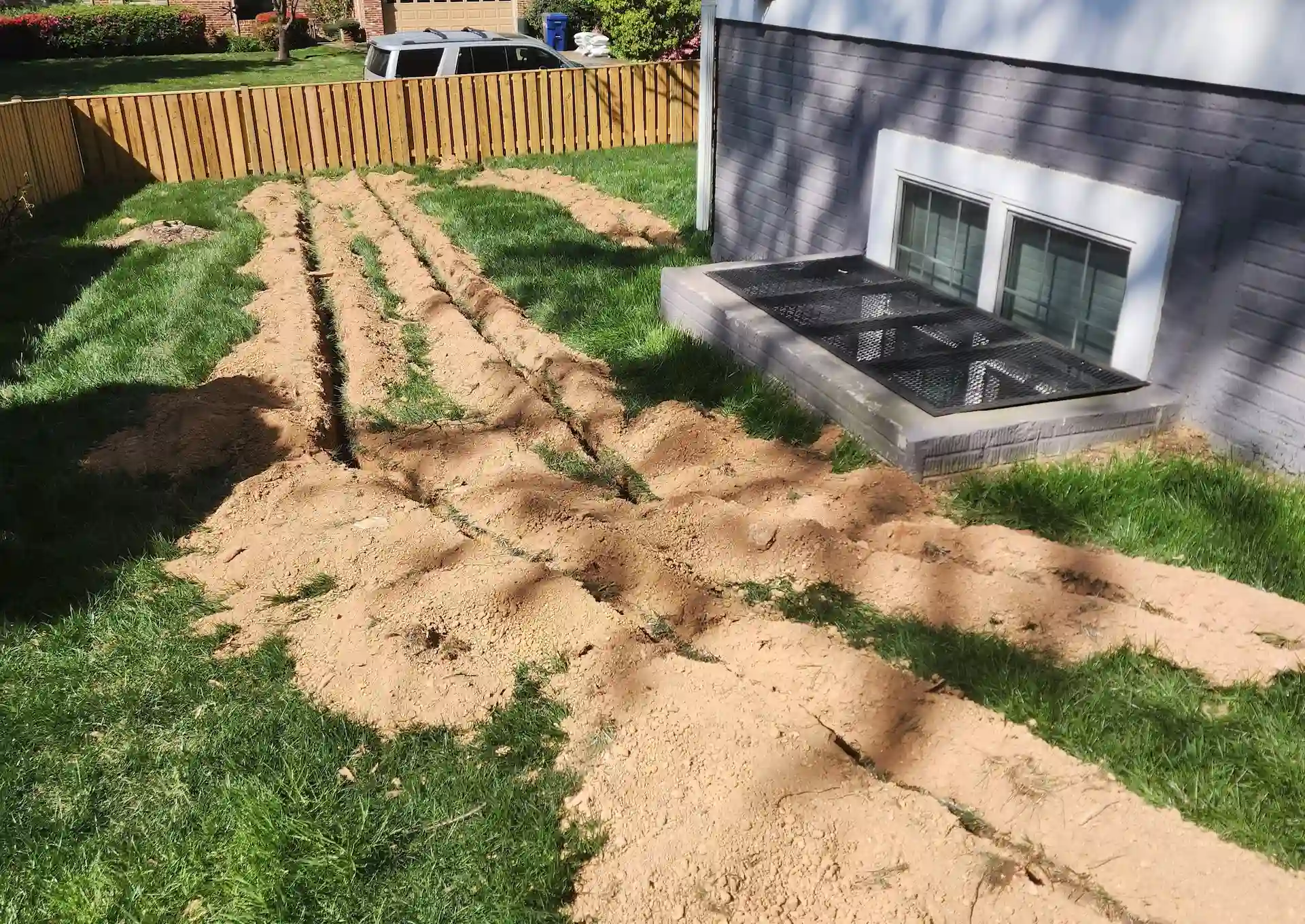
The #1 Cause of Basement Leaks
A standard residential roof collects hundreds of gallons of water during a typical Virginia rainstorm. Roof water dumping right next to your foundation is a recipe for disaster. Flimsy, two-foot plastic splash blocks aren't enough—they simply cycle the water directly back into the backfill zone surrounding your basement walls. When this soil saturates, the resulting hydrostatic pressure forces water through concrete pores, leading to flooded basements, bowed foundation walls, and cracked driveway slabs.
The only permanent solution is civil-grade subterranean piping. At Tuck GC, we excavate deep trenches to hard-pipe that water 20+ feet away from your home to a safe, engineered discharge point. We treat your roof runoff not as a landscaping annoyance, but as a critical threat to your home's structural integrity.
1. The Diagnostic: We Do Not Use "Black Corrugated"
If you hire a standard landscaper to bury your downspouts, they will almost universally use cheap, flexible black corrugated pipe. This is a fatal mistake. Corrugated pipe is paper-thin; it crushes easily under the weight of settling soil, the tires of a riding lawnmower, or simple foot traffic, creating a subterranean dam that traps water underground.
Furthermore, the interior of corrugated pipe is heavily ribbed. Leaves, roofing granules, and shingle grit wash down the gutter and catch on these ribs, quickly forming impenetrable clogs. Finally, the joints on black plastic pipe are merely taped or snapped together. Thirsty tree roots effortlessly seek out these weak connections, penetrating the pipe and choking off the entire system within a few seasons. Once a corrugated pipe is clogged or crushed, it is impossible to snake or clean—it must be entirely dug up and replaced.
2. The Tuck Standard Protocol: Rigid PVC Engineering
To guarantee that your roof water flows rapidly away from your foundation for the lifespan of your home, we utilize heavy-duty municipal sewer and drain protocols. Here is how we engineer our burial systems:
- Laser Grade Topography & Trenching Water requires gravity to move efficiently. We shoot grades with a laser transit to map the exact slope away from your foundation, ensuring a continuous fall in the pipe. We then excavate a deep trench, carefully peeling back existing sod to minimize damage to your lawn.
- Rigid PVC (SDR-35) Installation We use thick-walled PVC sewer pipe (such as SDR-35 or Schedule 40) that will never crush under the weight of soil or vehicles. The smooth interior walls ensure that leaves and debris flow right through at high velocities, naturally scrubbing the pipe clean and preventing clogs.
- Glued & Sealed Joints Unlike snap-together plastic, every joint and elbow in our PVC system is primed and chemically welded (glued) together. This creates a completely monolithic, watertight conduit that is 100% impenetrable to seeking tree roots.
- Clean-Outs Integration We install surface-level "Y-access" cleanout points directly below the downspout transition. This allows you, or a maintenance professional, to easily insert a hose or a plumber's snake to flush the line if shingle grit or heavy autumn debris ever accumulates.
- Engineered Discharge Options Where does the water go? We design the exit based on your yard's specific topography. We utilize Pop-Up Emitters (a discreet green lid in the lawn that pops up when water flows, then snaps shut to keep critters out), Curb Coring (where permitted, we core-drill through the street curb to dump water directly into the municipal gutter), or Dry Wells (for yards with no slope, we dig an underground gravel pit to allow water to percolate safely into the subsoil).
3. Material Science: Rigid PVC vs. Corrugated Plastic
| Specification | The Tuck Standard (Rigid PVC) | Standard Landscaper (Corrugated) |
|---|---|---|
| Pipe Wall Strength | Heavy-wall SDR-35; impossible to crush. | Paper-thin plastic; easily crushes under mowers. |
| Interior Surface | Smooth pipe; debris flushes out instantly. | Ribbed; catches leaves and clogs constantly. |
| Joint Integrity | Chemically glued; 100% root-proof and watertight. | Taped or snapped; roots easily penetrate. |
| Maintenance | Features easy-access Y-cleanouts for snaking. | No cleanouts; impossible to snake without destroying. |
| Lifespan | Permanent structural addition. | 3 to 5 years before failure. |
4. The Northern VA Factor: Soil Saturation and Local Codes
Why is downspout burial so critical in our specific region? Across expansive zones like Fairfax County, Prince William County, Burke, Springfield, and Woodbridge, the native soil is predominantly heavy marine clay. Marine clay absorbs water and expands violently. When your downspouts dump water next to your home in these zones, the clay acts like an inflating balloon pressing against your basement walls, eventually causing the cinderblocks to bow inward and crack. Moving the water 20 feet away into a pop-up emitter or dry well diffuses this pressure entirely.
In densely populated jurisdictions like Arlington, Alexandria, Falls Church, and the Town of Vienna, property lines are incredibly tight. You cannot legally dump your bulk roof runoff onto your neighbor's property. In these areas, we specialize in high-capacity subterranean dry wells and permitted municipal curb-coring. We handle the local zoning restrictions to ensure your drainage solution is highly effective, neighbor-friendly, and 100% code-compliant.
5. Downspout Burial FAQ
No. The key to freeze prevention is gravity. Because we shoot our trenches with a laser transit to guarantee a continuous downward slope, water never sits stagnant inside the smooth PVC pipe. The water evacuates immediately after leaving the gutter, leaving the pipe empty before the temperature drops enough to freeze.
We cannot defy gravity, but we can engineer around it. If your yard lacks the necessary slope to run a pipe to a pop-up emitter at the curb, we will install a subterranean Dry Well system. We excavate a large pit far away from the foundation, line it with geotextile fabric, fill it with clean washed stone, and pipe the downspouts directly into it, allowing the water to slowly percolate deep into the subsoil.
Yes. We install a specialized, watertight transition adapter that takes your rectangular aluminum or copper downspout and seamlessly connects it to the round PVC pipe just above the soil line, ensuring a clean, architectural finish.
6. Stop the Saturation Today
A flooded basement or cracked foundation will cost tens of thousands of dollars to repair. By aggressively piping roof runoff away from your home, you are making the most cost-effective preventative investment possible. Whether you need to navigate the dense clay of Manassas or the strict municipal curb codes of Arlington, Tuck GC delivers permanent, rigid PVC drainage solutions. Stop relying on plastic splash blocks. Protect your foundation.