
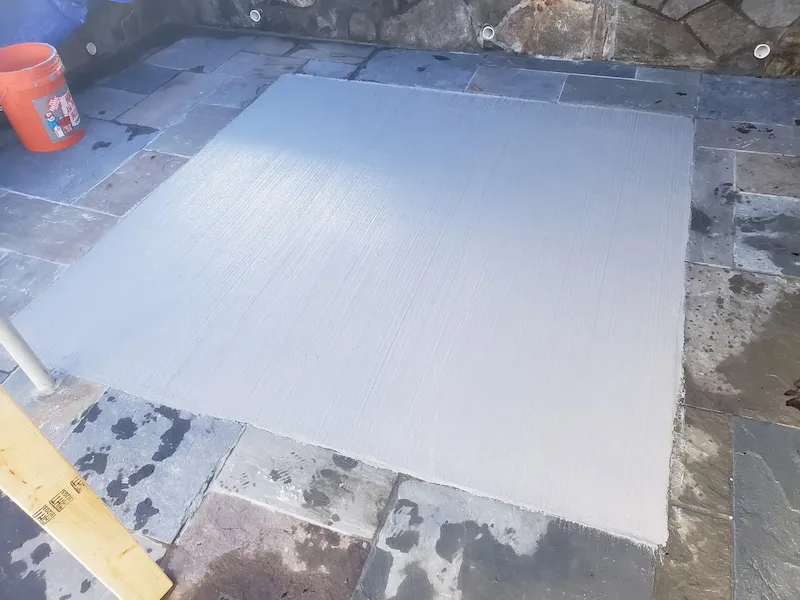
The Diagnosis: Why Your Concrete is Spalling
Many Fairfax County homeowners look at their pitted, flaking driveway and assume the entire slab has failed. This is rarely the case. What you are seeing is "Surface Spalling," often caused by chloride ion penetration from road salts or poor finishing techniques during the original pour.
When the structural integrity of the slab (the "bones") is intact, ripping it out is a massive waste of capital. A full demolition and replacement can cost $15,000 - $25,000. Concrete Resurfacing is the engineering solution that bridges the gap. By removing the damaged "cream" layer and bonding a high-strength polymer overlay, we can restore a brand-new surface for a fraction of the cost.
The Resurfacing Protocol: It's All in the Prep
90% of resurfacing failures happen because contractors apply new cement over dirty or painted concrete. It peels off in sheets within months. Tuck GC follows a strict mechanical bonding protocol:
- 1. Surface Scarification & Cleaning We use 4,000 PSI industrial pressure washers and mechanical grinders to strip away oil, grease, old sealers, and loose debris. We must open the "pores" of the concrete to ensure the new material can bite into the substrate.
- 2. Structural Crack Repair Before resurfacing, we chase cracks with a diamond blade and fill them with a semi-rigid epoxy or polymer filler. This prevents the old cracks from "telegraphing" (reflecting) through the new surface.
- 3. Slurry Bond Coat We apply a liquid polymer bonding agent. This acts as the "glue" between the old, dry concrete and the new material. Without this chemical link, delamination is inevitable.
- 4. Polymer-Modified Overlay We do not use standard sand-mix concrete. We use a specialized "Polymer-Modified" cementitious overlay. The polymers make the concrete flexible enough to withstand thermal expansion and strong enough (5,000+ PSI) to handle vehicle traffic at only 1/4 to 1/2 inch thickness.
- 5. Broom Finish & Seal We apply a non-slip broom finish to match the look of a freshly poured driveway. Finally, we apply a penetrating siloxane sealer to lock out water and salt, protecting your investment for years.
Material Science: Why DIY Paint Fails
Don't be fooled by "Concrete Driveway Paint" sold at big box stores. It is an acrylic coating that sits on top of the concrete. Our overlays become part of the concrete.
| Feature | DIY Concrete Paint | Tuck Polymer Overlay |
|---|---|---|
| Chemistry | Acrylic / Latex (Paint) | Portland Cement + Polymers |
| Thickness | Paper thin (Mils) | 1/4 Inch to 1/2 Inch |
| Durability | Peels under hot tires | Structural Strength (5000 PSI) |
| Texture | Slippery when wet | Textured Broom Finish (Safe) |
| Failure Mode | Flakes off in sheets | Permanent Bond |
The Northern Virginia Factor: Salt & Freeze/Thaw
The Salt Cycle: VDOT and private plows use magnesium chloride and rock salt heavily in our region. You drive through this slush, park in your driveway, and the salt water drips onto the concrete. As the water evaporates, salt crystals grow inside the concrete pores, exerting hydraulic pressure that pops the surface off (spalling).
The Resurfacing Advantage: Our polymer-modified overlays are significantly denser than standard concrete. This density makes them far more resistant to chloride ion penetration. By resurfacing and sealing, you are essentially putting a "Bulletproof Vest" on your driveway against future winter damage.
Frequently Asked Questions
Don't Demolish. Restore.
If your concrete has good bones, don't pay for unnecessary demolition and hauling. Let Tuck GC inspect your slab to see if it is a candidate for resurfacing. It is the smart, cost-effective way to get that "new driveway" look.
Request a Site Evaluation