
Why Do Walls Fail? Water.
A retaining wall is not a landscaping feature; it is a heavy civil engineering structure. Most retaining walls fail because amateur contractors believe the wall's job is to hold back dirt. In reality, a wall's job is to hold back water. When the soil behind a wall becomes saturated, it creates immense hydrostatic pressure. If that water cannot escape, it acts like a hydraulic press, inevitably pushing the wall over. We do not just stack blocks; we engineer advanced drainage systems using clean stone backfill and perforated piping to ensure your wall stands for decades.
In Northern Virginia, the rolling topography of Great Falls, the steep grades of Clifton, and the tight lot lines of Arlington frequently require retaining walls to level the earth and create usable yard space. At Tuck GC, our preferred methodology relies on massive, poured-in-place concrete footings, steel-reinforced cinder block (CMU) cores, and stunning natural stone veneers. This approach minimizes soil disturbance behind the wall while delivering the ultimate in structural rigidity and aesthetic luxury.
1. The Diagnostic: The Flaw in Segmental Blocks (SRWs)
Many landscaping companies aggressively push Segmental Retaining Walls (SRWs)—those pre-cast, interlocking concrete blocks you see stacked in commercial parking lots. While SRWs have their place, they come with significant drawbacks for residential applications. To build a tall SRW correctly, the contractor must excavate a massive area behind the wall to install layers of "geogrid" (a plastic mesh that ties the blocks into the hillside).
This process is highly destructive. It often requires tearing up existing patios, destroying mature trees, and moving hundreds of yards of soil. Furthermore, if the geogrid is not installed perfectly, the SRW will inevitably bow and collapse. Finally, the "faux stone" look of a concrete SRW rarely matches the high-end natural aesthetics required in premium markets like Vienna or McLean.
2. The Tuck Standard Protocol: Steel, Concrete, and Stone
We prefer to build permanent, structural masonry walls. Our method requires significantly less excavation behind the wall, preserving your existing landscaping, while resulting in a stronger, more beautiful finished product. Here is our engineering protocol:
- The Deep Concrete Footer We excavate a wide trench below the frost line and pour a massive, continuous concrete footing. Before the concrete cures, we embed vertical steel rebar "dowels" into the footer, sticking straight up. This footer acts as an immovable anchor for the entire structure.
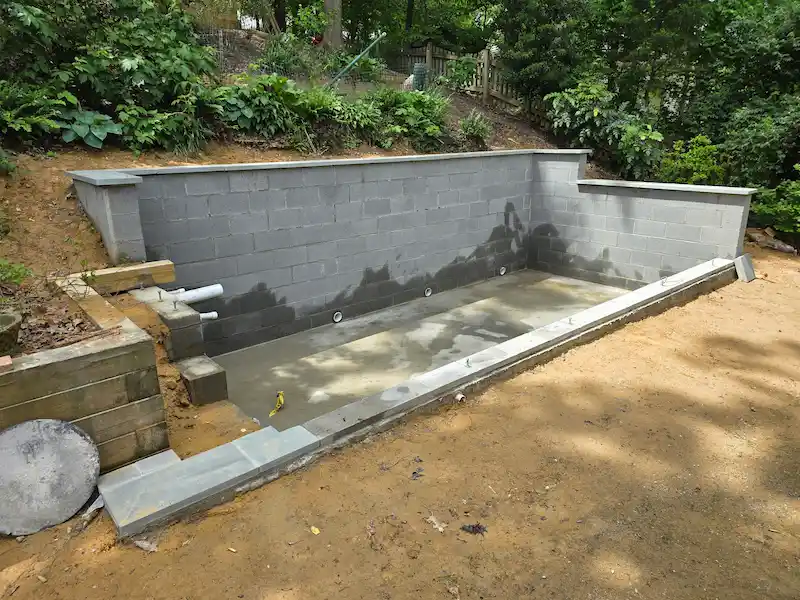
- The CMU Core & Rebar Grid We build the core of the wall using heavy-duty Concrete Masonry Units (cinder blocks). As we stack the blocks, we slide them directly over the vertical rebar dowels extending from the footer. We also lay horizontal rebar between the courses of block, creating an unbreakable steel grid within the wall.
- The "Solid Pour" (Cell Filling) Once the CMU core is built, we pump liquid concrete directly into the hollow cells of the cinder blocks, completely encasing the steel rebar. The wall transforms from a stack of hollow blocks into a single, monolithic, steel-reinforced concrete monolith capable of holding back immense hillside pressure in areas like Lorton and Woodbridge.
- The Hydrology System (Water Management) Before backfilling the dirt, we waterproof the rear of the wall. We install a perforated, fabric-wrapped drainage pipe at the base of the footer, and backfill the entire rear cavity with #57 clean washed stone (not dirt). We install "weep holes" through the face of the wall. This ensures that any groundwater instantly drops through the stone and is piped safely away, completely eliminating the hydrostatic pressure that causes walls to fail.
- The Natural Stone Veneer & Cap To finish the project, our master masons apply a Type-S mortar scratch coat to the face of the CMU wall and hand-lay premium natural stone veneer (such as Pennsylvania Fieldstone, Shenandoah Rubble, or crisp Bluestone). We cap the top of the wall with custom-cut, heavy flagstone or pre-cast architectural coping, delivering a breathtaking aesthetic that easily secures HOA approval in Haymarket or Fairfax Station.
3. Material Science: The Structural Wall Comparison
| Wall Type | Structural Method | Excavation Footprint | Aesthetic Profile |
|---|---|---|---|
| CMU Core + Natural Stone | Steel rebar, concrete footing, solid poured cells. | Minimal. Does not require massive rear excavation. | Premium natural stone. Matches high-end foundations. |
| Segmental Block (SRW) | Gravity, interlocking lips, and heavy geogrid mesh. | Massive. Requires destroying the hillside behind the wall. | Pre-cast concrete "faux stone" look. Commercial feel. |
| Landscape Timbers (6x6) | Spikes and dead-men tie-backs. | Moderate. | Will eventually rot and fail. Not installed by Tuck GC. |
4. The Northern VA Factor: Marine Clay and Engineering Codes
Building a retaining wall in Northern Virginia requires battling "Marine Clay." Highly prevalent in Springfield, Burke, and Alexandria, this soil expands violently when wet and shrinks when dry. It exerts crushing pressure on foundations and walls. Our reinforced concrete footing and solid-poured CMU methodology is specifically designed to resist the shearing force of this shifting clay.
Furthermore, any retaining wall in Fairfax County or Prince William County that exceeds 36 inches in height (from the bottom of the footing to the top of the wall) strictly requires a building permit, detailed civil engineering plans, and a certified structural stamp. Walls exceeding this height are no longer landscaping projects; they are structural liabilities. Tuck GC’s in-house team handles the entire process, working directly with geotechnical engineers to secure the permits and ensure your wall is 100% legal and code-compliant.
5. Retaining Wall FAQ
No. Once a wooden retaining wall begins to lean, the structural tie-backs have failed and the wood is actively rotting. The only safe and permanent solution is total demolition and the construction of a new, masonry-based wall.
Yes. Because our CMU walls utilize a veneer application, we have total aesthetic freedom. We source stone from the top quarries supplying the Mid-Atlantic, allowing us to perfectly match your existing flagstone patio, brick home foundation, or outdoor fireplace.
While we strongly recommend the durability and minimal site disturbance of our CMU/Stone Veneer method, we will install SRW block walls if the client specifically requests them or if the budget strictly requires it. However, we will never compromise on the required geogrid engineering or hydrology systems necessary to make them safe.
6. Reclaim Your Sloped Yard
Do not surrender your valuable square footage to steep, unusable hillsides. From engineering massive, terraced retaining systems in McLean to executing elegant, low-profile planter walls in Falls Church, Tuck GC delivers permanent earth-retention solutions. Stop fighting erosion and start utilizing every inch of your property.