
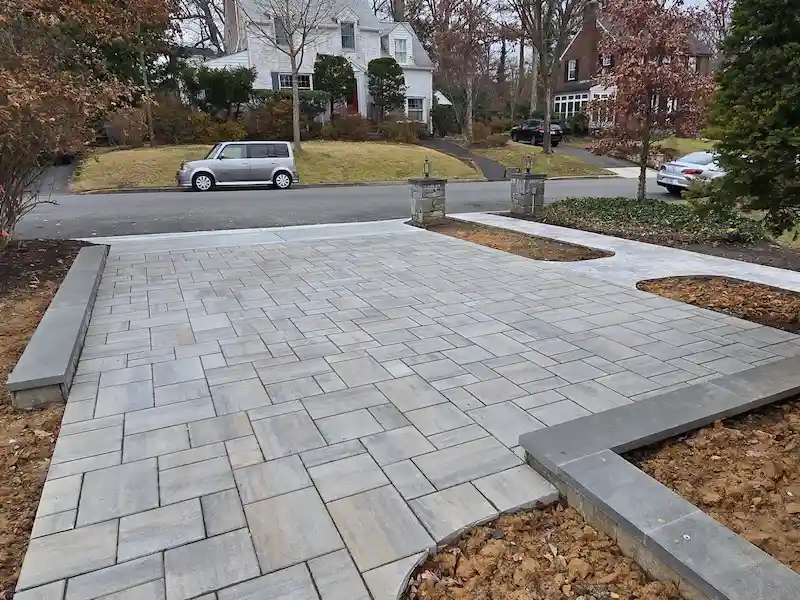
The Diagnosis: The "Wavy Driveway" Syndrome
We have all seen them: expensive paver driveways that look beautiful for six months, but then develop distinct "ruts" where the tires roll. The bricks start to settle, weeds explode through the gaps, and the edge pavers start falling into the lawn.
This is not a failure of the brick. Modern pavers from manufacturers like Techo-Bloc and EP Henry are rated for 8,000+ PSI (stronger than concrete). The failure is always in the sub-base Preparation. Most contractors treat a driveway like a patio, excavating only 4-6 inches. A driveway is a road. It supports 6,000-pound SUVs daily. If you build it like a patio, it will fail like a patio.
The Driveway Protocol: Building a Road, Not a Patio
At Tuck GC, we engineer driveways to withstand vehicular loads, turning torque, and Virginia's freeze-thaw cycles. Here is the non-negotiable standard:
- 1. Deep Excavation (12+ Inches) We excavate a minimum of 10-14 inches below grade. This allows us to remove the organic topsoil and the unstable "marine clay" found throughout Fairfax and Prince William counties. We must reach a stable subgrade before we build up.
- 2. Geotextile Stabilization Fabric This is the "insurance policy" most contractors skip. We roll out a heavy-duty woven geotextile fabric over the clay soil. This fabric separates the clay from the stone base, preventing the stone from sinking into the mud over time (which causes ruts). It also reinforces the soil structure, similar to rebar in concrete.
- 3. The "21A" Structural Base We install 8-10 inches of VDOT-approved 21A crushed stone aggregate. We compact this in 3-inch "lifts" using a 5,000 lb reversible plate compactor. This creates a monolithic, rock-hard foundation that creates the load-bearing capacity for the driveway.
- 4. Concrete Bond Beam (The Edge Restraint) Plastic edging borders (held down by 10-inch spikes) eventually heave up from frost. Tuck GC uses a Concrete Bond Beam. We trowel wet concrete along the entire perimeter of the driveway, burying the edge pavers in a solid wedge of cement. This locks the pavers in place permanently.
- 5. Polymeric Sand Locking We sweep high-grade polymeric sand into the joints and vibrate it down. When activated with water, this sand hardens like grout, locking the pavers together (interlock) and preventing weeds and ants from penetrating the joints.
Material Science: Pavers vs. The Rest
Why Interlocking Concrete Pavers (ICP) offer the highest ROI of any driveway material.
| Feature | Interlocking Pavers | Stamped Concrete | Asphalt |
|---|---|---|---|
| PSI Strength | 8,000+ PSI (Very High) | 3,500 PSI | Flexible (Low) |
| Flexibility | Moves with Frost (No Cracks) | Rigid (Will Crack) | Flexible (Will Crack) |
| Repairability | "Unzip" & Replace Bricks | Cannot match patch | Ugly patch marks |
| Winter Safety | Textured/Non-Slip | Slippery when wet | Absorbs Ice |
| Aesthetics | Custom Colors/Patterns | Fades over time | Industrial/Plain |
The Northern Virginia Factor: Zoning & Permeable Pavers
The "Lot Coverage" Issue: In crowded areas like Arlington, Falls Church, and Vienna, zoning laws strictly limit how much of your lot can be covered by "impervious" surfaces (concrete/asphalt) to prevent flooding. If you want to widen your driveway, you might hit this limit.
The Permeable Solution (PICP): We specialize in Permeable Interlocking Concrete Pavers. These systems use open-graded stone bases that allow rainwater to drain through the driveway and into the ground. Fairfax County views this as a "Best Management Practice" (BMP), often allowing you to build a larger driveway than would be permitted with standard concrete.
Frequently Asked Questions
The 50-Year Driveway
A paver driveway is not an expense; it is an asset. It creates an immediate "estate" look that distinguishes your home from every other house on the block. Built to the Tuck Standard, it will likely outlast your tenure in the home.
Request a Design Consultation