
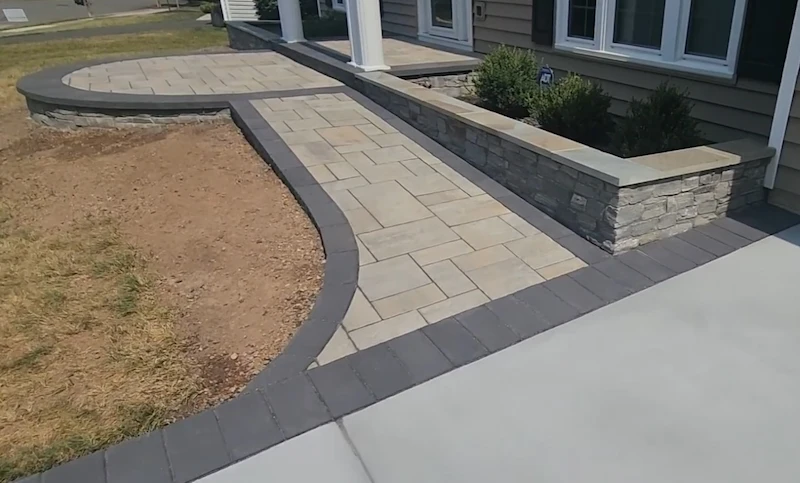
Diagnosing Interlocking Pavement Failure
Interlocking concrete pavers offer design versatility that natural stone simply cannot match. From the sleek, ultra-modern lines of large-format slabs to the rustic, tumbled charm of European cobblestones, pavers allow for exact architectural matching. However, a paver patio is only as strong as the unseen foundation beneath it.
Most paver failures in Northern Virginia are not material defects; they are base engineering failures. When a landscaping contractor under-excavates the site or uses improper fill material to save time, the results are highly predictable. Within three to five years, the patio develops sunken ruts that hold water, the outer edges begin to spread and separate, and the polymeric sand joints crack, allowing aggressive weed root systems to take hold.
These issues are entirely preventable. At Tuck GC, we are certified installers for industry-leading manufacturers including Techo-Bloc, EP Henry, and Nicolock. We do not lay premium pavers on compromised subgrades. We engineer structural, deep-aggregate pavement systems designed to withstand decades of freeze-thaw cycles without settling a single fraction of an inch.
The Tuck Standard Protocol: Deep Aggregate Engineering
We adhere strictly to the engineering guidelines established by the Interlocking Concrete Pavement Institute (ICPI). By prioritizing the depth and mechanical compaction of the base layers, we eliminate soil migration and frost heave. This is our 5-step interlocking installation process:
- Deep Excavation & Geotextile Integration We excavate the patio footprint to a minimum depth of 7 to 9 inches (deeper for vehicular loads or highly plastic soils). Before any stone is introduced, we lay a commercial-grade woven geotextile fabric over the subgrade. This critical step prevents the heavy aggregate base from sinking into the soft clay over time.
- Crushed Aggregate Base Matrix We install a compacted base of dense-graded aggregate (such as VDOT 21A or #57 stone, depending on drainage requirements). We do not use round river gravel, which rolls and shifts. The crushed angular stone locks together when mechanically compacted in 2-inch lifts, creating a rigid, load-bearing platform.
- Screeded Bedding Layer We apply a precise 1-inch layer of clean, coarse bedding sand or clean crushed grit. This layer is laser-screeded to create a perfectly uniform setting bed. We never use stone dust for this layer, as it holds moisture, expands when frozen, and causes the pavers above to heave.
- Interlocking Placement & Structural Edge Restraint Premium pavers from Techo-Bloc, EP Henry, or Nicolock are laid tightly in the specified pattern. To prevent lateral spreading—the most common cause of joint failure—we install heavy-duty edge restraints around the entire perimeter, anchoring them deeply into the aggregate base with 10-inch steel spikes, or utilizing a troweled concrete edge hidden below the soil line.
- Polymeric Jointing & Mechanical Consolidation We sweep high-performance polymeric sand into the joints and run a vibratory plate compactor over the entire surface. This forces the sand deep into the crevices and locks the pavers together through friction. The sand is then activated with water, curing into a hard, weed-proof, and insect-proof binder.
Structural Comparison: Tuck Standard vs. Builder-Grade
The true cost of a patio is determined by how long it lasts before requiring major resetting. Here is why our ICPI-compliant installations vastly outperform typical landscaping executions.
| Engineering Metric | Tuck GC (ICPI Certified Protocol) | Builder-Grade Landscaping (The Competitor) |
|---|---|---|
| Subgrade Separation | Commercial geotextile fabric prevents soil mixing. | No fabric. Base stone slowly sinks into mud over time. |
| Base Depth & Material | Minimum 6" compacted crushed angular aggregate. | 2-4" of poorly compacted dirt or round gravel. |
| Bedding Material | 1-inch coarse screeded concrete sand or clean grit. | Stone dust (traps water, freezes, and heaves stones). |
| Edge Restraints | Continuous hidden concrete curb or spiked steel/heavy poly. | Flimsy plastic edging that pulls out after one winter. |
| Paver Quality | Techo-Bloc, EP Henry, Nicolock (High-density, color-thru). | Big-box store blocks (Low-density, color fades rapidly). |
The Northern Virginia Factor: HOA Approvals & Marine Clay
Building in Northern Virginia requires navigating two major localized hurdles: aggressive soils and strict Homeowner Associations. Geotechnically, areas spanning from Centreville and Chantilly down to Gainesville and Bristow sit on highly expansive marine clay. If a paver base is not excavated deeply enough or lacks geotextile reinforcement, this clay will swallow the aggregate base during the wet spring, causing the patio to sag in the middle. Our deep-base engineering specifically neutralizes this regional soil threat.
Aesthetically, neighborhoods in Ashburn, Leesburg, South Riding, and Burke have rigorous Architectural Review Boards (ARBs). Submitting a design with standard, low-grade pavers often results in rejection. By partnering with premium manufacturers like Techo-Bloc, we provide our clients with comprehensive product catalogs, color swatches, and engineered 3D design plans that consistently sail through HOA approval processes. We build patios that enhance neighborhood property values, not detract from them.
Technical Diagnostics & FAQ
Build on a Foundation That Doesn't Compromise.
Don't let a landscaping company install a beautiful product on a failing foundation. If you want a paver patio that remains perfectly level, weed-free, and structurally sound for decades, you need an ICPI-certified approach.
SCHEDULE A STRUCTURAL EVALUATION