
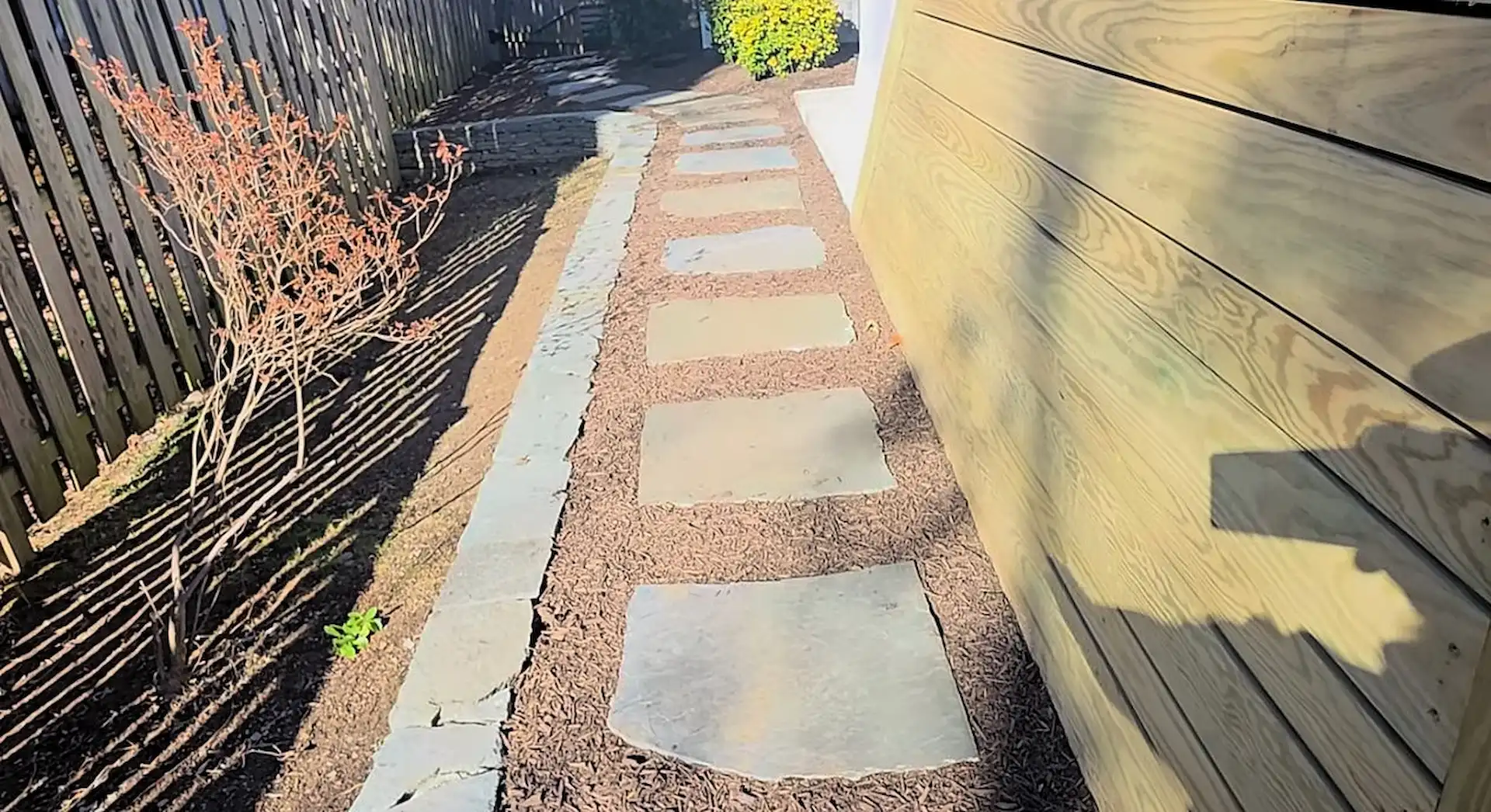
The Journey Through Your Garden
Not every path needs to be a formal masonry structure. For side yards, garden access, or connecting a patio to a fire pit, stepping stone pathways offer a softer, more organic look. We install natural flagstone stepping stones, stabilized pea gravel paths with steel edging, and rustic chip seal walkways that blend beautifully into your landscaping.
However, "organic" does not mean un-engineered. A beautiful garden pathway in the premium sectors of Vienna, McLean, or Fairfax Station must withstand the intense seasonal freeze-thaw cycles of Northern Virginia. Without proper subgrade preparation, heavy natural stone will sink, shift, and become a tripping hazard, while gravel paths will spread into your lawn and succumb to weed infestations. At Tuck GC, we bring structural masonry standards to organic pathway design, ensuring your landscape connections are beautiful, functional, and permanent.
1. The Diagnostic: Why Standard DIY Pathways Fail
The most common mistake homeowners and amateur landscapers make is treating a garden pathway as a surface-level project. They purchase beautiful, heavy natural stone or premium gravel and simply lay it over topsoil or a thin layer of sand. Within a single season, the pathway degrades.
Topsoil is highly compressible and biologically active. When exposed to rain and foot traffic, it turns to mud, acting as a lubricant that allows heavy stone to slip and sink. Furthermore, without a heavy-duty geotextile barrier, native weeds and root systems will immediately colonize the joints of stepping stones or erupt through gravel beds. Finally, without proper edge restraints, aggregate materials naturally migrate outward, blurring the lines of the pathway and making lawn maintenance a nightmare. A true garden pathway requires a fortified foundation hidden beneath the organic aesthetic.
2. The Tuck Standard Protocol: Pathway Engineering
To guarantee that your pathway remains level, stable, and weed-free for decades, Tuck GC utilizes a rigorous, multi-step sub-surface engineering process. This is how we build paths that last:
- Precision Excavation & Subgrade Compaction We do not lay stone on grass. We excavate the pathway footprint to a depth of 4 to 6 inches, removing all organic topsoil and root matter until we reach the stable subsoil layer. This trench is then mechanically compacted to create a hardened, load-bearing floor.
- Commercial-Grade Geotextile Membrane Application A high-tensile, non-woven geotextile fabric is laid across the compacted subgrade. This acts as an impermeable weed barrier and separates the native soil from our clean base aggregates, preventing the base from sinking into the mud during heavy rains.
- Angular Base Aggregate Installation We install a compacted layer of crushed angular aggregate (such as CR-6). Unlike smooth gravel, angular stones lock together under pressure, creating a highly stable, rigid foundation that actively resists freeze-thaw heaving while promoting vertical drainage.
- Edge Restraint & Setting Bed Depending on the path type, we install heavy-duty, low-profile edge restraints (flexible poly or steel) to permanently define the borders and prevent material migration. We then apply a fine setting bed of angular stone dust or coarse sand, screeded to a perfect level, allowing us to individually seat and level each piece of natural stone.
- Joint Stabilization & Finishing For stepping stone paths, the joints are filled with premium soil, mulch, or polymeric sand (depending on the desired aesthetic). For gravel paths, we apply a stabilizing binder or compact the surface to reduce aggregate displacement, leaving a pristine, walkable surface.
3. Material Science: The Tuck Pathway vs. Builder-Grade
| Specification | The Tuck Standard Pathway | Standard Landscaper / DIY |
|---|---|---|
| Foundation | 4-6 inches of compacted angular aggregate base over subsoil. | Laid directly on topsoil or 1 inch of loose play sand. |
| Weed Prevention | Commercial non-woven geotextile fabric spanning the entire trench. | Thin plastic landscape fabric (easily torn) or none at all. |
| Edge Integrity | Hidden steel or heavy-duty poly restraints staked deep into the base. | No edging; stones shift and gravel migrates into the lawn. |
| Stone Selection | High-density natural flagstone, bluestone, or premium stabilized aggregates. | Thin, low-grade slate that cracks under foot traffic. |
| Drainage Profile | Engineered to allow vertical water percolation into the sub-base. | Pools water on the surface, creating mud pits and slip hazards. |
4. The Northern VA Factor: Navigating Local Terrain
Designing pathways in our core operational zones—such as Fairfax County, Prince William County, Arlington, and Alexandria—requires specific knowledge of the localized geography and zoning laws. Northern Virginia is not a uniform landscape.
In expansion zones like Lake Ridge, Manassas, Gainesville, Haymarket, Woodbridge, and Bristow, we frequently encounter highly expansive marine clay subsoils. When saturated, this clay swells aggressively; when dry, it shrinks and cracks. If a pathway is not built with a deep, compacted aggregate base to act as a shock absorber, the clay will inevitably heave the stepping stones out of alignment during the winter. Our deep-trench excavation protocol neutralizes this threat entirely.
In premium, densely populated sectors like Vienna, Clifton, McLean, Fairfax Station, Great Falls, and Lorton, municipalities and Architectural Review Boards (ARBs) strictly monitor "impervious surface ratios"—the amount of hardscaping allowed on a property to control stormwater runoff. Formal concrete or mortared masonry paths count against this ratio. However, our natural stepping stone pathways set in soil, or our stabilized permeable gravel walkways, often classify as pervious surfaces. This allows homeowners to beautifully connect their outdoor living spaces, fire pits, and side yards without violating strict local environmental codes or triggering complex stormwater management permits.
5. Pathway Engineering FAQ
While no outdoor surface is 100% immune to airborne seeds, our dual-layered defense system makes weed growth incredibly difficult. We start with a commercial-grade geotextile fabric at the base of the trench to stop deep-rooted native weeds. Then, depending on the pathway style, we utilize compacted stone dust or advanced polymeric sand in the joints, which hardens and prevents surface seeds from taking root.
Not when engineered correctly. We do not use smooth, rounded "pea gravel" that rolls underfoot like marbles. We utilize angular aggregates that lock together when mechanically compacted. For high-traffic areas, we can also apply an invisible stabilizing binder that solidifies the gravel surface, making it firm enough to comfortably walk on in heels, roll a wheelbarrow over, or push a lawnmower across without displacing the stones.
Sloped areas require careful water management. Instead of a continuous flat path that acts as a water slide during heavy rains, we design stepped pathways. We integrate natural stone risers or rustic timber retainers to create flat, level landing pads for the stepping stones or gravel, naturally slowing down water runoff and preventing base erosion.
6. Secure Your Property's Navigation
A well-designed garden pathway is more than just a walkway; it is the connective tissue of your landscape. Whether you are navigating the heavy clay soils of Burke and Springfield, or managing the intricate landscaping rules of Great Falls and Arlington, Tuck GC builds organic hardscapes that endure. Stop dealing with muddy shoes, sinking stones, and migrating gravel. Invest in a pathway engineered for permanence.