

The Handshake of Your Home: Utility Meets Curb Appeal
Your driveway entrance sets the tone for your entire property. In Fairfax County, however, many homeowners face a daily struggle: narrow, builder-grade aprons that feel cramped and uninviting. Whether you are shuffling cars to make room for teenage drivers, tired of parking on the grass, or simply want to create a Grand Estate Entrance, the apron is the key to unlocking your property's potential.
At Tuck GC, we bridge the gap between functionality and luxury. We specialize in maximizing your legal frontage to create double-wide concrete aprons that solve your parking headaches while boosting your home's value. We don't just pour concrete; we engineer the correct slope for drainage and guide you through the VDOT requirements to expand your entrance legally.
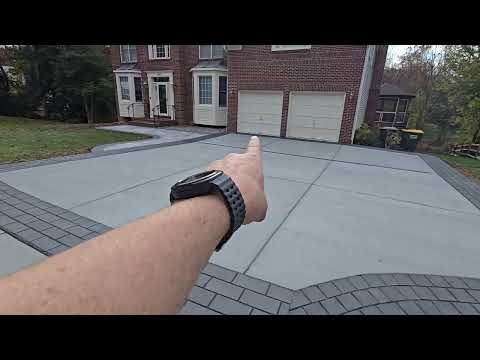
Stop the "Fairfax Car Shuffle" (Solving the Parking Crisis)
Is your family juggling cars every morning because of a narrow driveway? Many neighborhoods in Annandale, Burke, and Springfield were built in the 1970s and 80s with restrictive 10-foot aprons. These "single-file" designs simply cannot handle the modern family dynamic of multiple vehicles, SUVs, and teenage drivers.
The Solution: Strategic Widening and Extra Parking. We help you reclaim your front yard for practical use. By identifying the location of your water meter, gas lines, and VDOT right-of-way, we can often widen your apron by 4 to 8 feet. This simple expansion transforms a frustrating bottleneck into a smooth, two-car entry, allowing you to park side-by-side without driving over your lawn edges.
Our Widening & Conversion Solutions
- Maximum Legal Width: We calculate the maximum apron width allowed by your property's frontage and pipe sizing, often increasing usable space by 50% or more.
- Curb Cuts & Reshaping: We use industrial concrete saws to professionally cut and reshape the existing curb. This creates a seamless, expanded entrance and eliminates the "bump" at the street, preventing bottoming out.
- Asphalt to Concrete Conversion: We permanently remove crumbling asphalt skirts and replace them with 4,000 PSI VDOT-approved concrete. Concrete offers superior durability, better visibility at night, and a cleaner aesthetic that defines the property line.
- Estate Entrances (CG-9D): For larger properties in McLean and Great Falls, we install the VDOT "Large Radius" detail, allowing for smooth, sweeping turns into your property.
Curb Cuts & Extra Parking: The Engineering Details
Adding extra parking places isn't just about pouring more pavement; it's about water management and structural integrity. When we expand a driveway to accommodate an extra vehicle, RV, or boat, we have to modify the VDOT Curb and Gutter system.
The Saw-Cut Advantage: Many contractors try to break the curb with a sledgehammer or jackhammer, leaving jagged, ugly edges. Tuck GC utilizes precision diamond-blade saw cutting. This ensures a razor-sharp transition between the old curb and the new expansion. We then dowel into the existing curb with steel rebar to "pin" the new concrete to the old, preventing separation over time.
Asphalt to Concrete Conversion: The ROI Calculation
Why are so many Fairfax County homeowners ripping out asphalt aprons and replacing them with concrete? It comes down to the Lifecycle Cost. Asphalt is a flexible pavement; it relies on oil binders that dry out under the Virginia sun. At the "apron point" (where the driveway meets the street), asphalt is subjected to the heaviest turning loads and plow strikes.
The Failure Point: Asphalt aprons typically crumble at the edges within 5-7 years, creating "alligator cracking" that allows water to seep into the subbase. Once the subbase softens, the apron sinks.
The Concrete Solution: A VDOT-Spec Concrete Apron is a rigid pavement. It bridges over soft spots in the subgrade. By converting your asphalt apron to concrete, you are installing a 30-year solution. We use Class A3 Concrete (4,000 PSI) with air-entrainment chemicals that resist freeze-thaw cycles, ensuring your investment looks pristine for decades.
The "Grading Secret": Why Apron First?
Fairfax County is notorious for difficult topography. VDOT infrastructure—including sidewalks, curb and gutter systems, and utility strips—often sits higher than ideal for modern driveway installations. This creates a critical decision point for homeowners: Do you pave the driveway first, or the apron first?
The Ramp Effect: In the video below, you will see a project where another contractor installed a paver driveway before addressing the apron. Because the driveway height was locked in, we could not lower the apron to fix the steep grade coming off the street. If we had managed the entire excavation, we could have lowered the entire system by 4-5 inches, eliminating the "hump" that causes cars to bottom out.
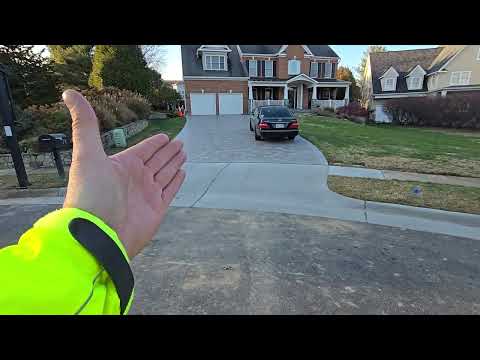
The Tuck Strategy: Economy of Scale
Doing both the apron and driveway at the same time isn't just about aesthetics; it's about engineering control. By excavating the apron and driveway simultaneously, we gain control over the entire slope. This allows us to smooth out transitions, eliminate scraping, and ensure water flows away from your garage. Plus, it opens up tight spaces for our equipment, reducing manual labor costs and saving you money.
Navigating the VDOT LUP-A Permit Process
Getting a driveway permit in Fairfax County requires strict adherence to the LUP-A (Land Use Permit) guidelines. VDOT regulations state that the property owner must be the applicant, as the permit is tied to your deed and property lines. However, the technical requirements—detailed site drawings, bond calculations, and traffic control plans—can be overwhelming for a homeowner.
We act as your Authorized Agent. Tuck GC handles the entire "heavy lifting" phase of the permit. We produce the engineering drawings, calculate the required surety bond, and prepare the entire packet for your signature. We then interface directly with the VDOT Northern Virginia District Office on Prime Court to submit the paperwork and schedule inspections. We know exactly what the inspectors are looking for—from the depth of the aggregate base to the specific expansion joint placement—ensuring your project passes inspection the first time.
Fairfax County LUP-A Technical Requirements
When working within the VDOT Right-of-Way in Fairfax County, strict adherence to engineering standards is non-negotiable. We ensure every project meets the following criteria:
| Specification | VDOT / Fairfax County Standard |
|---|---|
| Concrete Strength | Min. 3,500 PSI (Tuck GC uses 4,000 PSI Class A3) |
| Base Material | 6-8 inches of Compacted 21A Stone Aggregate |
| Utility Separation | Min. 3 Feet clearance from Hydrants & Utility Poles |
| Entrance Grade | Must not direct water onto the public roadway |
| Pipe Sizing | 15" Minimum RCP or CMP (if culvert is required) |