
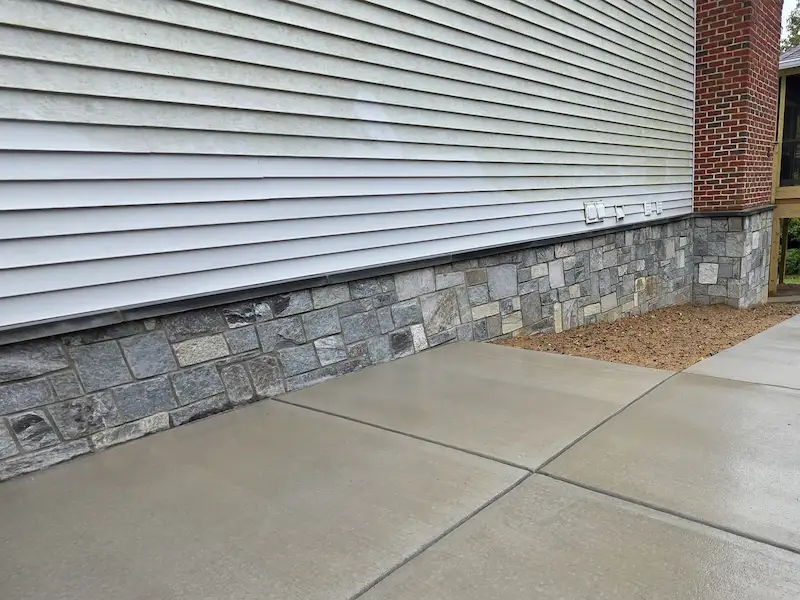
Hide the Gray Concrete
Take a walk around the perimeter of your home. The transition point between your beautiful siding or brick and the dirt below is often an ugly band of exposed, unfinished concrete or cinder block. This is your foundation wall. Over time, it becomes stained with mud, cracked from frost, or covered in peeling, flaking exterior paint. At Tuck GC, we eliminate this eyesore permanently.
By applying a layer of natural stone veneer (known as a "skirt" or "water table") directly over the exposed foundation, we visually anchor the house to the ground. In premium neighborhoods across McLean, Vienna, and Arlington, a continuous stone foundation is the hallmark of custom, high-end architecture. For homes with existing block foundations experiencing severe surface degradation, we also specialize in structural cement "parging" to restore a clean, smooth, highly protective finish to the base of your home.
1. The Diagnostic: Why Foundation Paint Fails
The most common—and worst—solution homeowners attempt is painting their exposed concrete foundation. Concrete is porous. It acts like a hard sponge, constantly absorbing ground moisture from the soil and wicking it upward. When you apply exterior paint over concrete, you trap that moisture. As the water attempts to evaporate out of the concrete, it pushes against the paint from the inside out, causing the paint to blister, bubble, and peel off in large flakes. Once a foundation is painted, it traps you in a miserable cycle of scraping and repainting every two to three years.
In older homes in Alexandria and Falls Church built with cinder block foundations, this moisture issue causes "spalling." The face of the cinder block literally begins to disintegrate and crumble away during freezing winter cycles. To stop this degradation, the concrete must be protected with a breathable masonry application—either a thick parge coat or a mortared stone veneer—that allows the wall to release moisture without destroying the surface finish.
2. The Tuck Standard Protocol: Veneer & Parging
Fixing a foundation wall requires working at the dirt line, meaning waterproofing and moisture management are absolutely critical. Here is how we execute the restoration:
- Surface Remediation & Paint Removal We cannot apply new mortar over failing paint. We use industrial grinders and specialized masonry stripping tools to remove existing paint, loose concrete, and dirt from the foundation wall. We take the surface down to the raw, structural concrete or block to ensure maximum adhesion.
- The Weep Screed Integration This is the step amateur masons skip. Before applying any stone, we install a galvanized metal "weep screed" exactly at the transition point where the wood framing of your house meets the concrete foundation. This engineered flashing creates a dedicated channel for any moisture trapped behind your siding to safely exit the wall, preventing the new stone veneer from trapping water against your sill plate.
- Metal Lath & The Scratch Coat To guarantee the heavy stone or parging cement does not separate from the foundation wall over time, we mechanically anchor a galvanized diamond-mesh lath directly into the concrete. We then apply a dense Type-S mortar scratch coat, embedding the mesh completely within the cement.
- Application: Natural Stone Skirting For maximum curb appeal, we hand-lay natural thin stone veneer (or premium manufactured stone) into the wet scratch coat. We fit the stones tightly together, extending the masonry from the dirt line up to the base of your siding, completely masking the original concrete. We top the stone skirt with a sloped masonry sill to shed water perfectly.
- Application: Structural Parging If you prefer a clean, minimalist look (highly popular in Mid-Century modern homes in Springfield and Burke), we skip the stone and apply a "parge coat." This involves troweling a thick, specialized blend of Portland cement and masonry sand over the lath. We float the finish perfectly smooth, resulting in a pristine, structural concrete surface that seals the old, crumbling blocks permanently.
3. Material Science: Finishing the Foundation
| Finish Type | Aesthetic Profile | Moisture Breathability | Ideal Application |
|---|---|---|---|
| Natural Stone Veneer | Heavy, luxurious, matches patios/chimneys. | Excellent. Mortar joints allow vapor transmission. | Custom homes, estate properties, high-visibility elevations. |
| Structural Cement Parging | Smooth, uniform, clean utilitarian concrete. | Excellent. Protects old blocks while breathing. | Older cinder block homes, side/rear elevations, modern designs. |
| Elastomeric Paint | Flat color, shows all imperfections. | Poor. Traps hydrostatic pressure causing peeling. | Temporary DIY fix. Not recommended by Tuck GC. |
4. The Northern VA Factor: Tying the Hardscape Together
When homeowners in Great Falls or Clifton invest heavily in a new flagstone patio or composite deck, the glaring gray concrete of the exposed foundation becomes painfully obvious. At Tuck GC, we view the foundation veneer as the critical "tie-in" point. We frequently wrap the foundation of the house using the exact same stone profile we used to build the retaining walls or the outdoor fireplace. This creates a cohesive, master-planned architectural flow where the house and the hardscape appear to be built from the same continuous quarry.
In higher-density areas like Lorton, Woodbridge, and Manassas, where lots are frequently graded on severe slopes (resulting in massive, 10-foot tall exposed foundation walls on the rear of the house), a stone veneer application breaks up the imposing "concrete bunker" look. It softens the elevation and drastically improves the resale value and exterior aesthetic of walk-out basements.
5. Foundation Veneer FAQ
No. Parging and stone veneer are above-grade exterior finishes. They protect the face of the block from weather and spalling, but they will not stop subterranean groundwater from penetrating your basement. True waterproofing requires excavating the foundation below the dirt line and applying specialized rubberized membranes and french drains.
Yes. If your home has an existing brick water table on the front, but exposed concrete on the sides and rear (a common cost-saving tactic used by tract builders), we can source thin-brick veneer that matches your original brick and mortar color, extending the premium look entirely around the house.
We typically excavate a shallow trench and run the stone veneer or parge coat 4 to 6 inches below the final grade of your soil or mulch. This ensures that even if the mulch washes away or the dirt settles slightly over time, you will never see a gap of exposed concrete at the bottom of the wall.
6. Ground Your Architecture
Stop battling peeling paint and crumbling cinder blocks. From executing flawless, smooth parging restorations on historic Alexandria townhomes to wrapping massive, multi-level foundations in fieldstone across Fairfax County, Tuck GC delivers permanent masonry solutions. Protect the base of your home and command absolute curb appeal.