
Diagnosing Hardscape Failure in Virginia
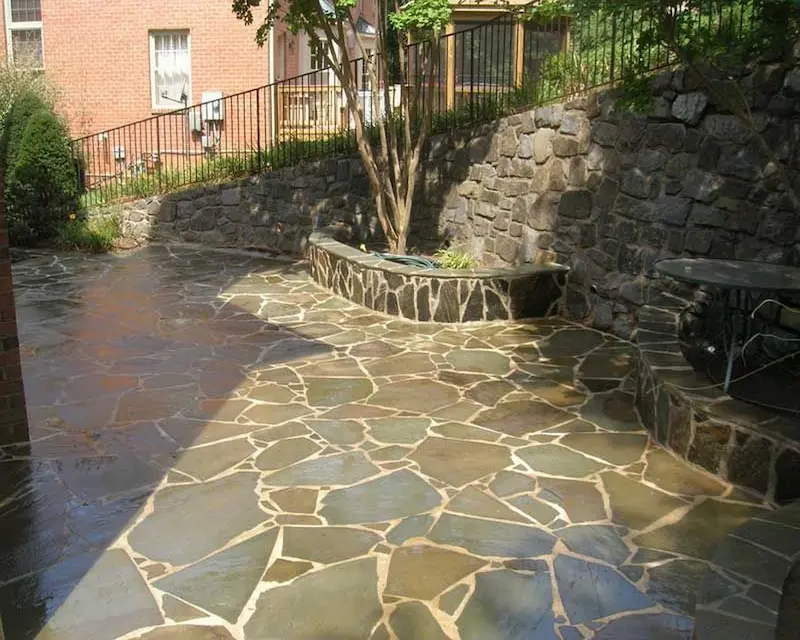
When people say "stone patio," they usually mean Pennsylvania Variegated Flagstone. Its beautiful mix of blues, greens, tans, and rust colors perfectly complements Northern Virginia homes. We specialize in Wet-Set Masonry, installing the stone on a reinforced concrete slab with mortar joints for a permanent, weed-free surface that never shifts.
Unfortunately, the vast majority of hardscape contractors in the market do not practice masonry; they practice landscaping. They offer "dry-laid" flagstone patios, resting the heavy stones on a loose bed of stone dust or sand. While this allows them to undercut pricing and complete the job rapidly, it is fundamentally an engineering compromise. In the Mid-Atlantic climate, a sand base is a guarantee of future failure.
Surface water inevitably infiltrates the unsealed, sand-filled joints of a dry-laid system. This saturates the base layer. When temperatures plummet, this trapped water freezes and expands, causing hydrostatic pressure and "frost heave." By spring, the stones have shifted, sunk, or lifted, creating severe tripping hazards and allowing aggressive weed root systems to take hold. We completely reject this methodology. We do not build temporary surfaces. We engineer permanent, structural masonry systems.
The Tuck Standard Protocol: Wet-Set Engineering
A true flagstone patio is not landscaping; it is a structural concrete pour finished with a natural stone veneer. By anchoring the Pennsylvania Variegated thermal flagstone to a monolithic reinforced slab, we eliminate the variable of soil movement. This is our non-negotiable 5-step installation process:
- Structural Excavation & Subgrade Preparation We excavate the footprint entirely past organic topsoil down to stable, load-bearing subgrade—typically 8 to 12 inches depending on existing site conditions. We verify the soil integrity before proceeding, mitigating any soft spots.
- Aggregate Base Matrix We install and mechanically compact a dense-graded aggregate base. This layer acts as a capillary break to prevent groundwater from wicking upward, ensuring a stable platform for the structural foundation.
- Reinforced Concrete Foundation (4,000 PSI) This is where cheap contractors cut corners. We pour a minimum 4-inch structural concrete slab, heavily reinforced with steel rebar or welded wire mesh. This creates a rigid, monolithic foundation that bridges unstable soil and completely nullifies frost heave.
- Thermal Setting & Adhesion Using high-strength Type S masonry mortar, we "wet-set" premium 1.5-inch thick thermal-cut Pennsylvania Variegated Flagstone directly onto the cured concrete slab. Every single stone is fully buttered and chemically bonded to the foundation, ensuring zero hollow spots or potential for shifting.
- Precision Joint Pointing & Pitching The final step is pointing the joints with weather-resistant mortar. We tool the joints to shed water effectively. The entire system is engineered with a strict ¼-inch per foot slope to guarantee positive drainage away from your home's foundation, completely preventing standing water.
Structural Comparison: Wet-Set vs. Dry-Laid
Understanding the difference in structural integrity is crucial before investing in your outdoor living space. Here is the technical breakdown of why our wet-set process is the only permanent solution.
| Engineering Metric | Tuck Wet-Set Masonry (The Standard) | Builder-Grade Dry-Laid (The Competitor) |
|---|---|---|
| Foundation Base | 4-inch steel-reinforced concrete slab (4,000 PSI). | Loose compacted sand, stone dust, or gravel. |
| Stone Movement | Zero. Chemically bonded to concrete foundation. | High. Stones will independently sink and heave over time. |
| Weed & Pest Resistance | 100% impenetrable. Solid mortar joints block organic growth. | Low. Ants excavate sand; weeds inevitably root in joints. |
| Water Management | Engineered monolithic slope safely channels water away. | Water permeates the joints, pooling under stones and eroding the base. |
| Lifecycle Expectancy | Multi-generational. A permanent addition to the home's structure. | 3 to 5 years before significant resetting and maintenance is required. |
The Northern Virginia Factor: Soil & Zoning Mechanics
Hardscaping in Northern Virginia requires specialized localized knowledge. The underlying geology of the region is notorious for highly plastic marine clays—specifically prevalent in areas like Fairfax Station, Clifton, McLean, and Lorton. This clay absorbs water rapidly, expanding forcefully during the wet spring, and shrinking dramatically during the dry summer. This extreme subterranean movement will quickly devour a standard dry-laid gravel base. Our reinforced concrete foundation bridges this unstable clay, acting as a rigid raft that floats uniformly above the shrink-swell soil dynamics.
Furthermore, jurisdictions like Arlington County, the City of Alexandria, and the City of Falls Church have rigorous zoning ordinances regarding lot coverage and impermeable surface ratios. Expanding a patio often requires detailed plat calculations, engineered drainage solutions, and strict permitting. In higher elevation zones like Great Falls, Oakton, and Vienna, managing hillside topography often dictates integrating structural retaining walls into the patio sub-system. We navigate these complex local codes and geotechnical challenges daily, ensuring total municipal compliance before a single shovel hits the earth.
Technical Diagnostics & FAQ
Stop Settling for Temporary Hardscapes.
Don't pay masonry prices for a landscaping execution. If your current patio is shifting, sinking, or growing weeds, the base has failed. We engineer patios that outlast the homes they are built behind.
SCHEDULE A STRUCTURAL EVALUATION