
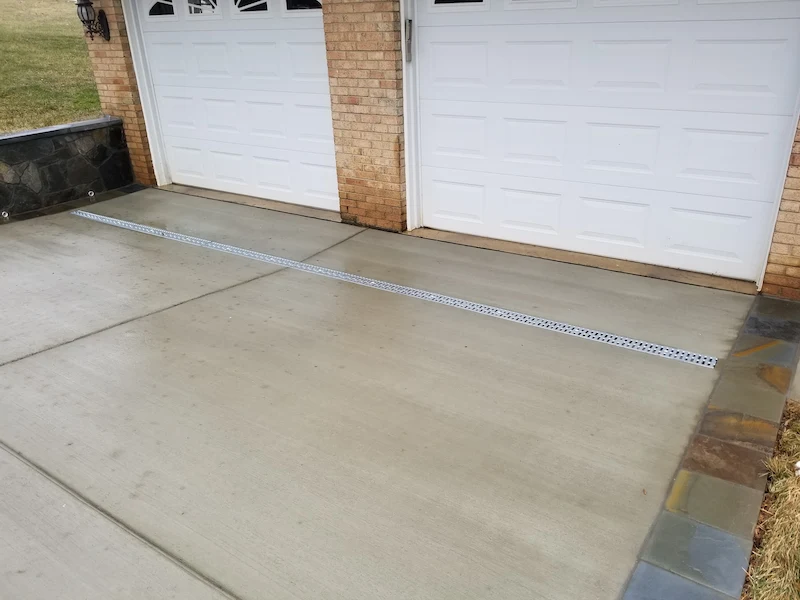
The Diagnosis: The "Negative Slope" Nightmare
If your driveway slopes downward toward your garage, you are living with a constant risk. During the intense summer downpours common in Northern Virginia, your driveway acts like a funnel, directing thousands of gallons of water straight at your garage door.
A rubber seal on the bottom of your garage door cannot stop this hydrostatic pressure. The water forces its way in, ruining drywall, soaking storage boxes, and creating mold. The only engineering solution is a Linear Channel Drain (Trench Drain) installed across the entire width of the apron to intercept the water before it strikes the foundation.
The Installation Protocol: Why Ours Don't Crack
Most channel drain failures occur because "handyman" installers lay the plastic channel directly on the dirt. When a 5,000 lb SUV drives over it, the plastic crushes. Tuck GC installs commercial-grade systems using a structural concrete footer:
- 1. Concrete Saw Cutting We cleanly saw-cut a 12-18 inch trench across your driveway. We remove the asphalt or concrete and excavate the soil to a depth that allows for a structural footer.
- 2. The Structural Concrete Footer We pour a wet concrete bed (footer) at the bottom of the trench. We set the channel drain into this wet concrete. This ensures the drain is supported by stone and cement, not dirt. It essentially becomes part of the slab.
- 3. ACO Commercial Channels We do not use the black plastic kits from Home Depot. We install ACO Polymer Concrete or High-Density Fiber reinforced channels. These are commercial-grade units designed for airports and loading docks. They are thermally stable and virtually indestructible.
- 4. Concrete Encasement (The Haunch) We pour concrete around the sides of the drain (the haunch) to lock it in place laterally. This prevents the drain from shifting or popping up when vehicles brake or turn on top of it.
- 5. Discharge Piping The drain is useless if the water has nowhere to go. We trench a 4-inch PVC discharge line (SDR-35) to carry the captured water away from the house to a daylight exit or a French Drain dry well system.
Material Science: Professional Grade vs. Big Box Store
Why Tuck GC refuses to install hardware store plastic drains.
| Feature | Home Depot Plastic (NDS) | Tuck / ACO Commercial |
|---|---|---|
| Material | Thin HDPE Plastic | Polymer Concrete / Fiber Reinforced |
| Load Class | Class A (Pedestrians) | Class B/C (Cars & Light Trucks) |
| Installation | Laid on dirt/sand | Set in Concrete Footer |
| Grate Locking | Snap-in (Pops out easily) | Bolted Steel Locking System |
| Lifespan | 3-5 Years (Cracks/Warps) | Lifetime Structural Integrity |
The Northern Virginia Factor: "Micro-Burst" Storms
The Volume Problem: Fairfax and Prince William counties are prone to summer "Micro-Bursts"—intense storms dropping 2-3 inches of rain in an hour. Standard 2-inch or 3-inch drains cannot evacuate water fast enough, leading to "over-topping" (water rushing over the grate).
The Capacity Solution: We typically install 4-inch or 5-inch wide channels with high-flow galvanized or cast iron grates. We calculate the square footage of your driveway to ensure the pipe discharge capacity exceeds the volume of water generated during a 100-year storm event.
Frequently Asked Questions
Stop the Flood Before It Starts
A wet garage leads to mold, rusted tools, and structural damage. Install a commercial-grade hydraulic defense system that solves the problem permanently. Do it right, do it once.
Request a Drainage Evaluation