
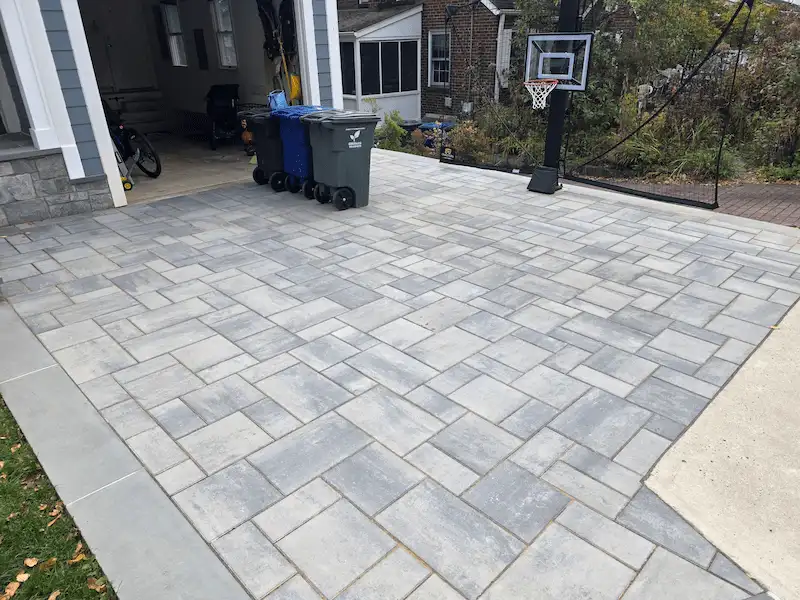
Solving the "Lot Coverage" Crisis
In Northern Virginia's most desirable neighborhoods—Arlington, Vienna, and McLean—zoning laws have changed. Homeowners are strictly limited on how much "impervious surface" (concrete, asphalt, roof) they can have on their lot.
If you want to expand your driveway, build a pool, or add a patio, the county may say "No" because of runoff. The solution is Permeable Interlocking Concrete Pavers (PICP). Unlike standard driveways that shed water into the street, a Tuck GC Permeable Driveway acts as a giant stormwater management facility hidden beneath beautiful stone.
⚠️ Zoning Warning: Arlington & Vienna
Arlington County and the Town of Vienna enforce strict lot coverage limits (often 25-30%). Installing a standard driveway without a permit can result in code enforcement fines and forced demolition. A certified Permeable Pavement system is often the only legal way to expand your parking footprint.
Not Just "Pavers on Gravel"
A permeable driveway is a civil engineering project. It costs significantly more than a standard driveway because it requires massive excavation and specific geology to function as a reservoir.
The Tuck GC Engineering Standard
We adhere to the ICPI / CMHA specifications. A true permeable system requires three distinct layers of clean, washed aggregate.
-
LAYER 1
Top Surface80mm Permeable Pavers
We use heavy-duty vehicular pavers (Techo-Bloc Hydra or Belgard Aqualine) with widened joints. These joints are filled with ASTM No. 8 or No. 9 Stone Chips—never sand—to allow water to pass through instantly. -
LAYER 2
2" DepthBedding Layer (ASTM No. 57)
A smooth layer of crushed stone that locks the pavers in place while allowing rapid vertical drainage. -
LAYER 3
12" - 36"+The "Reservoir" (ASTM No. 2 Stone)
This is the critical difference. We install massive 2-3 inch rocks (railroad ballast style) compacted to create a structural bridge. The void space between these rocks holds hundreds of gallons of rainwater, allowing it to slowly soak into the ground rather than flooding your neighbor's yard. -
LAYER 4
SubgradeNon-Woven Geotextile Fabric
A specialized filter fabric separates the stone from the clay soil, preventing the reservoir from clogging over time.
The "Perc Test" Variable
Why does the price vary? It comes down to the Perc Test (Percolation). Before we give a final engineering price, we dig a test pit to measure how fast your soil absorbs water (The Infiltration Rate).
- Good Soil (Sandy/Loam): We may only need 12-18 inches of base rock.
- Bad Soil (Heavy Marine Clay): If the water sits, we must dig deeper—sometimes up to 2-3 feet (24-36 inches)—to create a large enough holding tank for the water.
Note: In extreme failure cases (where water won't drain at all), we must engineer an overflow pipe connected to the municipal storm sewer or a dedicated pop-up emitter.
Inspection & Permitting
This is not a "weekend warrior" project. Installing a permeable driveway in Arlington or Fairfax triggers a rigorous inspection process.
1. Engineering Plans
We submit detailed CAD drawings showing slope, stone depths, and gallon retention capacity to the Zoning department.
2. Mid-Point Inspection
The county engineer must physically inspect the open pit to verify we used the correct clean stone (washed aggregate) and Geotextile fabric before we lay a single paver.
Maintenance: The "Vacuum" Myth
Many homeowners worry about maintenance. The reality is simple: Keep the joints clean.
Can I power wash it?
No. High-pressure washing can blast the stones out of the joints. We recommend using a leaf blower regularly to keep organic debris (leaves/mulch) off the surface.
What if it clogs?
Every 3-5 years, the joints may need "regenerative maintenance." We use a specialized vacuum system to suck out the top 1 inch of sediment and replace it with fresh, clean #8 stone chips. This restores the flow rate to 100%.
Ready to Expand Your Driveway Legal?
Don't risk a stop-work order. Hire the team that understands the Civil Engineering behind the stone.
Request Site Engineering Consult