
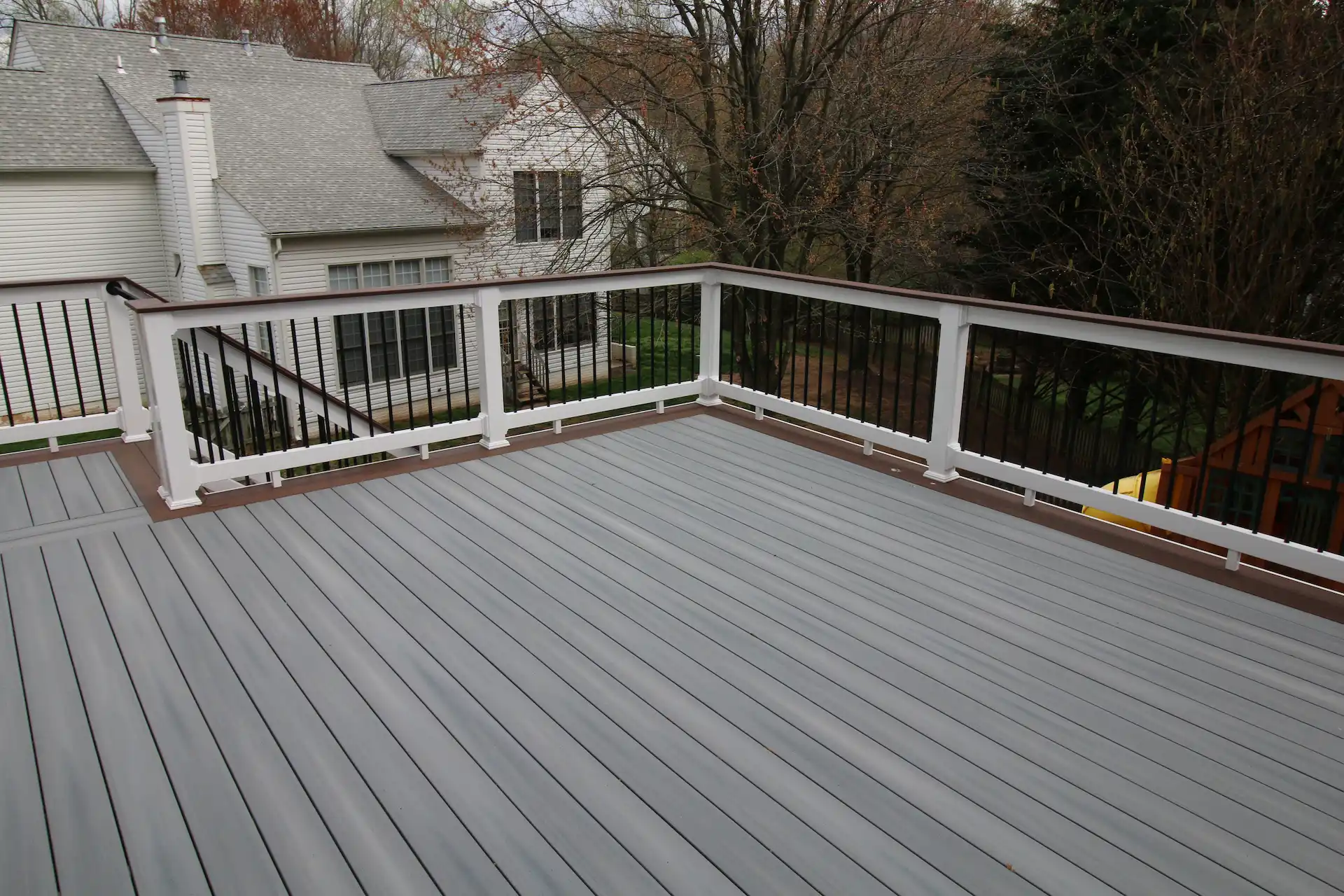
Never Sand or Stain Again
Traditional pressure-treated lumber warps, cracks, and gives you splinters within a few years. It demands a grueling cycle of power washing, sanding, and re-staining every season just to survive the harsh Mid-Atlantic climate. Premium composite decking, such as Trex and TimberTech, completely eliminates this maintenance burden. It utilizes a high-performance polymer shell wrapped around a dense, recycled core that aggressively resists fading, rot, mold, and termites for 25 to 50 years.
For homeowners in Fairfax County, Prince William County, Arlington, and Alexandria, the investment in advanced polymer capping translates directly to peace of mind and significantly enhanced property value. We have seen traditional pine decks in wooded areas like Burke and Clifton degrade to the point of structural failure in less than a decade. The sheer volume of ambient moisture combined with brutal summer UV rays creates a hostile environment for organic wood. By eliminating the organic material from the surface, we stop the decay cycle permanently.
However, installing composite decking requires a level of carpentry precision that far exceeds traditional wood decking. Because composite boards expand and contract differently than wood, and because they are heavier and more flexible, the underlying framing must be engineered to much stricter tolerances. At Tuck GC, we are certified installers who fuse the advanced material science of composite decking with structural framing protocols to build decks that are perfectly flat, flawlessly finished, and completely maintenance-free. Our crews do not just lay boards; we execute heavy civil engineering principles on a residential scale. From evaluating the subgrade bearing capacity for your footings to calculating the exact shear load on your ledger board connection, every element of our build protocol is designed to outlast the warranty of the boards themselves. We are building generational structures.
1. The Diagnostic: Why Standard Decks Fail with Composite
A common and costly mistake homeowners make is hiring a standard framing crew to install premium composite materials on top of a standard pressure-treated wood frame. Traditional wood frames are often built with joists spaced 16 to even 24 inches on center. If you lay composite decking over this wide span, the boards will sag in the heat of the summer, creating a "wavy" deck surface that holds water and looks terrible.
Furthermore, amateur builders often face-screw composite boards just like they would cheap lumber. This immediately compromises the waterproof polymer shell, creating hundreds of entry points for moisture and voiding the manufacturer's warranty. The exposed screw heads will also "mushroom," pushing the plastic upward to create sharp hazards. A true composite deck must be built with a fortified sub-structure, specialized hidden fasteners, and fully wrapped exterior elements to achieve total maintenance freedom.
Beyond the surface aesthetics, the most catastrophic point of failure in Northern Virginia deck construction is the ledger board attachment. Fast-paced builder-grade crews frequently fail to install proper zinc-coated or stainless-steel lateral tension hardware, relying instead on standard lag bolts that corrode rapidly when exposed to the copper azole preservatives used in modern treated lumber. When moisture infiltrates behind an improperly flashed ledger board in areas like Manassas, Woodbridge, or Lorton, it rots the home's rim joist. Our diagnostic process identifies and eliminates these invisible structural threats before a single piece of composite is ever laid.
2. The Tuck Standard Protocol: Composite Engineering
We approach deck building not just as carpenters, but as structural engineers. Our composite installations are designed to maximize the lifespan of the premium decking materials. Here is our exact protocol:
- Fortified Sub-Structure & Joist Spacing To prevent composite board deflection (sagging), we over-engineer the sub-structure. We build our floor joists strictly at 12-inches on center (rather than the industry standard 16-inch). This creates a rock-solid, deflection-free floor system that provides a perfectly flat plane for the decking. Additionally, we excavate and pour heavy-duty concrete footings deep below the Northern Virginia frost line (minimum 24 to 30 inches), often upgrading to flared bell footings or helical piers to prevent winter heave in unstable soils.
- Hidden Fastener Integration We never face-screw the main decking boards. We utilize proprietary, color-matched hidden fastener clips that slot into the grooved edges of the Trex or TimberTech boards. This creates a flawless, screw-free walking surface while allowing the boards to naturally expand and contract along the joists without warping or buckling. We also apply a specialized butyl rubber joist tape to the top of every pressure-treated joist before laying the deck. This self-sealing barrier prevents water from resting on the wood structure, stopping joist rot and easily doubling the lifespan of the frame beneath your composite surface.
- Total PVC Framing & Post Wrapping A "maintenance-free" deck is a lie if the wooden support posts and perimeter rim joists are left exposed to the elements. We wrap all visible pressure-treated framing—including support columns, beams, and fascia boards—in premium, brilliant white cellular PVC trim (like AZEK). This means you never have to paint, stain, or replace rotting structural posts. Every seam is perfectly mitered and chemically bonded using specialized PVC adhesives, ensuring that moisture can never penetrate the structural core, resulting in a crisp, architectural aesthetic that rivals interior millwork.
- Architectural Aluminum Railing Systems We replace bulky, splintering wooden railings with sleek, powder-coated aluminum railing systems. These railings provide immense structural safety while offering a slim profile that preserves your view of the backyard. They will never rust, rot, or require painting. We secure these high-tensile metal systems using ultra-heavy-duty structural post blocks hidden beneath the decking, ensuring zero wobble and compliance with the strictest commercial-grade load bearing codes.
- Low-Voltage LED Lighting Integration We embed low-voltage LED lighting directly into the deck design. We install flush-mount riser lights on the stairs for safety and under-rail post cap lights to create a warm, ambient glow across the deck surface, extending your entertaining hours deep into the night without harsh floodlights. All wiring is safely concealed within the PVC wrapping and routed to a smart transformer, allowing you to control the exact ambiance of your outdoor living space directly from your smartphone.
3. Material Science: The Tuck Composite Deck vs. Builder-Grade Wood
| Specification | The Tuck Composite System | Standard Pressure-Treated Wood |
|---|---|---|
| Decking Surface | Capped composite (Trex/TimberTech); fade & stain resistant. | Pine; cracks, splinters, and requires bi-annual staining. |
| Joist Spacing | 12-inches on center for zero deflection. | 16 to 24-inches on center; leads to wavy, bouncy floors. |
| Fastening Method | Concealed hidden clips; screw-free walking surface. | Face-screwed or nailed; screws pop up causing trip hazards. |
| Structural Wrapping | 100% cellular PVC fascia and post wrapping (no painting). | Exposed lumber that rots and requires constant painting. |
| Railing Systems | Powder-coated architectural aluminum. | Chunky wood balusters that warp and block the view. |
The data speaks for itself. While a pressure-treated pine deck may present a lower initial upfront cost, the true cost of ownership is staggering. When you calculate the mandatory bi-annual labor and materials required for power washing, scraping, applying chemical strippers, and high-end exterior staining, a standard wood deck becomes a massive financial and temporal liability. Our highly engineered composite systems are an asset—a one-time capital improvement that delivers uninterrupted luxury and massive ROI when it is time to sell your property.
4. The Northern VA Factor: HOA Approvals and Climate Resilience
Building a deck in Northern Virginia requires navigating strict local building codes and demanding Homeowner Associations. In premium communities like Fairfax Station, Great Falls, Vienna, and Clifton, ARBs (Architectural Review Boards) frequently reject standard pressure-treated wood decks for new construction or replacements. They require high-end materials that maintain their aesthetic value without degrading. Our combination of premium composite decking, PVC-wrapped columns, and architectural aluminum railings guarantees swift HOA approval by exceeding their aesthetic and structural requirements. We provide the necessary 3D architectural renderings, lot surveys, and material cut-sheets required to get your project green-lit rapidly. We understand the bureaucratic language these boards speak, and our technical documentation leaves no room for rejection.
Furthermore, the localized climate across Prince William and Fairfax counties—characterized by brutal summer humidity and freezing winter ice—destroys organic wood. In expansion zones like Haymarket, Gainesville, Bristow, and Lake Ridge, where many homes back up to heavy tree lines or retention ponds, the ambient moisture levels accelerate wood rot and mold growth on traditional decks. The impermeable polymer shell of our capped composite decking acts as an armor against this humidity, refusing to absorb water and easily washing clean with a garden hose. Moving eastward toward the high-density sectors of Arlington, Alexandria, and McLean, our teams expertly navigate tight-access lots, restrictive set-back lines, and aggressive impervious surface regulations. Whether we are dealing with marine clay subsoils in Springfield or mitigating sheer loads on a steep-grade drop-off in Occoquan, our structural engineering adaptations are geo-locked to the exact environmental hazards of your specific zip code.
5. Composite Decking FAQ
Early generations of composite decking did trap significant heat. However, modern premium composites feature advanced, heat-mitigating core technology and lighter color profiles that reflect UV rays. While any surface sitting in direct Virginia sunlight will get warm, our top-tier lines remain comfortable underfoot and will not burn like old solid plastics.
We call this a "deck resurfacing," and yes, it is possible—but only if the underlying structure is flawless. We must perform a rigorous structural inspection of your existing footers, posts, and joists. If the pressure-treated frame is sound and meets modern load-bearing codes, we can add joist tape to protect the wood, adjust the joist spacing to 12-inches on center, and install the new composite surface.
Yes. In Fairfax, Prince William, Arlington, and Alexandria, any deck attached to a house or standing more than 16.5 inches off the ground strictly requires a building permit, detailed architectural plans, and county inspections for footings and framing. Tuck GC handles the entire permitting process in-house, ensuring your deck is 100% legal and code-compliant.
We utilize advanced ledger board protocols. Instead of relying solely on standard lag bolts, we install engineered tension ties and structural timber screws that lock the deck’s framework directly into the interior floor joists of your home. We also apply multiple layers of specialized metallic flashing and self-adhering polymer membranes behind the ledger to ensure zero water penetration into your home's envelope, completely neutralizing the risk of hidden rot.
6. Secure Your Maintenance-Free Weekend
Your weekend should be spent enjoying your outdoor living space, not power washing and staining it. From designing custom, multi-tiered platforms in McLean to executing rapid, HOA-approved resurfacings in Woodbridge, Tuck GC delivers the pinnacle of composite deck engineering. Reclaim your time and invest in a structure built to outlast your mortgage. Do not trust your home's structural integrity to amateur landscapers or low-bid handymen. You need a Class A Contractor with a relentless commitment to material science and structural perfection. Stop maintaining your backyard, and start living in it.