
Water Belongs in Pipes, Not on Grass
Northern Virginia clay soil traps water on the surface, killing your grass and breeding mosquitoes. We design comprehensive drainage systems that capture surface water and pipe it to a safe exit point. Whether you need deep French drains to intercept groundwater, catch basins for heavy stormwater, or simple swale regrading, we have the solution to dry out your yard.
However, standing water is more than a mere landscaping nuisance; it is a profound structural threat to your property. When surface water is allowed to pool against your foundation, or when the subterranean water table rises without a relief valve, immense hydrostatic pressure builds. Over time, this pressure will force water through basement walls, heave concrete driveways, and cause expensive natural stone patios to settle and crack. At Tuck GC, we treat yard drainage not as a gardening chore, but as a critical civil engineering requirement to protect your home's structural integrity.
1. The Diagnostic: Why Landscaper-Grade Drainage Fails
Most landscape contractors treat drainage as a superficial afterthought. They dig a shallow trench, throw in a cheap, unperforated thin-walled plastic pipe, cover it in unwashed gravel, and bury it. Within months, this system is completely compromised. Why? Because without a commercial-grade geotextile fabric envelope, the surrounding soil and silt immediately migrate into the gravel and clog the pipe's weep holes, blinding the system.
Furthermore, thin-walled corrugated pipes easily crush under the weight of lawnmowers or natural soil settling, creating subterranean dams. A failed drainage system is often worse than having no system at all, as it actively collects water and traps it underground, creating a hidden swamp that rots roots and erodes sub-bases. To truly move water, you need an engineered conduit.
2. The Tuck Standard Protocol: Hydrostatic Relief & Routing
We engineer permanent, high-capacity water evacuation systems designed to handle the torrential downpours common in the Mid-Atlantic. Here is how we build drainage systems that last a lifetime:
- Laser Transit Topography & Grading Water obeys gravity. Before we dig, we shoot grades with a laser transit to map the exact topography of your property. We calculate the required slope to ensure a minimum 1% continuous fall from the collection zone to the discharge point, guaranteeing water never pools in the pipes.
- Deep-Trench Excavation We cut a surgical trench deep past the root zone and topsoil layer. By digging deep, we intercept the rising subterranean water table before it can reach the surface, effectively lowering the moisture level across the entire affected area.
- Total Geotextile Encapsulation (The Burrito Wrap) We line the entire excavated trench with a commercial-grade, non-woven needle-punched geotextile fabric. This acts as a permanent filter. It allows water to pass through freely but blocks 100% of silt, mud, and roots from entering the system.
- Commercial High-Flow Pipe & Washed Aggregate We lay a rigid PVC or heavy-wall smooth-interior perforated pipe at the bottom of the trench. We then backfill the trench entirely with clean, washed crushed aggregate (such as #57 stone). We do not use unwashed gravel, as the stone dust quickly turns to mud. Finally, we fold the geotextile fabric over the top of the stone before burying it, creating a fully encapsulated "burrito."
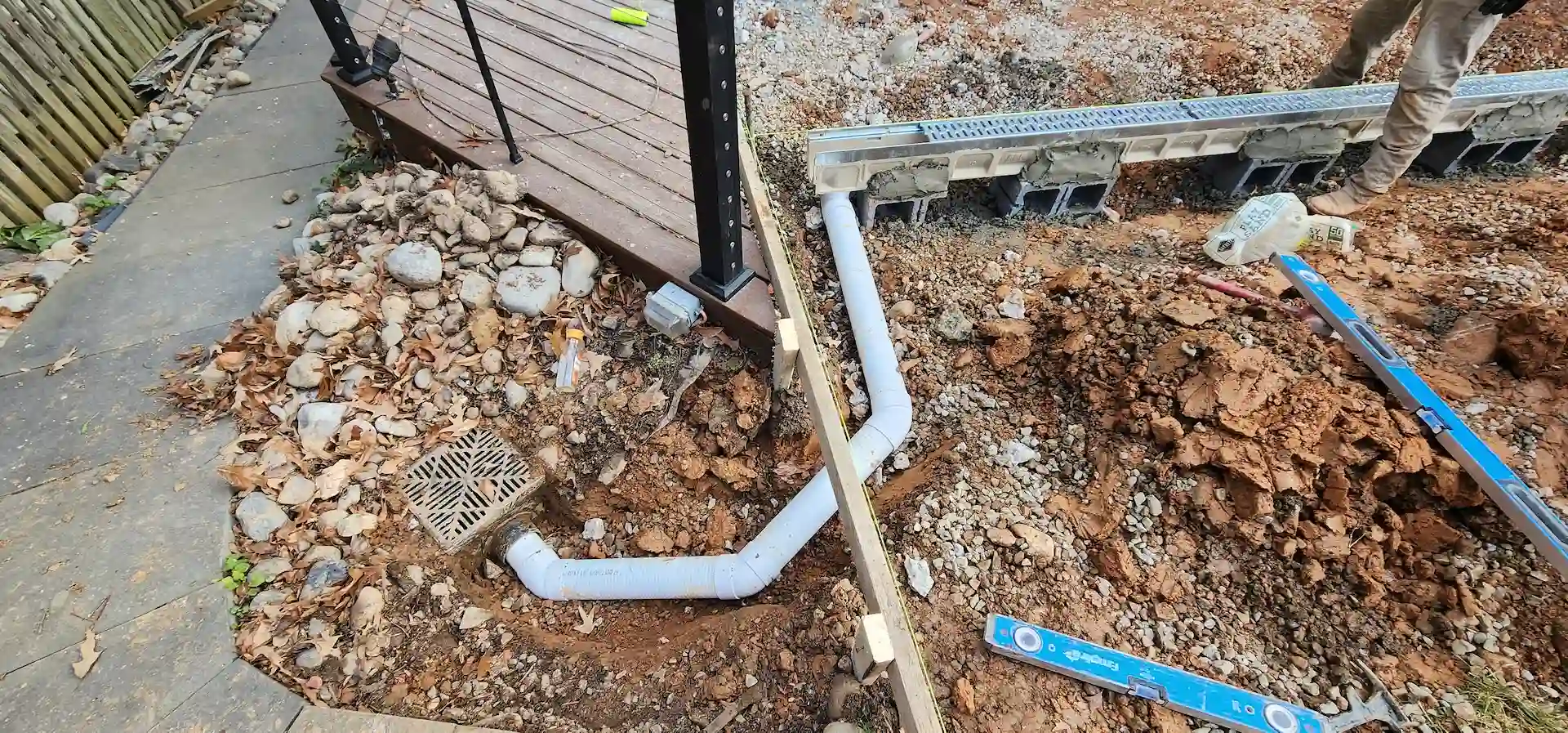
- Surface Catchment & Safe Discharge To manage roof runoff, we hard-pipe downspouts directly into the system using solid (non-perforated) pipe, preventing roof water from saturating the yard. The entire system is then routed to a safe exit—such as a pop-up emitter at the curb, a municipal storm drain, or an engineered subterranean dry well.
3. Material Science: The Tuck Drainage System vs. Builder-Grade
| Specification | The Tuck Engineered System | Standard Landscaper / DIY |
|---|---|---|
| Pipe Material | Rigid SDR-35 PVC or heavy-wall smooth-interior corrugated. | Thin, crushable single-wall black plastic pipe. |
| Silt Prevention | Full "Burrito Wrap" with non-woven geotextile fabric. | No fabric, or cheap woven plastic weed barrier that clogs. |
| Aggregate Core | Cleaned, washed crushed stone (maximum void space). | Unwashed gravel full of dust that turns to mud inside the pipe. |
| Surface Water Catchment | Heavy-duty inline catch basins with removable debris traps. | Tiny surface grates that instantly clog with a single leaf. |
| Discharge Method | Engineered dry wells, pop-up emitters, or storm sewer taps. | Dumping bulk water directly onto the neighbor's property. |
4. The Northern VA Factor: Marine Clay and Tight Lot Lines
Navigating the specific geological and legal challenges of Northern Virginia is essential for effective water management. In our expansion zones like Lake Ridge, Manassas, Gainesville, Haymarket, Woodbridge, Bristow, and Lorton, the predominant soil type is highly expansive marine clay. This soil has a percolation rate of near zero. It does not absorb water; it holds it on the surface like a vinyl tarp. In these zones, deep French drains are absolutely mandatory. They create a subterranean void space for the water to enter and evacuate, preventing your lawn from becoming a permanent, muddy swamp after every storm.
Conversely, in the premium, high-density sectors like Vienna, Clifton, McLean, Fairfax Station, Great Falls, Arlington, and Alexandria, the primary challenge is property lines and strict impervious surface laws. When installing a large patio or driveway, Arlington and Fairfax counties require rigorous stormwater management plans. You cannot legally pipe your bulk runoff directly onto an adjacent property. In these tight jurisdictions, we frequently engineer subterranean "dry wells"—massive underground holding tanks wrapped in fabric and stone. These dry wells capture surge water during a torrential storm and allow it to slowly percolate deep into the earth over 24 to 48 hours, satisfying municipal codes and keeping the water safely contained on your own property.
5. Yard Drainage Engineering FAQ
A French drain is designed to manage subsurface groundwater and relieve hydrostatic pressure. It utilizes a perforated pipe surrounded by gravel to slowly collect water across a large area as the water table rises. A catch basin (often attached to a solid pipe) is designed to rapidly manage bulk surface water, such as the heavy flow pouring out of a gutter downspout or sheeting off a concrete patio.
Gravity is the engine of our drainage systems. Depending on your property's topography and local zoning laws, we route the water to the lowest elevation possible. This usually terminates at a pop-up emitter near the street curb, taps directly into a municipal storm sewer connection (if permitted), or flows into an engineered dry well buried deep in the yard.
We approach excavation with surgical care. Whenever possible, we carefully cut and peel back the existing sod before trenching. We place the excavated dirt on tarps or transport it off-site immediately to prevent lawn damage. Once the system is installed and the trench is backfilled, we restore the surface. Once the grass recovers, the powerful drainage system working below is completely invisible.
6. Protect Your Property and Reclaim Your Yard
Do not let another season of heavy rain turn your backyard into an unusable mud pit or threaten the structural integrity of your foundation. From mitigating the dense marine clay soils of Burke and Springfield to navigating the strict stormwater discharge zoning requirements of Arlington and Alexandria, Tuck GC has the civil engineering expertise to permanently solve your drainage nightmares. Stop treating the symptoms. Let us cure the source.