
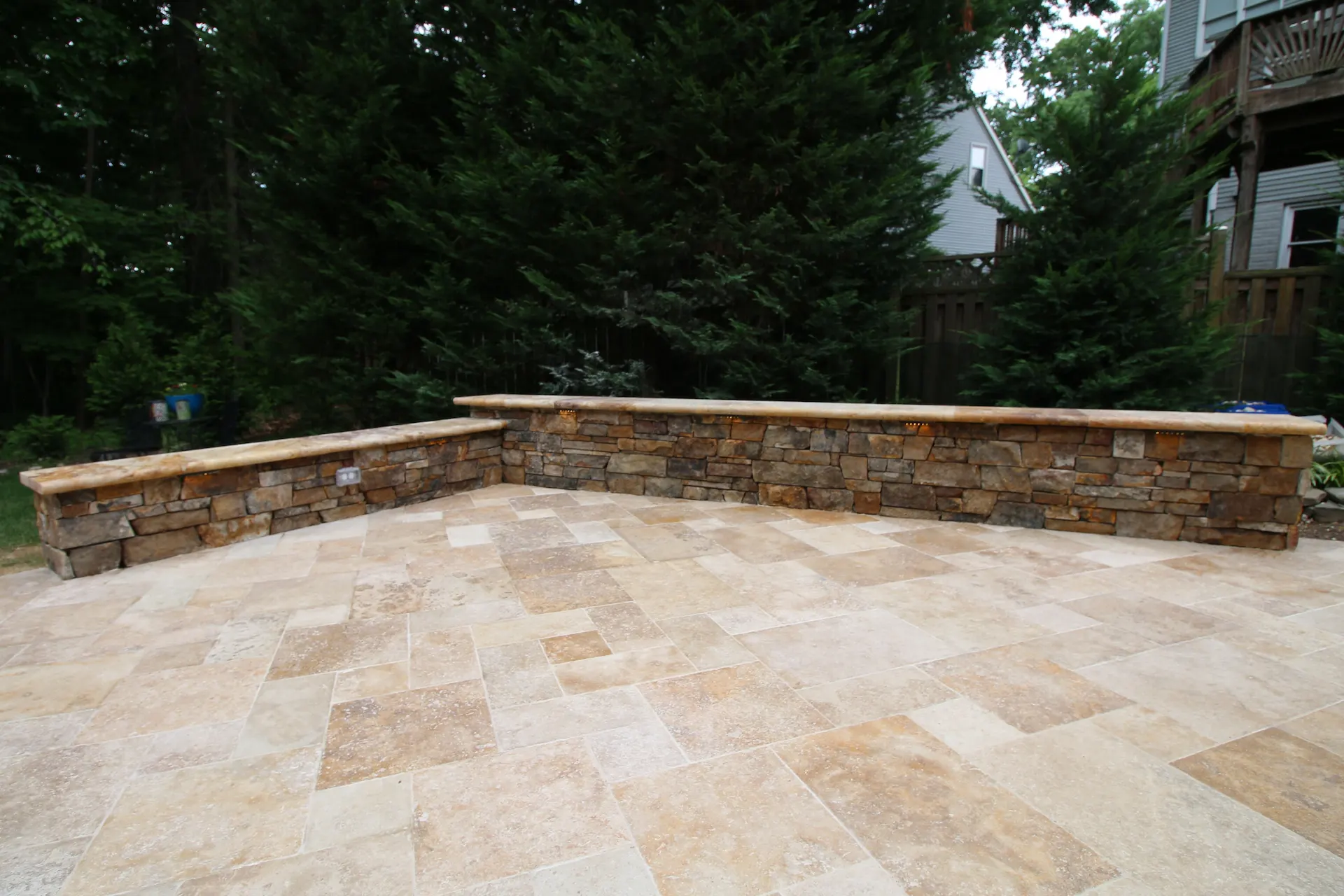
More Than Just a Border
A low stone wall serves a dual purpose: it clearly defines the edge of your patio, separating it from the lawn, and provides permanent, weatherproof seating for entertaining. We design and build custom freestanding seat walls (typically 18-21 inches high) using natural flagstone, brick veneer, or modern architectural block with smooth, comfortable caps for your guests.
When you transition from a flat patio to incorporating vertical stone elements, you fundamentally change the geometry of your outdoor living space. Stone seating walls go on top of patios, making grand-scale outdoor entertaining possible without cluttering your valuable square footage with bulky outdoor furniture. They expand seating capacity exponentially, create intimate conversational zones around fire pits, and provide the perfect housing for integrated low-voltage lighting. A seating wall introduces a vital three-dimensional aspect to your project, elevating a simple flat surface into a true outdoor room.
1. The Diagnostic: Why Builder-Grade Walls Lean and Crack
A seating wall looks simple from the outside, but structurally, it is fighting a constant battle against gravity, lateral pressure, and moisture. The biggest mistake amateur landscapers make is treating a freestanding seat wall like a decorative Lego set, gluing blocks directly on top of shifting soil or directly onto an un-reinforced patio edge. Within a few seasons, these walls begin to lean, wobble, and ultimately crack along the mortar joints.
Furthermore, the coping (the flat capstone where people actually sit) is highly susceptible to delamination if improperly installed. When contractors use standard masonry mortar to attach capstones without accounting for thermal expansion and freeze-thaw cycles, moisture inevitably penetrates the joints. When that water freezes, it acts like a wedge, popping the heavy capstones right off the wall. Finally, a wall built without an internal structural core lacks the rigidity to withstand the lateral force of multiple adults leaning back against it. For a seating wall to be permanent, it must be engineered from below the frost line up.
2. The Tuck Standard Protocol: Vertical Masonry Engineering
At Tuck GC, we do not build temporary hardscapes. Our stone seating walls are constructed utilizing heavy-duty structural masonry techniques, ensuring they remain plumb, level, and structurally sound for generations. Here is the protocol:
- Deep-Trench Footer Construction Whether integrating the wall into a new patio build or retrofitting it to an existing space, we begin with the foundation. We excavate a dedicated trench below the wall footprint and install a deeply compacted, crushed aggregate base or a steel-reinforced poured concrete footer. This prevents the heavy vertical stone load from settling independently of the surrounding patio.
- CMU Structural Core Assembly We do not rely on the decorative veneer for strength. The heart of our seating walls is a solid core of CMU (Concrete Masonry Unit) block, often reinforced with vertical steel rebar depending on the height and lateral load requirements. This core creates an unyielding spine for the structure.
- Precision Veneer Application Once the core is cured, we apply the exterior finish. Whether you choose hand-chiseled natural fieldstone, elegant brick, or sleek modular block, we apply the veneer using modified, high-adhesion polymer mortars that bond aggressively to the CMU core while resisting moisture penetration.
- Custom Coping & Capstone Integration The seat itself must be flawless. We source premium, thick-cut flagstone, bluestone, or pre-cast caps. These are leveled perfectly, providing a smooth 18-to-21-inch-high resting surface. We secure the coping using advanced flexible adhesives or specialized exterior epoxies that absorb thermal expansion rather than cracking like traditional mortar.
- Low-Voltage Lighting & Electrical Integration To maximize the 3D aspect of the build, we integrate the wiring for low-voltage LED hardscape lighting directly into the CMU core during construction. We install sleek under-cap light fixtures that cast a warm, downward glow, illuminating the patio floor and highlighting the texture of the stone veneer without blinding your guests.
3. Material Science: The Tuck Seat Wall vs. Standard Landscaper
| Specification | The Tuck Standard Seat Wall | Standard Landscaper / DIY Kit |
|---|---|---|
| Internal Structure | Solid CMU block core (steel reinforced if needed). | Hollow decorative blocks glued together. |
| Foundation | Independent aggregate trench or concrete footer. | Built directly on top of dirt or shifting patio pavers. |
| Coping Adhesion | High-flexibility exterior epoxy or polymer-modified thinset. | Basic Type-S mortar (prone to popping off during winter). |
| Lighting Integration | Wires hidden internally within the core during the build. | Ugly wires stapled to the exterior or no lighting at all. |
| Design Geometry | Custom curves, integrated pillars, and 18-21" ergonomic height. | Rigid, straight lines dictated by pre-fab kit limitations. |
4. The Northern VA Factor: Surviving the Soil and the Code
Building vertical masonry structures across our core jurisdictions—Fairfax County, Arlington, Alexandria, and Prince William County—requires a deep understanding of local soil mechanics. In specific expansion zones like Woodbridge, Lorton, Manassas, and Burke, the subsoil is heavily composed of marine clay. This clay is highly expansive; it acts like a sponge, swelling violently when saturated and shrinking during summer droughts. If a heavy stone seating wall is built without an engineered, free-draining gravel trench or deep footer, the hydrostatic pressure and freeze-thaw cycle of this clay will literally heave the wall out of the ground, causing catastrophic cracking.
In premium sectors such as McLean, Great Falls, Vienna, Fairfax Station, and Clifton, homeowners frequently request complex outdoor living spaces that include towering stone pillars, integrated fire pits, and sweeping curved seat walls. These additions must often pass rigorous Architectural Review Board (ARB) inspections. Because Tuck GC utilizes structural CMU cores rather than cheap landscape blocks, our seating walls exceed local load-bearing and building codes, ensuring a smooth approval process and a hardscape that looks like an original architectural extension of your luxury home.
5. Seating Wall Engineering FAQ
For optimal ergonomic comfort, a seating wall should be built between 18 and 21 inches tall, including the capstone. This mirrors the height of a standard dining chair. The coping (the seat itself) should be a minimum of 12 inches deep to provide comfortable support, though 14 to 16 inches is preferred for maximum comfort and structural proportion.
Yes, but it requires surgical precision. We cannot simply build a heavy wall on top of old pavers that weren't designed to bear that localized weight. We will saw-cut and remove the perimeter of the existing patio, excavate a proper footer for the new wall, construct the structure, and then seamlessly tie the existing patio back into the new vertical face.
Absolutely. Terminating a seating wall with a structural stone pillar (typically 24x24 inches) is a hallmark of premium hardscape design. These pillars serve as bold architectural anchors, provide excellent platforms for large lantern-style light fixtures, and offer structural framing for entryways onto the patio.
6. Elevate Your Outdoor Entertaining
A custom stone seating wall is the definitive upgrade that transforms a simple backyard patio into a high-end, three-dimensional outdoor living room. Whether you need to enclose a fire pit space in Gainesville, add illuminated seating to a pool deck in Arlington, or define the edge of an elevated terrace in Springfield, Tuck GC delivers permanent, structural elegance. Stop replacing weathered outdoor furniture. Invest in permanent seating crafted from stone.