
Create the Open Space You Want
Modern life happens in open spaces. Older homes across Northern Virginia were designed with highly compartmentalized floorplans—small, boxed-in kitchens completely isolated from the main living and dining rooms. Homeowners want the modern "open concept" aesthetic, which requires tearing down these interior walls. The problem? Those walls are often holding up the second floor or the roof.
Removing a load-bearing wall is not a demolition project; it is an intense structural engineering challenge. Often, a homeowner will hire a kitchen remodeling company or an interior designer to plan their new space, only to find out the remodeling contractor is not legally licensed or technically equipped to alter the home's structural framing. That is where Tuck GC steps in. As a Class A Builder, we serve as your specialized structural partner. We handle the heavy lifting: engineering the load paths, installing massive steel or LVL beams, and ensuring the structural integrity of your home remains flawless, handing off a wide-open canvas to your interior finishing team.
1. The Diagnostic: Identifying the Load Path
A house is held together by gravity. The weight of the roof (the "dead load" of the shingles plus the "live load" of winter snow) pushes down on the exterior walls and the central interior walls. These walls transfer the massive weight downward through the floor joists and ultimately into the concrete foundation in the basement. If you swing a sledgehammer through an interior wall without understanding this "load path," the floor above will instantly begin to sag.
In many 1980s and 1990s colonials in Fairfax, Burke, and Springfield, telling a load-bearing wall from a simple partition wall requires expert forensic analysis. We must investigate the attic to see which direction the roof trusses run, and we must inspect the basement to locate the main steel I-beam. If the wall you want to remove runs perpendicular to the floor joists above it, it is almost certainly load-bearing and will require major beam integration.
2. The Tuck Standard Protocol: Safe Structural Removal
We do not guess with gravity. Every wall removal project we execute follows a strict, legally permitted, engineered protocol to ensure zero deflection (sagging) in your home's framing:
- Architectural Permitting & Engineering Before demolition begins, we partner with structural engineers to calculate the exact weight the wall is currently supporting. We then size the new replacement beam (LVL or Steel) to carry that specific load across the new, wider span. We submit these stamped calculations to the county to secure the necessary building permits.
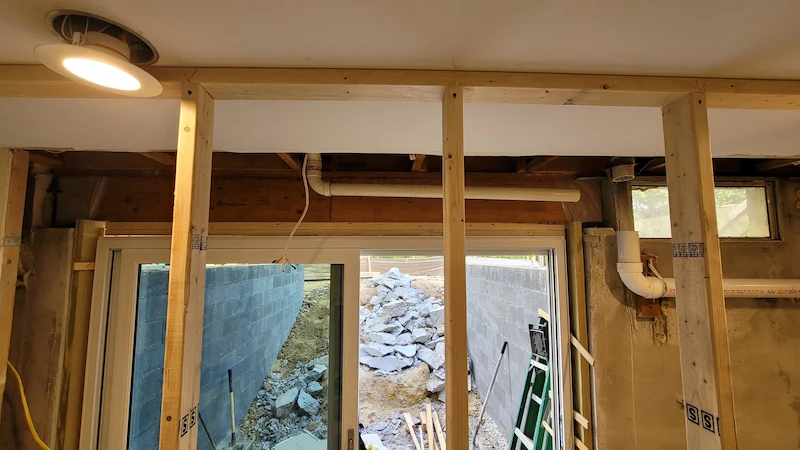
- Temporary Shoring (The Safety Net) You cannot remove a support wall without first building a temporary one. We construct heavy-duty temporary stud walls (shoring) on either side of the wall being removed. This catches the ceiling joists and safely transfers the weight of the second floor down to the foundation while we work.
- Surgical Demolition & Utility Re-Routing Interior walls are highways for your home's mechanical systems. We carefully remove the drywall and expose the studs. Our licensed electrical and plumbing teams safely cut, cap, and reroute any wires, HVAC ducts, or plumbing pipes hidden within the wall before we remove the structural lumber.
- Beam Hoisting & Installation This is the critical maneuver. Depending on the span (often 15 to 25 feet), we use specialized material lifts to hoist massive Glued Laminated Timber (LVL) beams or heavy steel W-flange beams to the ceiling. We rest the ends of these beams securely on new, reinforced vertical support columns (king and jack studs) that carry the load directly down to the foundation.
- Point Load Transfer (The Basement Check) A massive new beam concentrates thousands of pounds of weight onto the two vertical posts at either end. If those posts are resting directly over an empty space in your basement, the floor will collapse. We trace these "point loads" all the way down to the dirt. If necessary, we will excavate the basement floor and pour new concrete micro-footings directly beneath the new support columns to handle the concentrated weight.
3. Beam Configurations: Drop Beams vs. Flush Beams
| Installation Method | Aesthetic Result | Labor Complexity | Ideal Application |
|---|---|---|---|
| The "Flush" Beam (Hidden Pocket) | Completely flat, seamless ceiling. The beam is hidden inside the floor joists above. | Extremely High. Requires cutting floor joists and using joist hangers to attach them to the side of the new steel beam. | Luxury open concepts where an uninterrupted ceiling is strictly required. |
| The "Drop" Beam | The beam hangs down below the ceiling (usually 10 to 14 inches) and is wrapped in drywall or decorative wood. | Moderate. The beam simply sits directly beneath the existing floor joists to support them. | Cost-conscious remodels; designs that utilize the exposed beam as a rustic architectural feature. |
4. The Northern VA Factor: Navigating the Codes
Executing structural modifications in Arlington County, the City of Alexandria, or Loudoun County is heavily policed by building inspectors. You cannot simply slide a beam into place and cover it with drywall. The inspector must see the raw, exposed beam resting on the support columns. They must verify the framing nail patterns, the structural Simpson Strong-Tie hardware, and the load paths down to the basement footings.
At Tuck GC, we manage the entire bureaucracy. Whether you are opening up a tight townhome in Reston or executing a massive first-floor blowout in a McLean colonial, we handle the engineering stamps, schedule the rough-in framing inspections, and guarantee that the structural alterations will pass county code on the first attempt, preventing costly delays to your broader kitchen remodel.
5. Wall Removal FAQ
Never assume. A wall running parallel to the floor joists above it is usually just a partition wall, but a wall running perpendicular to the joists is almost always load-bearing. Exterior walls are always load-bearing. If you are unsure, you must have a licensed contractor or structural engineer evaluate the attic and basement framing.
Yes, but it requires highly engineered materials. Standard lumber will bow and fail over a 20-foot span. To achieve a completely clear span, we must install heavy-duty, multi-ply LVL (laminated veneer lumber) beams or commercial-grade steel I-beams, which are sized specifically by an engineer to handle the load without sagging.
Yes. While we often partner with other remodeling companies purely for the structural phase, Tuck GC is fully equipped to handle the project from start to finish. If requested, we will frame the new beam, secure the inspections, and then install, tape, and mud the drywall so the space is ready for paint.
6. Open Up Your Home
Do not trust your home's structural integrity to a kitchen remodeler or a weekend handyman. Removing a load-bearing wall requires a heavy civil approach. From executing complex, hidden flush-beam installations in Vienna to installing massive steel clear-spans in Haymarket, Tuck GC delivers the engineering muscle required to create the open concept you want, with the absolute safety you need.