
Diagnosing Premium Hardscape Failure
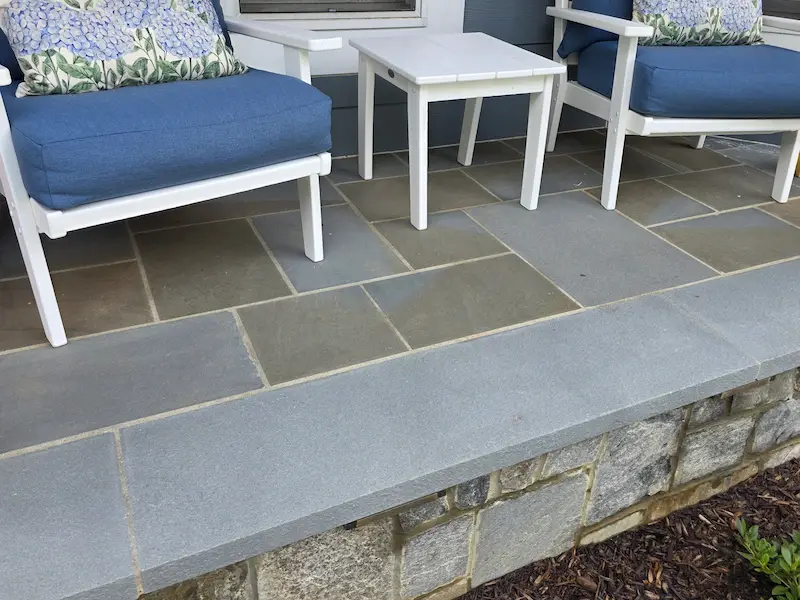
Pennsylvania Bluestone is widely regarded as the premier natural stone for formal outdoor living spaces. Unlike standard rustic flagstone, which has a highly irregular "cleft" surface, true architectural designs demand Thermal Bluestone. This stone is subjected to high heat at the quarry, popping off the irregular face to leave a perfectly flat, finely textured, non-slip surface. It is the definitive choice for modern landscapes, pool copings, and high-end patios.
However, installing a premium, geometrically perfect material like Thermal Bluestone over a cheap, dry-laid sand or gravel base is structural malpractice. Because the stone is precision-cut, any movement in the sub-base is instantly visible. When a sand base settles, or when the Mid-Atlantic freeze-thaw cycle induces frost heave, the flat edges of the bluestone create severe "lipage" (tripping hazards).
Furthermore, dry-laid systems rely on polymeric sand for the joints. Over time, water runoff and power washing evacuate this sand, leaving empty voids. This destabilizes the stones, leading to rocking, cracking under weight, and aggressive weed infiltration. To preserve the investment of architectural bluestone, it must be integrated into a rigid, permanent masonry system.
The Tuck Standard Protocol: Wet-Set & Thermal Integration
We approach a bluestone patio not as a landscaping task, but as structural concrete engineering finished with a luxury veneer. By anchoring the Thermal Bluestone—along with thick bluestone wall caps and coping—to a monolithic concrete and CMU block foundation, we neutralize soil movement entirely. This is our unyielding 5-step process:
- Load-Bearing Excavation & Base Compaction We excavate the entire footprint down to stable subgrade, removing all organic material. We then import and mechanically compact a dense-graded aggregate base. This layer breaks capillary action, preventing groundwater from attacking the underside of the concrete slab.
- Structural Concrete Foundation We pour a minimum 4-inch, 4,000 PSI concrete slab, heavily reinforced with steel rebar. For seating walls, retaining walls, and steps, we build rigid CMU (concrete masonry unit) block cores tied directly into the footing with vertical rebar. This creates a unified structural chassis.
- Full-Bed Mortar Setting (Wet-Set) Every piece of 1.5-inch Thermal Bluestone is fully "buttered" with high-strength Type S masonry mortar and set directly onto the cured concrete slab. We ensure 100% coverage to prevent hollow voids where water could pool, freeze, and pop the stone loose.
- Architectural Wall Caps & Coping For steps, fire pits, and seating walls, we install custom 2-inch thick bluestone wall caps. These oversized slabs are templated, cut, and wet-set with precision overhangs, providing a seamless visual transition and shedding water away from the masonry core below. We utilize both thermal edges and hand-rocked edges depending on the design.
- Precision Joint Pointing & Hydrostatic Control We tool every joint with weather-resistant mortar, locking the stones together into a single impermeable sheet. The entire system is laser-graded to a strict ¼-inch per foot slope, guaranteeing rapid water evacuation away from your home’s foundation.
Structural Comparison: Wet-Set vs. Dry-Laid Systems
Investing in luxury materials requires investing in the foundation that supports them. Here is the technical breakdown of why our wet-set bluestone protocol outperforms standard landscaping methods.
| Engineering Metric | Tuck Wet-Set Bluestone (The Standard) | Builder-Grade Dry-Laid (The Competitor) |
|---|---|---|
| Foundation Base | 4-inch steel-reinforced concrete slab (4,000 PSI). | Loose compacted sand, stone dust, or crushed gravel. |
| Stone Selection | Premium Thermal Finish (Perfectly flat, dimensionally stable). | Natural Cleft (Uneven, flaking layers, highly variable thickness). |
| Wall & Step Caps | 2-inch thick bluestone coping, wet-set to a reinforced CMU core. | Thin stone glued to loose retaining wall blocks. Will detach over time. |
| Joint Integrity | Solid Type S mortar. 100% impenetrable to weeds and insects. | Polymeric sand. Washes out, allowing ants and weeds to destabilize base. |
| Load Dispersal | Concrete slab disperses weight evenly. Stones will not crack under point-loads. | Individual stones bear direct weight. High risk of cracking over soft spots. |
The Northern Virginia Factor: Soil Dynamics & Zoning
The geologic reality of Northern Virginia dictates our engineering approach. The highly plastic marine clays found throughout the "Money Zone"—including McLean, Great Falls, Arlington, Alexandria, and Clifton—are notoriously unstable. This clay acts like a sponge, expanding violently in the wet spring and shrinking during the arid summer. A traditional dry-laid patio simply rides this volatile soil, leading to a warped and dangerous surface within a few seasons. Our reinforced concrete foundation bridges these soil anomalies, acting as a rigid raft that remains perfectly level regardless of subterranean shrink-swell behavior.
Furthermore, installing permanent masonry structures often triggers rigorous local zoning scrutiny. Jurisdictions such as Fairfax County, Arlington, and the City of Alexandria maintain strict impermeable surface ratios and lot coverage restrictions. High-end bluestone projects, particularly those integrating structural retaining walls or elevated terraces in Vienna or Manassas, require precise plat calculations and engineered drainage plans. We manage these municipal complexities, ensuring your structural hardscape is fully permitted and legally compliant.
Technical Diagnostics & FAQ
Architectural Stone Requires Structural Engineering.
Do not place premium thermal bluestone on a temporary foundation. If you want a perfectly flat, mortar-joined patio that will not shift, heave, or grow weeds, you need a masonry contractor, not a landscaper.
SCHEDULE A STRUCTURAL EVALUATION