
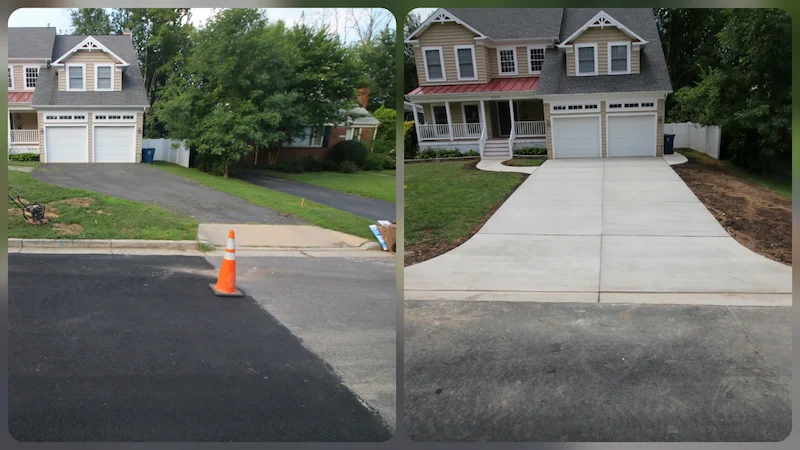
Why Your Asphalt Driveway Failed (The Science)
Converting an asphalt driveway to concrete is the definitive way out of the failure cycle Northern Virginia weather forces on flexible pavement. Asphalt is held together by oil-based binders. Summer UV bakes those oils out, turning the surface gray and brittle; winter then drives water into the resulting micro-cracks, where it freezes, expands, and pries the pavement apart. Each freeze-thaw cycle widens the damage the last one started.
Sealcoating only hides this. It is a cosmetic film that restores no structural integrity, so you end up paying every two or three years to keep a failing surface alive. The durable alternative is rigid pavement — a 4,000 PSI concrete slab built on a proper stone base, which is what an asphalt-to-concrete conversion delivers.
The Conversion Protocol: How We Do It Correctly
Swapping asphalt for concrete is not a like-for-like job. The two pavements sit on the soil differently, so the base has to be rebuilt from the subgrade up. Here is the sequence we follow for a conversion that lasts:
- 1. Demolition & Haul Away We remove the existing asphalt and haul it off-site.
- 2. Subgrade Check With the asphalt gone, we check the exposed subgrade for soft spots before any stone goes down. Unsuitable soil found during excavation is removed and replaced by Change Order.
- 3. The Stone Base (21A Aggregate) Concrete needs a stable, draining bed. Our standard 4-inch driveway gets about 8 inches of excavation and about 4 inches of compacted #21A crushed stone.
- 4. Wire Mesh Reinforcement We pull 6x6 welded wire mesh up into the middle of the slab during the pour, so it carries tension where the concrete is weakest and helps hold any cracks tight if the ground shifts over time.
- 5. The Pour (4,000 PSI Air-Entrained) We pour 4,000 PSI air-entrained concrete. The entrained air forms microscopic bubbles that give freezing water somewhere to expand inside the slab, which helps protect the surface from spalling through Northern Virginia's freeze-thaw winters.
Material Science: Asphalt vs. Tuck Concrete
Once you put the two surfaces side by side, the case for converting becomes a question of cost over time rather than cost up front:
| Feature | Standard Asphalt | Tuck Standard Concrete |
|---|---|---|
| Lifespan | Typically needs resurfacing or replacement much sooner than concrete | A well-built slab commonly lasts decades — service life depends on the base, drainage, and maintenance (not a warranty term) |
| Maintenance | Sealcoat every 2-3 years | Minimal — occasional cleaning |
| Summer Heat | Dark surface can reach 120–150°F in summer sun (EPA); softens under load | Reflects heat, stays rigid |
| Load Bearing | Can rut under heavy trucks/RVs | 4,000 PSI air-entrained mix on a compacted stone base; resists rutting under everyday vehicle traffic |
| Edge Strength | Crumbles at edges (alligatoring) | Defined, rigid edge |
The Northern Virginia Factor: Clay & Code
The Clay Problem: Much of Fairfax and Prince William County sits on marine clay — a soil that swells when it takes on water and shrinks as it dries. Asphalt moves with that seasonal heave and is slowly torn apart by it. A concrete slab poured over a compacted stone base is far better positioned to handle that movement, and it generally outlasts the asphalt it replaces (not a warranty term) — though a compacted stone base reduces, but cannot eliminate, the effects of clay movement (see The Tuck Standard, Section 5F). Control joints are tooled (or saw-cut) at intervals set by the slab layout. Where a new slab meets any existing (cold) slab we isolate it with an expansion joint, and if a plant delay keeps the next truck from arriving before the first batch sets, we install an expansion joint at that cold joint (see The Tuck Standard, Section 6F).
The VDOT Apron Requirement: A conversion often means rebuilding the apron — the section between your driveway and the street — to current VDOT standards. That work sits in the public right-of-way and typically involves cutting or replacing the curb and gutter as the entrance standard requires and setting the grade so runoff drains to the gutter rather than across the road. We coordinate the VDOT land use permit (LUP-PE) this transition requires. Review runs on the jurisdiction's schedule; in our experience it commonly takes 30 days or more, so we start that paperwork early rather than letting it hold up the pour.
Asphalt-to-concrete conversion is one of several driveway upgrades we offer across Fairfax, Loudoun, Arlington, and Prince William County. If your existing concrete is sound and you only need a short-term cosmetic refresh — before selling a house, for example — ask about concrete resurfacing, or review our full approach to new concrete driveways.
What Drives the Cost of an Asphalt-to-Concrete Conversion in Fairfax & Arlington
A conversion is two jobs in one — removing the old asphalt and building a new structural slab — so the cost reflects both. The largest driver is square footage, followed by the demolition and haul-off of the existing asphalt. Site prep can swing the number once the surface is stripped: a sound subgrade costs less than one where unsuitable soil found during excavation has to be removed and replaced by Change Order. Finish choice matters too — a broom finish is the standard, while integral color or exposed aggregate adds labor — as does access on the tighter Arlington and Fairfax lots where machines can't reach the back of the driveway. If we rebuild the apron in the right-of-way at the same time, that carries its own VDOT or municipal permit. We scope and price each conversion to the property rather than post a per-square-foot figure that ignores what the subgrade is actually doing.
Because every project is scoped to your property, we price each one individually rather than by a flat rate. You'll find our project minimum and a full breakdown of what different budgets cover on our contact page.
See Our Full Pricing BreakdownFrequently Asked Questions
Stop Renting Your Driveway
Stop pouring money into sealcoat every few years to keep a failing asphalt surface alive. A concrete driveway built on a sound base is a structural upgrade for your Fairfax or Arlington home, built on the base that gives a driveway its best chance at a long service life.
Request a Conversion Estimate