
We Build More Than Just Platforms
Tuck GC is a Class A design-build contractor building custom decks, screened porches, and porticos across Fairfax, Arlington, and Alexandria. A deck is a structural addition to your house, not a kit of boards, so we treat it like one: footings below the frost line, sized to the approved plans and the soil conditions of Northern Virginia's clay, a frame built to the standard the county inspector checks, and a composite surface built for Northern Virginia freeze-thaw and backed by the manufacturer's long-term warranty. The result reads as an extension of the home's architecture rather than a platform bolted to the back of it.
Building to that standard means we do not put pressure-treated wood on any surface or trim you touch — only composite, PVC, and the right metal. We coordinate the low-maintenance Trex composite deck, the bug-free screened-in porch with a vaulted ceiling, and the front portico, and we handle the permitting and the PE-stamped plans the county requires. HOA architectural review, which most of these neighborhoods enforce, is the homeowner's application; we support it with the drawings, material cut-sheets and specs the board asks for.
Arlington Master-Class Case Study
The Ultimate Design-Build Transformation: From Failing Wood to a Luxury Indoor/Outdoor Estate.
Phase 1: Front Approach & Hardscaping
- The Portico: Converted a failing wood porch into an elevated structural concrete base, beautifully overlaid with thermal bluestone and thick thermal border edging (executed with fully engineered county plans). Finished with composite PVC wrapping and a custom mahogany ceiling.
- The Driveway: A structural concrete base overlaid with Techo-Bloc Blu 80 (Slate Grey, HD2 smooth finish) covering the entire driveway and front walkway.
- Structural Edge: Built into the hillside with a deep footing system along the driveway, featuring a manufacturer-recommended isolated footer specifically designed for the basketball hoop to prevent structural vibration.
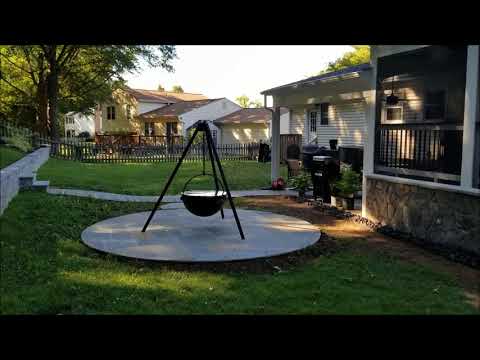
- The Transition: A natural stepping-stone pathway leading to the rear, providing an organic connection between the front and back without exceeding the property's lot coverage limits.
Phase 2: Rear Screen Room & Deck
- Maximized Footprint: We built the open Trex composite deck literally inches away from the county setback lines to maximize usable space for grills, smokers, and lounge chairs.
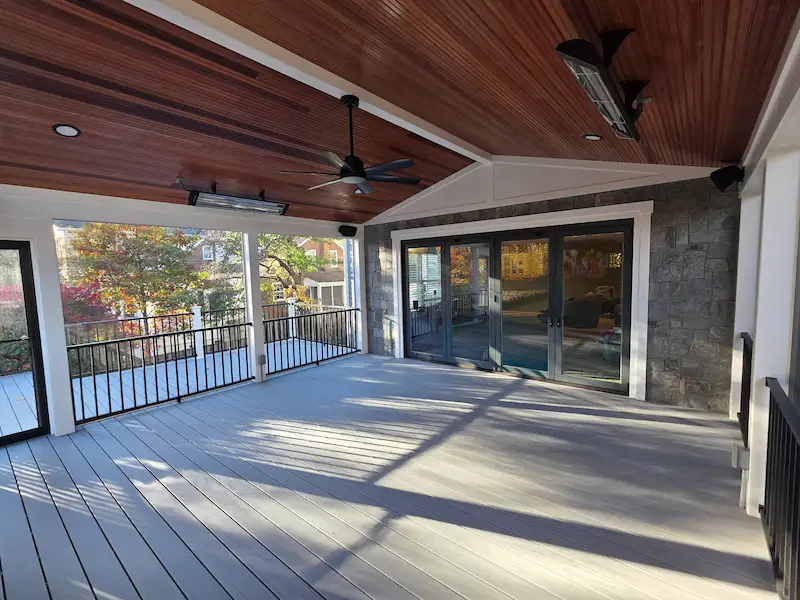
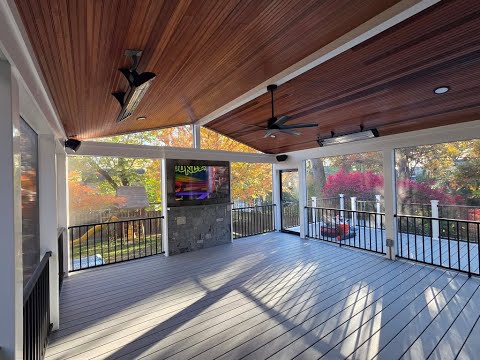
- The Screen Room: An expansive family area featuring modern aluminum railings, a custom stone foundation wall, and a false stone wall designed specifically to mount an outdoor TV facing the rear yard.
- Luxury Integrations: Outfitted with black, ceiling-mounted, angled Infratech electric heaters and a fully integrated Sonos surround sound system tied into the home's interior amplifier and new speakers.
- Under-Deck Storage: Reclaimed the space underneath with a highly custom, water-shedding horizontal skirt/fence design featuring alternating board sizes.
The Structural Highlight: The 12-Foot Marvin Door
After demoing the interior drywall to expose the framing, we found a continuous LVL header already spanning two existing windows and a French door, which the county inspector examined and approved for the new opening. Because that header was carrying the load, we could remove the entire wall section and install a 12+ foot Marvin Elevate Bi-Fold (Accordion) Door without adding new structure overhead. The homeowners can now fold the back of the house fully open, joining the interior family room and the new screen room into one continuous living space.
Explore Our Deck & Porch Services


Structural Framing: The Skeleton of Your Project
The surface is composite, but the frame under it is still pressure-treated lumber — and that frame is where a deck job is actually won or lost. In jurisdictions with rigorous plan review and inspection, like Arlington County and the City of Alexandria, framing that is merely adequate doesn't clear county inspection, and a frame that holds water rots from the inside long before the boards wear out. Here is how we detail ours.
The Tuck GC Structural Standard:
- ✓ Joist Spacing to the Span Table: We set joist spacing to the decking manufacturer's span table, often tighter than the typical 16" residential spacing. Closer joists shorten the unsupported span of each board, which is what takes the spring out of composite decking and gives the finished deck a firm, planted feel underfoot.
- ✓ Footings & Helical Piers: In the clay-heavy soils of Fairfax Station and Clifton, shallow concrete footings sit in ground that swells and shrinks with moisture and can heave or settle over the years. Our footings go below the frost line, to the depth and size the approved plans and soil conditions call for, and where the design calls for them we set helical piers — steel shafts driven down below that active layer — so the footing bears below the most active clay.
- ✓ Ledger Attachment & Flashing: The most common point of deck failure is rot at the ledger or along the joist tops, where rain sits on the end grain. We attach and flash the ledger to the approved plans and the county's deck details, and butyl joist tape across the tops of the framing, as your contract specifies, helps water shed off the wood instead of soaking into it.
- ✓ PVC Wraps: We wrap exposed structural posts and rim joists in cellular PVC trim, so the green pressure-treated lumber never shows on the finished deck.
Tailored Solutions for Your Zoning
1. The Townhome Retrofit (Alexandria & Reston)
In Old Town, Del Ray, and Reston, backyards are small and close to the neighbors, so privacy drives the design. The job is to get the most usable space out of a tight footprint while staying inside the local architectural review board's rules.
We use slatted privacy screens in aluminum or wood to break the sightlines from adjacent units while still letting air move through. On an elevated deck we can also add an under-deck drainage system, as scoped in your contract, which carries most rainwater away so the shaded space below can serve as a covered patio for seating or storage — usable square footage you already own but couldn't use before.
2. The Estate Pavilion (Great Falls & Bristow)
On larger lots in Great Falls, Bristow, and Haymarket, the constraints are scale and sun. A big south-facing yard bakes in July, and an open deck with no overhead structure goes unused for most of the afternoon.
The answer is a multi-zone structure: an open sun deck for the cooler hours tied into a covered pergola or a vaulted pavilion for shade, with the roof framed to your home's pitch and shingles selected to coordinate with the existing roof — new shingles read newer until they weather. These outdoor rooms carry ceiling fans, recessed lighting, and an outdoor kitchen. The HOA architectural review application is the homeowner's; we prepare the material specs and drawings the board asks for — in boards as strict as Dominion Valley's, a submittal that goes in complete and to exact geometry cuts down review comments.
The Composite Revolution: No More Pressure Treated
Pressure-treated pine was the default decking surface for decades because it was cheap. The trade-off shows up a few summers in: the boards cup, splinter, and gray out, and they need sanding and re-staining roughly every year to stay ahead of Virginia's heat and humidity. We don't install pressure-treated decking boards or surface railings — the up-front savings get eaten by a maintenance bill that never stops.
Instead we build the walking surface in capped composite and PVC decking, using premium lines from Trex. A capped board has a hard polymer shell bonded over its core, which is what gives it the warmth of an exotic hardwood like Ipe or Mahogany without the upkeep — no sanding, no staining, no sealing. That shell is also what holds the color under the strong UV on open lots in Great Falls and resists the mold film that wood grows on the shaded, wooded lots common in Burke.
Deck Design Discovery Questions
Planning your composite deck or screened porch? Consider these factors before we meet:
- How do you access the backyard (stairs vs. landing)?
- Do you want a covered, drained zone underneath for a hardscape patio?
- Will you want to screen it in later? (Requires different footings).
- Lighting needs (cap lights, stair riser lights, under-rail)?
- Furniture layout: Dining table vs. Lounge chairs?
- Outdoor Kitchen or grill placement (gas line run needed)?
- Privacy concerns from neighbors?
- Your target investment range?
The Range of Decks & Porches We Build
Custom Composite
High-end composite decking, custom aluminum railings, hidden fasteners, and PVC wrapped framing. Ideal for Front Porticos as well.
Three-Season Living
Vaulted ceilings, electrical packages, advanced screening technology, and premium trim finishes on an elevated composite platform.
Multi-Structure Build
Multi-structure GC integration: Large composite deck, screened porch, hardscape patio below, and a custom outdoor kitchen.
More Featured Deck & Porch Projects
Let's Design Your Dream Deck
Schedule a site visit to discuss materials, layout, structural requirements, and budget.
Request ConsultationComposite vs. Pressure-Treated Wood — and Why the Frame Underneath Still Matters
The decking you walk on is the easy decision. The engineered frame hidden beneath it is what actually passes a strict Arlington or Alexandria inspection — and what determines whether your deck still feels solid years from now.
Capped Composite & PVC (Trex)
- Upfront cost: Higher than wood — you pay for the surface once.
- Lifetime cost: Lower. No staining cycle, far fewer repairs, and it rarely needs early replacement.
- Maintenance: An occasional wash with soap and water — no sanding, staining, or sealing.
- UV & mold resistance: Capped polymer shell resists fading, staining, and mold even on hot, wooded lots.
- Lifespan: Decades, backed by a long manufacturer surface warranty.
Pressure-Treated Wood (Surface)
- Upfront cost: Lower — the cheapest way onto a deck.
- Lifetime cost: Higher over 25 years once staining, repairs, and earlier replacement add up.
- Maintenance: Sanding, staining, or sealing roughly every year to fight the weather.
- UV & mold resistance: Grays, warps, and splinters under UV; holds moisture and mold.
- Lifespan: Shorter on the surface — which is why we keep it where it belongs: inside the frame.
The Surface Is Composite — the Engineered Frame Is What Passes Inspection
Choosing the board is the easy part. In jurisdictions with rigorous plan review and inspection, like Arlington County and the City of Alexandria, the structure underneath is where deck jobs pass or fail. We set joist spacing to the decking manufacturer's span table, often tighter than 16", so capped boards feel firm and planted underfoot; set footings below the frost line to the depth the approved plans and soil conditions call for, with helical piers where the design calls for them in the clay-heavy soils of Fairfax Station and Clifton; attach and flash the ledger to the approved plans and the county's deck details, with butyl joist tape as your contract specifies to help guard against the rot that ends most decks; and wrap visible posts and rim joists in cellular PVC so you never see green lumber. We build design-build, and when the county requires it we coordinate a licensed professional engineer for PE-stamped or county-reviewed plans — we don't perform structural engineering in-house.
Composite Decks → Deck Railings → Screened Porches → Under-Deck Waterproofing →
Deck & Porch FAQ
How much does a custom composite deck or screened porch cost in Northern Virginia?
It depends on size, height off the ground, railing and decking lines, and whether you're screening it in or adding a roof — so we price every project individually rather than post a misleading per-square-foot figure. Custom composite decks, screened rooms, and full multi-structure outdoor living builds each scope up with size and complexity.Tell us your scope on the contact page and we'll give you a real number.
Composite/Trex vs pressure-treated wood — which, and how do lifetime cost and maintenance compare?
For the walking surface and railings we build in capped composite and PVC (premium Trex lines), not pressure-treated wood. Wood is cheaper up front but needs sanding, staining, or sealing roughly every year and still warps, splinters, and grays out in our climate — so over 25 years the staining, repairs, and earlier replacement usually cost more than composite did. Capped composite resists fading, staining, mold, and UV, carries a long manufacturer surface warranty, and typically needs nothing more than an occasional wash. The one place pressure-treated lumber still belongs is hidden inside the frame, where it's flashed and wrapped — never on the surface you touch.
Do I need a building permit for a deck or porch in Fairfax, Arlington, or Alexandria, and who handles the engineered plans?
Almost always, yes — an elevated deck, a screened porch, or a portico is a structural addition, and Fairfax, Arlington, and Alexandria all require a building permit with stamped or county-reviewed structural plans showing footings, framing, and connections. We handle the permit process and coordinate a licensed professional engineer for PE-stamped plans whenever the county requires them; we don't claim to perform structural engineering in-house. As a Class A (RBC) contractor we build to the approved drawings and schedule the inspections for our scope of work.
Can I screen in my deck later, or convert an open deck to a screened porch?
Yes, but it's far easier and cheaper when the structure is designed for it from day one. A screened porch and especially a roofed porch add real weight and wind load, which means deeper footings and heavier framing than an open deck needs. If you think a screen room is in your future, tell us now — we'll build the footings and posts to the engineer's stamped design for that future load so you're not tearing apart a finished deck to add it. If you already have an open deck, we'll evaluate whether its existing footings and framing can carry the conversion or what has to be reinforced.
What can I do with the space under an elevated deck?
On an elevated deck that space is some of the cheapest square footage you'll ever add. With an under-deck waterproofing system — an internal drainage ceiling that catches water between the joists — most rainwater is carried away from the area below, so it can work as a covered patio, an outdoor TV lounge, or a hot tub area (it's water mitigation, not absolute waterproofing; see The Tuck Standard, Section 10). You can also wrap the support posts in stone veneer chosen as the closest commercially available match to your home's masonry (new stone reads newer and won't be identical; see The Tuck Standard, Section 8L), or close in a secure, lockable storage room — protected by the drainage ceiling above — for mowers and patio furniture. Many of our projects combine all three.
How long does composite decking last, and what maintenance does it really need?
Capped composite and PVC decking is made to last decades (not a warranty term) and carries a long manufacturer warranty against fade and stain — and we frame the substructure to the decking manufacturer's installation requirements. Real-world maintenance is minimal: a wash with soap and water a couple of times a year to keep pollen, dirt, and the occasional mold film off the surface. There's no sanding, staining, or sealing like wood demands. Just remember the boards carry their own manufacturer materials warranty, separate from our one-year workmanship warranty on the installation.
Will you build to HOA architectural-review and county setback requirements?
Yes — that coordination is part of a design-build job, not an afterthought. We design to your lot's rear and side setbacks and lot-coverage limits, and while HOA approval is the homeowner's application, we support it with the material specs, colors, and drawings your architectural review board asks for (a plat of survey, if needed, is an outside cost). In communities with strict boards, like Dominion Valley, submittals that go in complete and to exact geometry cut down review comments, so we prepare them before we break ground.
What's covered by your warranty, and are you licensed?
We're a Virginia Class A (RBC) contractor, license #2705160024, licensed and insured. Our installation work — the framing, footings, flashing, fastening, and finish carpentry — carries a one-year workmanship warranty from completion. The composite decking, railings, doors, and other manufactured products carry their own separate manufacturer warranties, which are often much longer, on terms the manufacturer sets; we hand off the product information at completion so you can register it with the manufacturer. Our Standards page spells out exactly what's covered.