
Water Belongs in Pipes, Not on Grass
Yard drainage is the engineered process of capturing water that pools on your lot and routing it to a controlled exit. In Fairfax and Arlington, the underlying problem is the soil: dense marine clay holds water at the surface, drowning the grass and breeding mosquitoes instead of letting it soak in. The fix depends on where the water comes from. Deep French drains intercept a rising groundwater table; catch basins swallow bulk stormwater off hard surfaces; swale regrading redirects sheet flow before it ever ponds. Most yards need a combination, and we map which one best manages your specific problem.
Standing water is not just a landscaping nuisance — it is a structural threat. When surface water pools against your foundation, or the subterranean water table rises with no relief valve, hydrostatic pressure builds against the walls below grade. Over time that pressure pushes water through basement walls, heaves concrete driveways, and undermines the base course beneath patios until they settle and crack. We treat yard drainage as water management that helps protect the house, not as a gardening chore. When a project calls for stamped civil or geotechnical work, we partner with licensed PE firms in the region and build to their stamped design.
1. The Diagnostic: Why Landscaper-Grade Drainage Fails
Most landscape crews treat drainage as an afterthought: a shallow trench, a length of cheap thin-walled corrugated pipe, a scoop of unwashed gravel, and backfill. Within a season that system is already failing. Without a geotextile fabric envelope around the stone, the surrounding clay and silt migrate into the gravel and blind the pipe's perforations — water can no longer enter, so the drain stops draining.
Thin-walled corrugated pipe also crushes under foot traffic, mower weight, or normal soil settlement, and a crushed section becomes a subterranean dam that backs water up the line. A failed drain is often worse than no drain at all: it keeps collecting water and trapping it underground, rotting roots and saturating the base course beneath nearby patios and walkways. Moving water reliably takes an engineered conduit, not a buried hose.
2. The Tuck Standard Protocol: Hydrostatic Relief & Routing
We build durable drainage systems for the heavy downpours common in the Mid-Atlantic. Drawing on 20+ years of hands-on experience installing engineered drainage across Northern Virginia, here is the sequence we follow:
- Grade Check & Continuous Fall Water obeys gravity, so the system lives or dies on slope. Before we dig, we check grades to map the property's actual fall, then set the trench to a continuous fall from the collection zone to the discharge point. That fall is what keeps water from sitting in the pipe and silting it shut.
- Deep-Trench Excavation We cut the trench well below the topsoil and root zone. Going deep lets the drain intercept subsurface water before it reaches the surface, giving the saturated soil around the trench a place to drain instead of skimming the top inch.
- Geotextile Fabric as the Soil Requires Where the soil requires it, we line the trench with geotextile fabric before any stone goes in. The fabric acts as a filter: water passes through, while silt and mud are held out of the aggregate, which helps keep the system from silting up from the soil side.
- High-Flow Pipe & Washed Aggregate We lay rigid, smooth-wall perforated PVC pipe at the base of the trench, then backfill with washed crushed stone such as #57. Unwashed gravel carries stone dust that turns to mud and chokes the voids, so we don't use it. Where the trench is fabric-lined, we fold the fabric over the top of the stone before backfilling.
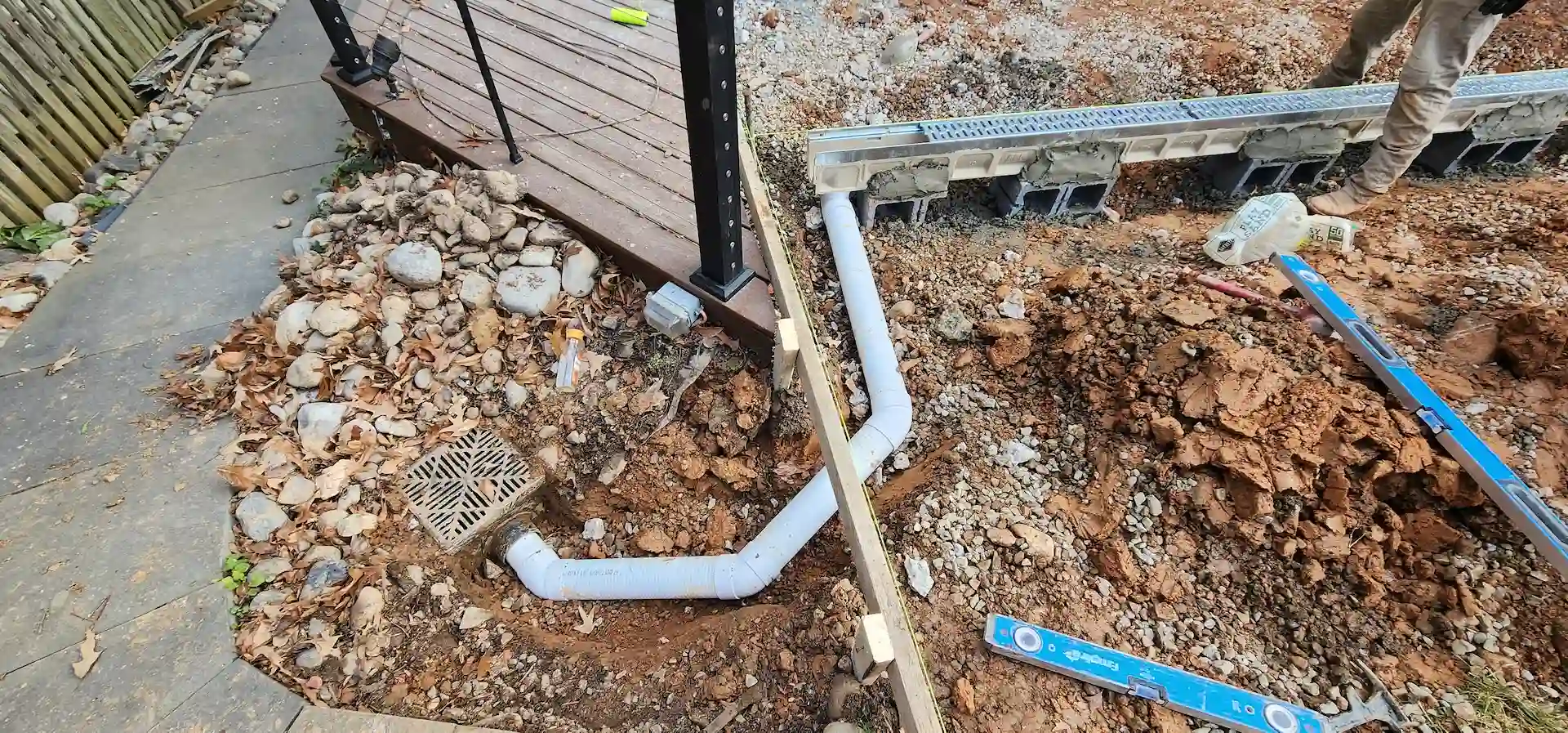
- Surface Catchment & Safe Discharge To manage roof runoff, we hard-pipe downspouts directly into the system using solid (non-perforated) pipe, preventing roof water from saturating the yard. The entire system is then routed to a safe exit—such as a pop-up emitter at the curb, a municipal storm drain, or a subterranean dry well.
3. Material Science: The Tuck Drainage System vs. Builder-Grade
| Specification | The Tuck Engineered System | Standard Landscaper / DIY |
|---|---|---|
| Pipe Material | Rigid, smooth-wall PVC set to a continuous fall. | Thin, crushable single-wall black plastic pipe. |
| Silt Prevention | Geotextile fabric as the soil requires. | No fabric, or cheap woven plastic weed barrier that clogs. |
| Aggregate Core | Cleaned, washed crushed stone (maximum void space). | Unwashed gravel full of dust that turns to mud inside the pipe. |
| Surface Water Catchment | Heavy-duty inline catch basins with removable debris traps. | Tiny surface grates that instantly clog with a single leaf. |
| Discharge Method | Dry wells, pop-up emitters, or storm sewer taps. | Dumping bulk water directly onto the neighbor's property. |
4. The Northern VA Factor: Marine Clay and Tight Lot Lines
Northern Virginia drainage is as much a geology and zoning problem as a plumbing one. Across Lake Ridge, Manassas, Gainesville, Haymarket, Woodbridge, Bristow, and Lorton, the dominant soil is expansive marine clay with a percolation rate near zero. It does not absorb water — it holds it at the surface like a tarp, so the water has to be carried off mechanically. Here deep French drains are often the right tool. They open a subterranean void the water can drop into and drain away through, which is often what it takes to keep the lawn from staying saturated after storms.
In the tighter, high-density areas — Vienna, Clifton, McLean, Fairfax Station, Great Falls, Arlington, and Alexandria — the constraint shifts to lot lines and impervious-surface limits. When a patio or driveway project disturbs 2,500 square feet or more, Arlington and Fairfax County require an approved land-disturbance plan that addresses stormwater; smaller projects still have to drain responsibly, and Virginia law doesn't let you collect roof or yard water and pipe it in a concentrated stream onto a neighbor's lot — drainage designs have to spread, infiltrate, or carry water to an approved outfall. On those lots we build subterranean dry wells: fabric-and-stone-wrapped chambers that store storm surge underground and release it into the soil as conditions allow. That helps hold the water on your own property.
5. What Drives the Cost of Yard Drainage in Northern Virginia
Every drainage system is scoped to the specific water problem on your lot, so the price tracks the scope of the fix. The biggest cost drivers are the linear footage of trenching and how deep we have to dig to intercept the water table, the type of system required (a French drain, catch basins, hard-piped downspouts, or a buried dry well), and the soil itself — near-zero-percolation marine clay in Lake Ridge or Gainesville forces deeper, more involved builds. From there, the number of downspouts and catch basins tied in, the discharge method (pop-up emitter, a permitted storm-sewer tap, or a dry well sized for tight Arlington and Alexandria lots), and any landscape restoration all move the number. We map the system to your property before quoting.
Because every drainage system is scoped to your property, we price each one individually rather than by a flat rate. You'll find our project minimum and a full breakdown of what different budgets cover on our contact page.
See Our Full Pricing Breakdown6. Yard Drainage Engineering FAQ
A French drain is designed to manage subsurface groundwater and relieve hydrostatic pressure. It utilizes a perforated pipe surrounded by gravel to slowly collect water across a large area as the water table rises. A catch basin (often attached to a solid pipe) is designed to rapidly manage bulk surface water, such as the heavy flow pouring out of a gutter downspout or sheeting off a concrete patio.
Gravity is the engine of our drainage systems. Depending on your property's topography and local zoning laws, we route the water to the lowest elevation possible. This usually terminates at a pop-up emitter near the street curb, taps directly into a municipal storm sewer connection (if permitted), or flows into a deep subterranean dry well buried in the yard.
We keep the excavated soil contained while we work. Where practical, we cut and set aside the existing sod before trenching and relay it over the trench; otherwise we backfill and rough-grade, and new seed or sod is a contract line item. The trench line fades as the lawn grows back.
Much of Northern Virginia sits on dense, expansive marine clay with a percolation rate near zero, so it holds water on the surface instead of absorbing it. In these conditions deep French drains are often the right tool because they create subterranean void space for water to enter and evacuate. In tighter, high-density jurisdictions like Arlington and Alexandria, we frequently build subterranean dry wells that store storm surge underground and release it into the soil as conditions allow, helping keep runoff on your own property.
Yes. Roof runoff is one of the biggest sources of yard saturation, so we hard-pipe your downspouts into the system using solid, non-perforated pipe that carries the water away from the foundation rather than dumping it at the base of the wall. From there it ties into the same routed network and discharges at a safe exit such as a pop-up emitter, a permitted storm sewer tap, or a dry well. We can detail this as a standalone buried downspout project or fold it into a full drainage build.
7. Protect Your Property and Reclaim Your Yard
Do not let another wet season turn the backyard into a mud pit or push water against your foundation. From the dense marine clay under Burke and Springfield to the strict stormwater discharge rules in Arlington and Alexandria, Tuck GC has the hands-on building experience — and the licensed engineering partners — to manage it properly rather than mask it — though extreme storms can overwhelm any system (see The Tuck Standard, Section 10). We address the source of the water, not just the symptom on the surface.
Yard drainage is one piece of a fully built site. Explore the rest of our Patios & Hardscapes work, or address water at its source with buried downspouts and hard-surface driveway channel drains. Ready to get the water moving? Contact Tuck GC for a custom drainage plan.