
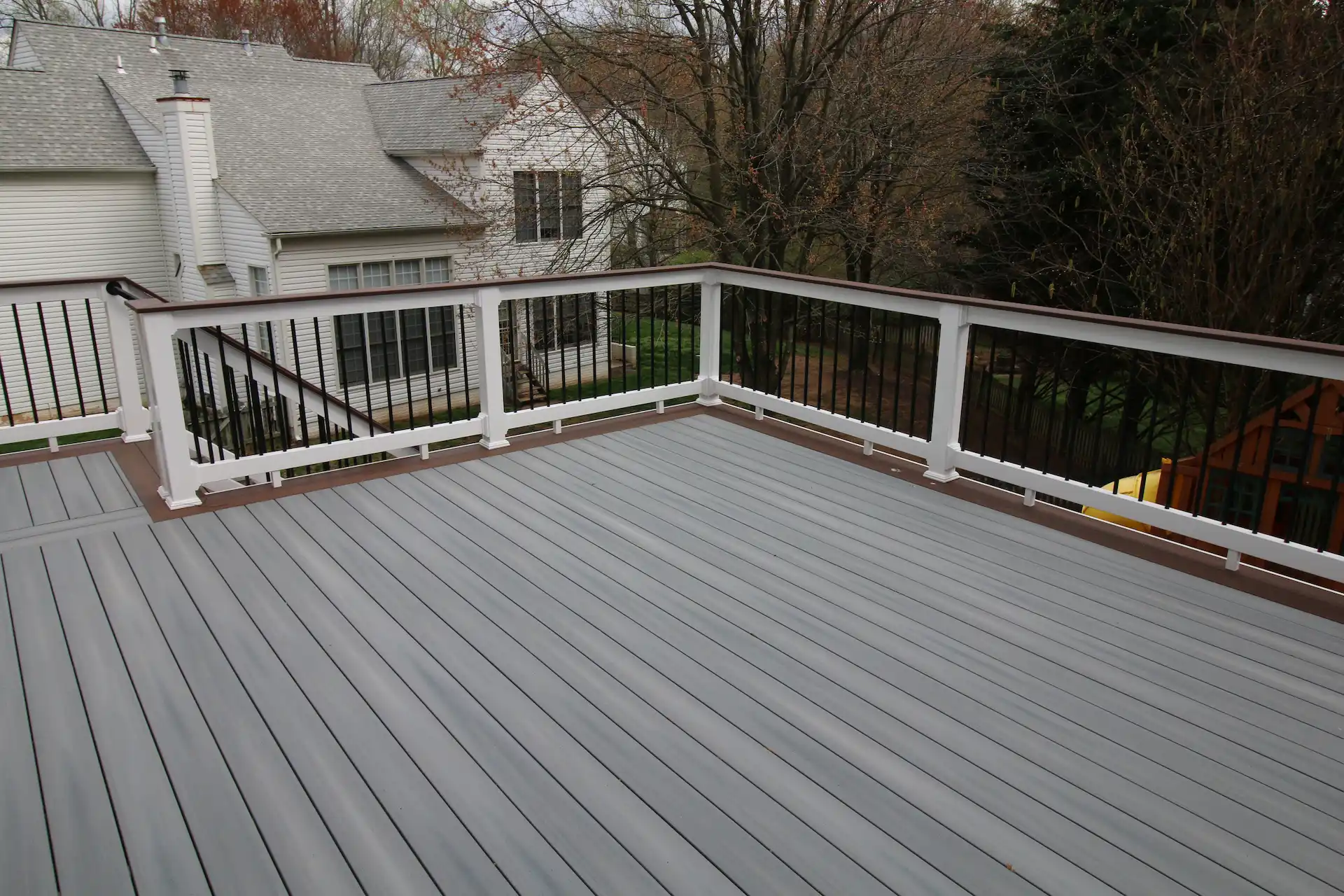
Skip the Sanding and Staining
A composite deck solves the problem pressure-treated lumber creates: pine warps, cracks, and splinters within a few years and demands a yearly cycle of power washing, sanding, and re-staining just to survive the Mid-Atlantic climate. Trex, TimberTech, and AZEK eliminate the sanding-and-staining cycle; upkeep drops to an occasional wash. Each board is a recycled-wood-and-polymer core wrapped in a hard polymer cap (a capped composite) that resists moisture, so the surface resists fading, rot, mold, and insects. Manufacturers back these boards with long limited product warranties on terms they set, which vary by line.
For homeowners in Fairfax, Arlington, Alexandria, Springfield, Burke, and Annandale, the case for a capped board is structural as much as cosmetic. We have seen pine decks in wooded lots near Burke and Clifton degrade to the point of structural failure in under a decade, because the same shade that makes a yard pleasant keeps the wood damp, and that constant moisture plus summer UV is exactly what rots an organic surface. Removing the organic material from the wear surface stops the decay cycle where it starts.
Composite is less forgiving to install than wood, not more. The boards are heavier, more flexible, and expand and contract with temperature far more than lumber does, so the frame underneath has to be built to tighter tolerances or the surface telegraphs every flaw. At Tuck GC we pair the material's requirements with disciplined framing: joist spacing set to the decking manufacturer's span table, joist tape as your contract specifies, and a ledger attached and flashed to the approved plans and the county's deck details. When a build calls for an engineered framing connection, an elevated structure, or a composite-deck framing detail that needs a stamp, we coordinate the project with a licensed structural engineering firm so the framing follows a PE-stamped design for county review. With 20+ years of hands-on experience, we frame the substructure to the decking manufacturer's installation requirements, not just to pass the minimum.
1. The Diagnostic: Why Standard Decks Fail with Composite
The most common and costly mistake is laying premium composite boards over a frame that was sized for wood. Builder-grade frames often run joists 16 inches on center, sometimes 24. Composite is more flexible than lumber, so over that span the boards deflect — they sag between joists in summer heat, giving the surface a wavy feel underfoot that holds water and reads as cheap regardless of how good the decking is. The board is only as flat as the frame beneath it.
The second failure is fastening. Face-screwing a composite board the way you would cheap lumber punches through the polymer cap, opening the core to moisture and voiding the warranty at every hole. As the board moves with temperature, those screw heads "mushroom" — the cap material lifts around them into raised edges you feel through a bare foot. A composite deck has to be built with tighter joist spacing, concealed fasteners that grip the board's grooved edge, and wrapped framing if it is going to stay truly low-maintenance.
The most dangerous failure is invisible: the ledger board, where the deck attaches to the house. A deck that pulls off the wall almost always fails at the ledger. Fast crews lean on a few lag bolts and skip the flashing, and those fasteners corrode quickly against the copper-azole preservatives in modern treated lumber. Once water gets behind an unflashed ledger — a frequent find on older decks around Manassas, Woodbridge, and Lorton — it rots the home's rim joist from inside the wall, where no one sees it until the deck moves. On a replacement or resurfacing we look over the exposed ledger and its flashing before any composite goes down; issues we find are shown to you and priced by Change Order, and a new ledger is attached and flashed to the approved plans and the county's deck details.
2. The Tuck Standard Protocol: Building for Composite
We build decks with a structural mindset, and every step below exists to protect the decking and the home it attaches to. This is the protocol:
- Joist Spacing & Frost-Depth Footings To stop composite deflection, we set joist spacing to the decking manufacturer's span table, often tighter than the 16-inch standard most wood decks use. Tighter spacing shortens the unsupported span, which is what keeps a flexible composite board from sagging between joists and gives the surface a flat, solid plane. Below grade, we set concrete footings beneath the Northern Virginia frost line — the published minimum here (Fairfax and Loudoun) is 24 inches below grade, and we set footings to the depth and size the approved plans and soil conditions call for — so seasonal freeze-thaw is far less likely to heave a post and rack the frame. Helical piers are used where the design calls for them.
- Hidden Fasteners & Sealed Joists Field boards are typically installed with the manufacturer's hidden-fastener system: color-matched clips slot into the board's grooved edge, leaving a screw-free walking surface and — just as important — leaving room for the board to expand and contract along the joist with temperature instead of buckling against a fixed screw. Before the decking goes on, butyl joist tape goes across the tops of the pressure-treated joists as your contract specifies. That self-sealing strip helps keep water from sitting on the wood at the fastener line, which is where framing usually starts to rot.
- PVC-Wrapped Posts, Beams & Fascia A low-maintenance surface over exposed, graying support posts isn't low-maintenance. We wrap the visible pressure-treated framing — posts, beam faces, and the perimeter fascia — in cellular PVC trim (AZEK), so no raw lumber is left exposed to stain or rot. Seams are mitered and bonded with PVC cement to keep water from tracking behind the trim, and the result reads as clean architectural trim rather than wrapped lumber. Wrapped PVC trim is caulked and painted at install where your contract calls for it (factory-finished post and railing sleeves aren't painted); after that, caulk and paint touch-ups as the material flexes and shrinks are the homeowner's upkeep (see The Tuck Standard, Section 9B).
- Architectural Aluminum Railing Systems We replace wood balusters with powder-coated aluminum railing systems that resist corrosion, don't rot, and skip the paint-and-stain cycle, and whose slim profile keeps the sightline to the yard open. Post connections are built to the railing manufacturer's details and the county's deck details so the rail meets the IRC's 200-pound concentrated load requirement, applied in any direction at the top rail.
- Low-Voltage LED Lighting We design low-voltage LED lighting into the build: flush riser lights on the stair treads for safe footing after dark, and post-cap or under-rail lights for ambient glow instead of a harsh floodlight. The licensed electrical trades we coordinate run the wiring concealed inside the PVC wrapping back to a transformer, so the lighting is part of the structure rather than an add-on stapled to it later.
3. Material Science: The Tuck Composite Deck vs. Builder-Grade Wood
| Specification | The Tuck Composite System | Standard Pressure-Treated Wood |
|---|---|---|
| Decking Surface | Capped composite (Trex/TimberTech); manufacturer-rated to resist fading and staining. | Pine; cracks, splinters, and requires bi-annual staining. |
| Joist Spacing | Set to the decking manufacturer's span table, often tighter than 16 inches, for a firm, low-deflection surface. | 16 to 24-inches on center; leads to wavy, bouncy floors. |
| Fastening Method | Manufacturer's hidden-fastener system on the field boards. | Face-screwed or nailed; screws pop up causing trip hazards. |
| Structural Wrapping | Cellular PVC fascia and post wrapping — caulked and painted where your contract calls for it; touch-ups as the material flexes and shrinks are the homeowner's upkeep (see The Tuck Standard, Section 9B). | Exposed lumber that rots and requires constant painting. |
| Railing Systems | Powder-coated architectural aluminum. | Chunky wood balusters that warp and block the view. |
A pressure-treated pine deck costs less upfront, but the lifetime cost is where the comparison turns. Wood demands recurring outlays — roughly every other year of power washing, scraping, stripping, and re-staining, in labor and materials, for as long as you own it. A capped composite system front-loads that spend into the build and then largely stops asking for it, which is also why it tends to hold value at resale rather than show up as deferred maintenance on an inspection report.
4. The Northern VA Factor: HOA Approvals and Climate Resilience
A deck in Northern Virginia has to clear two separate reviews: the county building permit and, in many neighborhoods, an HOA Architectural Review Board. The two are not the same and run on different clocks — the building permit involves county-reviewed structural plans and footing and framing inspections and can take weeks, so no honest builder promises a fast permit. The ARB is where material choice matters most. In communities around Fairfax Station, Vienna, and Clifton, boards often reject plain pressure-treated wood for replacements and expect materials that hold their look over time. A capped composite surface with PVC-wrapped posts and aluminum rail is built to meet that standard, and while HOA approval is the homeowner's application, we support it with the renderings, material cut-sheets and specs the board asks for (a plat of survey, if needed, is an outside cost).
The climate is the other half of the argument. Summer humidity and winter freeze-thaw are hard on an organic deck surface, and that is worse on lots that back to tree lines or retention ponds around Lake Ridge and Woodbridge, where the wood stays damp longer and rot and mold get a head start. A capped composite board resists that moisture; it sheds water and rinses clean with a hose. The framing has to adapt to the site, not just the climate: tight-access lots and impervious-surface limits in Arlington and Alexandria, marine-clay subsoils that hold water around Springfield and Annandale, or a steep drop-off that puts real lateral load on the posts. Where the soil or the elevation drives the structural design, we coordinate a licensed PE to size the footings and connections to that specific lot.
5. What Drives the Cost of a Composite Deck in Fairfax & Arlington
No two composite decks price the same, and the real cost drivers are structural, not cosmetic. The largest are the deck's footprint in square feet and how high it sits off the ground — an elevated deck needs taller posts, deeper and larger footings, and a full code-compliant stair run, all of which add material and labor faster than the floor area alone suggests. After that: the decking and railing lines you choose, since a premium capped board with architectural aluminum rail runs above an entry-grade composite; demolition and haul-off of an existing rotting deck; the building permit and county-reviewed structural plans; and site access on a tight Arlington or Alexandria lot where material has to be carried rather than staged at the build. Custom work — a cocktail rail, integrated LED lighting, PVC-wrapped posts, or footings pre-sized so the deck can carry a future screen porch — adds to the scope as well. Because every one of those is property-specific, we price each deck individually instead of quoting a per-square-foot number that wouldn't hold up on a real lot.
Because every deck is scoped to your property, we price each one individually rather than by a flat rate. You'll find our project minimum and a full breakdown of what different budgets cover on our contact page.
See Our Full Pricing Breakdown6. Composite Decking FAQ
Early composites did run hot. Today's capped lines use heat-mitigating caps, and lighter colors reflect more sunlight, so they stay noticeably cooler than the dark solid-plastic boards that gave composite its old reputation. Any deck in direct Virginia sun gets warm, but color choice is the real lever: pick a lighter tone for a south- or west-facing deck and the surface stays comfortable underfoot.
We call this a "deck resurfacing," and yes, it is possible—but only if the underlying structure is sound. We look over the existing footers, posts, joists, and ledger; anything we find is shown to you and priced by Change Order. If the pressure-treated frame is sound and meets current code, we can add joist tape to protect the wood, set the joist spacing to the decking manufacturer's span table, and install the new composite surface.
Yes. In Fairfax, Prince William, Arlington, and Alexandria, a deck attached to the house — and in practice virtually any freestanding deck — requires a building permit, structural plans, and county inspections of the footings and framing. Plan review is its own step and can run several weeks, so we don't promise an instant permit; the 1-to-3-day timelines you see refer to install, not approval. Tuck GC pulls the permits and schedules the inspections for our scope of work, and we build to the standard the county inspector checks.
At the ledger, which is where a deck that pulls away from the wall almost always fails. Instead of relying on a few lag bolts and no flashing, we attach and flash the ledger to the approved plans and the county's deck details, so water is directed away from the band joist rather than left to soak into it — the hidden rim-joist rot that takes down many older decks. On an existing house, framing issues we find at the ledger are shown to you and priced by Change Order.
We install premium capped composite and PVC decking systems from leading manufacturers, including Trex and TimberTech, paired with cellular PVC trim for the fascia and post wrapping. We help you select the line and color that best fits your home, your HOA's requirements, and your budget, then build it on a fortified sub-structure installed to the manufacturer's published installation requirements; we hand off the product information at completion so you can register the warranty with the manufacturer.
7. Secure Your Low-Maintenance Weekend
The point of a composite deck is to get the weekends back — to use the space instead of power-washing and staining it. Explore our full range of decks and porches, or pair the build with a shade-giving pergola or pavilion. From multi-tiered platforms in McLean to composite resurfacings in Woodbridge, the work is the same underneath: a frame built to the decking manufacturer's installation requirements. A deck is structural, and it attaches to your house — that is the part to hand to a Class A licensed contractor rather than the lowest handyman bid. Tuck GC backs the workmanship with a one-year warranty on top of the manufacturer's coverage for the decking.