
The Facelift Your Home Needs
Stone veneer is a thin masonry skin — real stone or cast concrete — bonded to your home's exterior wall over metal lath and a mortar scratch coat, with a weather barrier where the wall is wood sheathing. It delivers the look and texture of solid stone at a fraction of the weight and cost, which is why it has replaced full-bed masonry on nearly every facade, water table, and chimney built in the last forty years. Our dedicated trade crews and specialized trade partners, under Tuck GC's direct management, install it across the structural envelope of the house: front facades, architectural water tables, foundation wrapping, and chimney refacing.
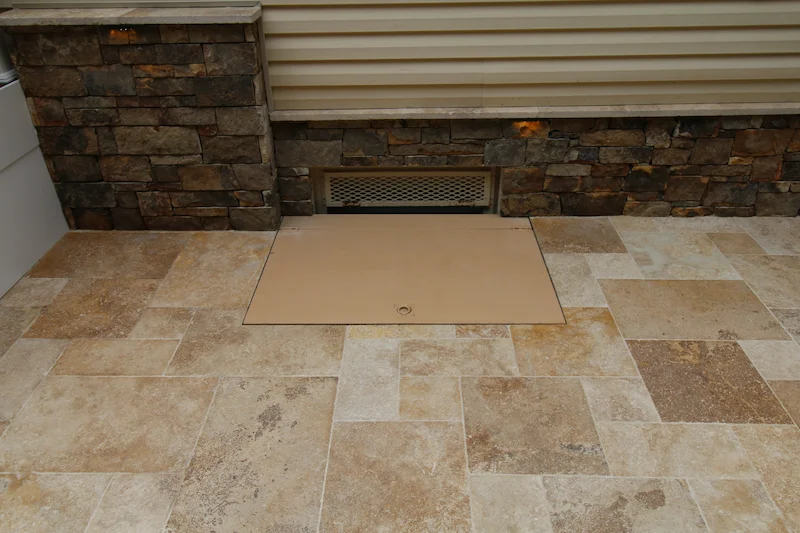
In the premium markets of McLean, Great Falls, and Fairfax Station, flat vinyl or hardboard siding rarely matches the lot it sits on. A stone "water table" — a veneer wrap covering the lower third of the exterior — visually anchors the house to the ground and adds the texture and depth a tall, blank wall lacks. Run that same stone into a flagstone patio or driveway apron and the masonry reads as one continuous, deliberate detail across the property.
1. The Diagnostic: How Stone Veneer Fails
Many tract homes across Loudoun and Prince William County were built with panelized faux-stone siding — plastic or high-density foam molded to look like stone and screwed directly to the wall. Over a few Virginia summers the UV-exposed panels fade to an unnatural purple or gray, and the caulk joints separate. Once water gets past those joints, it has nowhere to drain: it sits in the wall cavity and rots the OSB sheathing behind it.
Real stone veneer fails for a different reason — a skipped moisture barrier. Stone and mortar are porous, so water will reach the wall behind them by design; the system only works if there's a drainage plane to carry that water back out. When an installer laths and mortars straight over bare sheathing, trapped water freezes in our winter cycles and the expansion shears the stone off the wall in sheets. Most of the failed facades we tear off and rebuild in Fairfax and Arlington failed at the same point: the wall was never built to weep.
2. The Tuck Standard Protocol: Architectural Veneer Application
Hanging hundreds of pounds of stone on a vertical wall only works if the layers behind it are built in the right order. Each step below exists to keep water moving away from the wall and the stone mechanically keyed to it.
- Surface Demolition & Substrate Inspection We strip the work area — vinyl siding, rotting T1-11, or failing faux stone — down to the substrate, whether that is concrete, block, or OSB or plywood sheathing. If we find rot or damage once it's exposed, we show you and price the repair by Change Order before closing it in, because stone hides nothing it's laid over.
- Metal Lath on Concrete & Masonry On concrete or masonry surfaces — our usual case — we install the veneer over metal lath. The lath gives the mortar a mechanical key so the stone is anchored to the wall, not just glued to the surface.
- Weather Barrier on Wood Sheathing Because the finished masonry will let water through, a wood-framed wall behind it has to be protected. On wood or plywood sheathing, we follow the county's requirements for the wall assembly, which normally include a weather barrier, so moisture that reaches the back of the stone isn't left soaking the wood. This is the layer most failed installs skip.
- Scratch Coat & Stone Setting The masonry crew trowels a Type-S mortar scratch coat over the lath, forcing it through the diamond grid for a full mechanical bond, then score it and let it cure. We hand-set each stone into a fresh mortar bed. Whether the look is tight dry-stacked Ledgestone or a heavily jointed historic fieldstone, we run true 90-degree corner units so edges read as solid stone, not glued-on tile.
- Watertable Cap & Flashing Transition Where the stone water table meets the siding above, we set a continuous stone sill cap, with flashing at that transition as the county's requirements call for, so rain is shed off the ledge rather than driven in behind the stone.
3. Material Science: Natural vs. Manufactured Stone
| Stone Category | Composition & Weight | Aesthetic Profile | Ideal Application |
|---|---|---|---|
| Natural Thin Stone Veneer | Real quarried stone sawn to roughly 1 inch thick. Heaviest of the three. | Authentic depth, true color variation, irregular natural shapes no mold repeats. | High-end front facades, chimney refacing, complementing existing flagstone or fieldstone. |
| Manufactured Stone (Cultured) | Cast concrete, molded and pigmented. Lighter, less load. | Consistent color and sizing; clean, repeatable joints across a large run. | Coordinating with a subdivision palette, long continuous water tables, controlled budgets. |
| Clay Brick Veneer | Fired clay brick cut thin (Glen-Gery and similar). | Classic colonial or historic industrial brick face. | Historic Alexandria restorations, traditional home accents. |
4. The Northern VA Factor: HOA Compliance and Chimneys
Altering a front facade in governed communities like Gainesville, Bristow, and Ashburn usually means Architectural Review Board (ARB) approval before any stone goes up, and the board wants the new work to read as part of the original design. Because manufactured-stone lines (Techo-Bloc, Boral, Eldorado, and similar) come in defined profiles and color blends, we can often identify the mold and color blend the builder used and order the same product line, documented for the submittal. Even the same product varies run to run, and new stone reads newer than weathered originals until it blends over seasons — but ordering from the same product line is what turns a small builder accent into a full-house water table a review board will approve.
Chimney refacing drives steady demand in older neighborhoods in Burke and Springfield. Builder-grade brick chimneys from the 1980s often spall — the brick face flakes off as absorbed water freezes and expands in our winters. Rather than demolish the stack, we strip the failing brick and re-face the structure in stone veneer, which resets the chimney's look with a new face. The roofline flashing where the chimney meets the shingles is the most common chimney leak point; if it needs replacing, that roofing work is scoped separately in your proposal.
5. What Drives the Cost of Stone Veneer in McLean & Alexandria
Stone veneer is priced by the wall, not by a flat per-foot rate. The real cost drivers are the square footage of facade or chimney being wrapped; the material — natural thin stone carries a higher material cost than manufactured/cultured stone, and 90-degree corner units cost more per piece than flats and add up on a wall with many corners; the condition of the existing wall, since rotted sheathing or failing faux stone that has to be torn off and replaced adds demolition and carpentry labor before any stone is set; the amount of weather-barrier, lath, and flashing the envelope requires; the access and height, since a two-story chimney needs staging a single ground-level water table does not; and any HOA or architectural-review approval common in McLean and Alexandria. Brand selection — Techo-Bloc, Boral, Eldorado, or natural quarried stone — moves the number as well.
Because every facade is scoped to your elevation, wall condition, and the stone you choose, we price each one individually rather than by a flat per-square-foot rate. You'll find our project minimum and a full breakdown of what different budgets cover on our contact page.
See Our Full Pricing Breakdown6. Stone Veneer FAQ
Yes, this is an excellent indoor application. If your interior fireplace is outdated, dark red brick, we can apply a cement backer board or wire lath directly over the existing masonry and re-face it floor-to-ceiling with modern, bright Ledgestone or clean cut stone, entirely transforming your living room.
Typically not. Both natural thin stone veneer (sawn to about 1 inch thick) and cultured stone are made to be installed on standard wall construction, within the wall's and the veneer manufacturer's limits. Unlike full-bed building stone — which is 4 to 6 inches thick and needs a poured concrete foundation ledge to carry its weight — thin veneer is adhered over lath and a scratch coat, spreading its load across the wall; we confirm the wall and the product's limits before we build.
Generally, no. High-quality stone veneer is designed to withstand the elements without chemical sealants. In fact, sealing stone can sometimes trap moisture inside the wall. The only exception is in highly shaded, damp areas (like deep woods in Clifton) where some owners choose to apply a breathable siloxane sealer themselves to discourage moss or algae growth; that's the owner's option, not part of our install.
Whether thin-veneer work needs a permit depends on the scope and your building official — straight re-cladding of a house can be exempt, while new masonry veneer, work in a historic district, or anything touching structure usually needs a permit and inspection. We confirm with your county or city and pull it when required. If a project also touches a load-bearing element, we coordinate a licensed Virginia Professional Engineer (PE) for PE-stamped drawings and build to the stamped design.
Natural thin stone veneer is real quarried stone sawn to roughly 1 inch thick, prized for deep color variation and authentic texture on facades and chimneys. Clay brick veneer is fired-clay brick cut thin for a classic colonial or historic look, and we install Glen-Gery clay brick veneer for traditional Alexandria-style accents. Both are installed over lath and a scratch coat (with a weather barrier on wood sheathing, per the county's requirements); the choice is driven by the architectural style you want.
7. Anchor Your Home in Stone
A facade carries the first impression of the whole property, and flat, fading siding undersells it. From wrapping entryway columns in Vienna to full-facade natural stone work in Arlington, Tuck GC installs stone veneer as part of a complete architectural masonry envelope — built on the lath, weather-barrier and flashing details the substrate and the county's requirements call for, not just looking right on day one.
Stone veneer is one piece of a complete masonry envelope. If your project is concentrated below grade, see our dedicated foundation veneer work for wrapping exposed block and crawl-space walls, and explore matching brick & stone stoops to tie your entry steps into the same stone palette. Have questions about your facade? Request a consultation and we will walk the property with you.