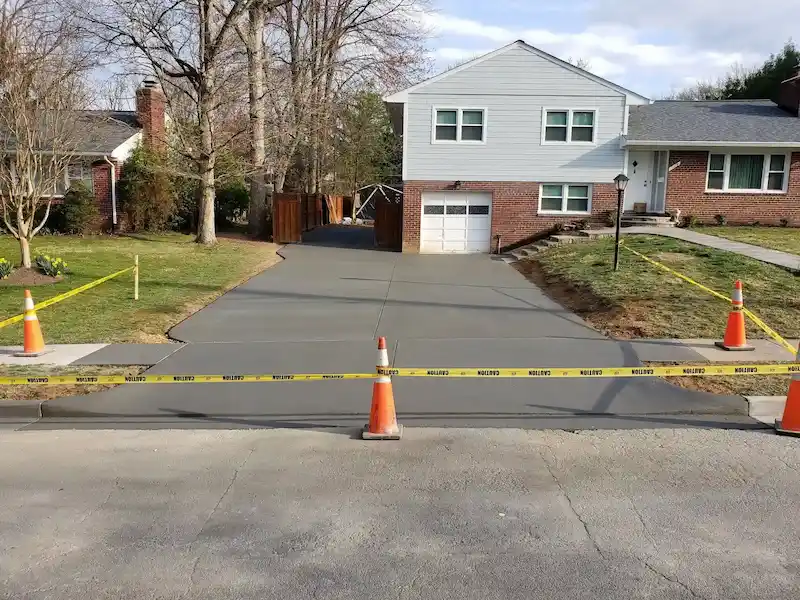
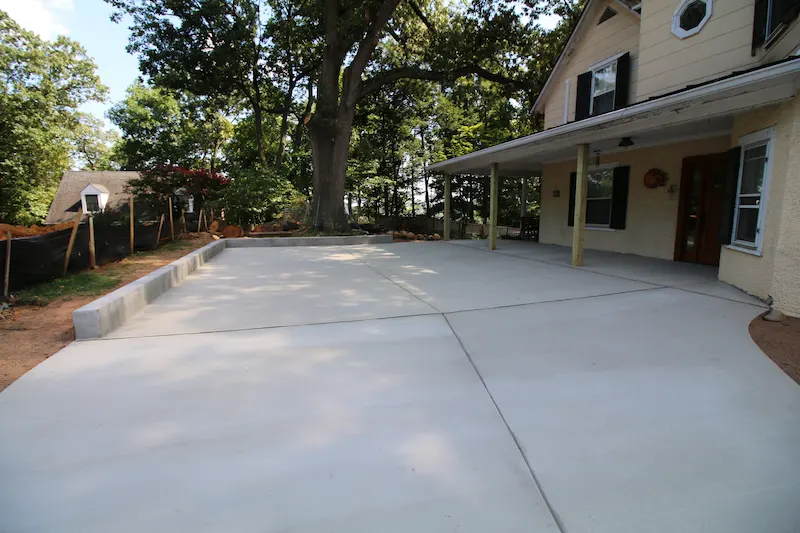
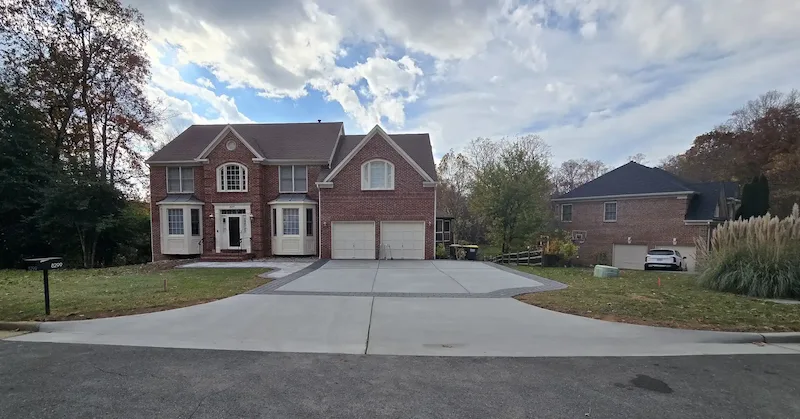
Concrete Driveway Replacement, Widening & Design-Build in Fairfax, Arlington & Alexandria
Tuck GC is a Class A general contractor that designs, permits, and pours concrete driveways across Northern Virginia — from a straightforward structural replacement to a triple-wide estate entrance with a VDOT apron and built-in drainage. What gives a driveway its best chance at a long service life isn't the concrete; it's the site work underneath it and the dedicated trade crews standing behind it — the part most contractors skip, and the part we're built around.
In Northern Virginia, a driveway is not just a place to park; it is the "Red Carpet" to your home. If you are searching for the cheapest "remove and replace" job, we might not be the right fit. There are plenty of guys with a pickup truck who can pour concrete for $6,000.
Tuck GC is a Design-Build Firm. We specialize in complex driveway projects that require grading, drainage correction, and aesthetic integration. We don't just pour concrete; we frame your home with borders, aprons, and walkways that increase property value.
The real difference, though, is accountability. A handyman with a mixer is gone the moment a slab cracks; a licensed Class A General Contractor is not. With Tuck GC you get genuine single-point accountability — one firm owns the permits, the grading, and the final pour, and coordinates the project's licensed engineer when one is required, so there is never a subcontractor blame-game on a six-figure investment.
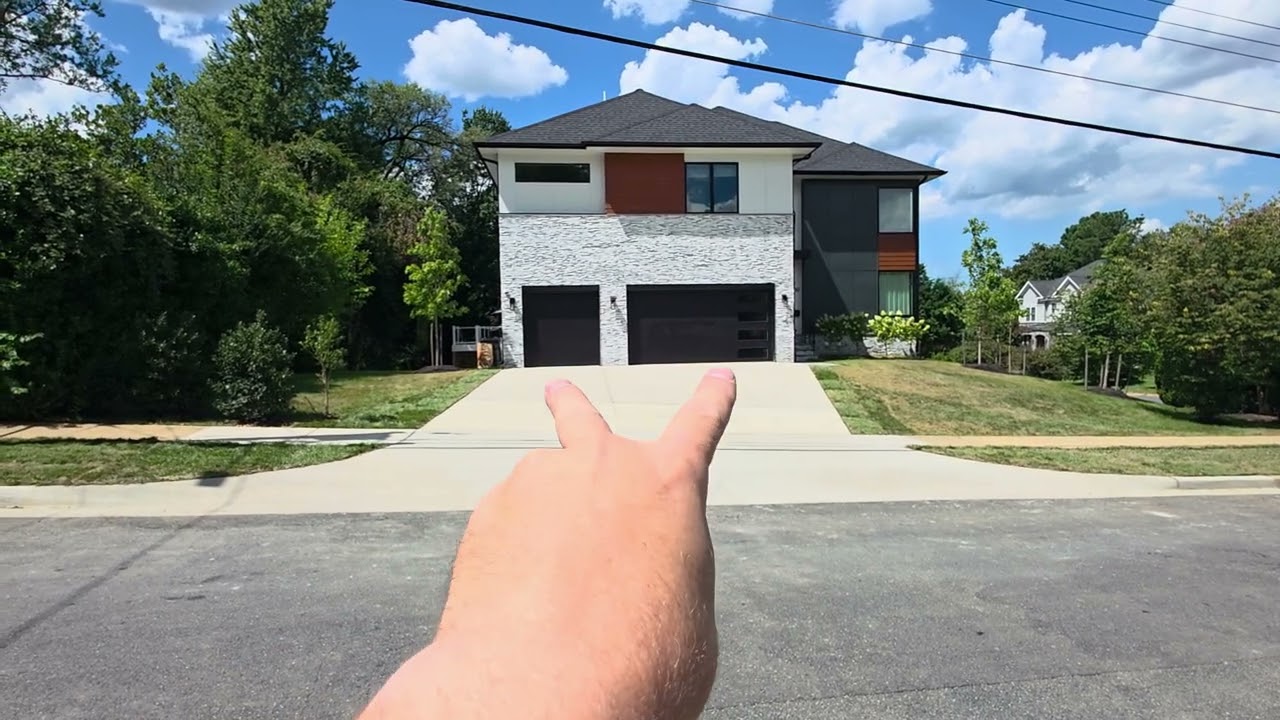
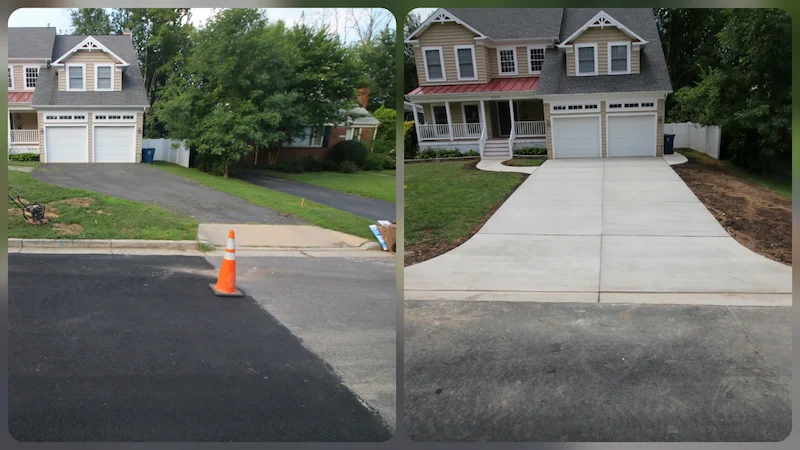
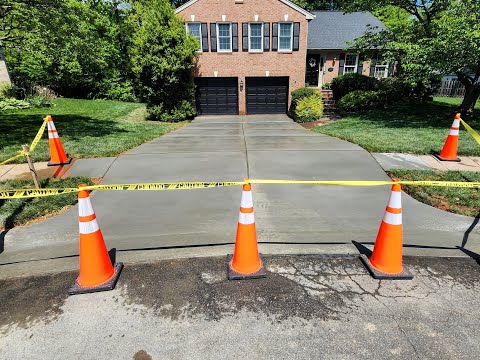
Case Study: A McLean Estate
The McLean Estate: Correcting Builder Mistakes with a Triple-Wide Expansion & Geometric Alignment.
Phase 1: Builder Mistakes & Spalling
- The Problem: The owner of this multi-million dollar estate in McLean, Virginia had a gorgeous three-car garage, but the original builder choked the entrance with a misaligned, skinny 10-foot apron. Worse, after just one year, the builder-grade driveway was experiencing "spalling" (surface flaking).
- The Initial Ask: The client originally called hoping to simply patch the bottom of the driveway and widen the street entrance.
Phase 2: The Grading Trap
- The Reality: With 20+ years of hands-on experience building these systems, we identified a massive grading issue. The elevation dropped off significantly from the existing driveway down to the street.
- The Verdict: A cheap patch was not workable. To make slopes match, we would have had to cut half the driveway back to a control joint and force an unnatural grade toward the street. We advised a full structural tear-out to replace the entire system the right way.
Phase 3: The Triple-Wide Expansion & Alignment
- Squaring the Geometry: The house did not sit perfectly square with the street. Instead of squaring the new driveway to the road (which would force an awkward curve), we squared the concrete directly to the house, providing a straight-shot exit from the garages.
- Adding Parking Space: We executed a massive driveway expansion, pouring a true triple-wide concrete footprint. Now, all three vehicles can pull in and out simultaneously without ever shuffling cars.
The Tuck Standard: The Maximum VDOT Entrance
To support this massive driveway widening, we needed an entrance that could handle the traffic. We successfully pulled the VDOT permits to build the entrance at the full 24-foot width — the maximum VDOT's standard private-entrance detail allows without a special exception. We constructed a commercial-grade CG-9D concrete apron measuring 24 feet wide with sweeping 10-foot radius wings. This completely transformed the property from a choked, barely-usable driveway into a grand, accessible estate entrance that perfectly matches the scale of the home.
Planning a transformation like the McLean estate? Request your design-build consultation →
Engineering the Pour: Two Tiers of Strength
We match the build spec to the use case. We offer two distinct structural packages based on your vehicle load requirements.
1. The Tuck Residential Standard
Ideal For: Standard SUVs, Sedans, and Daily Use.
This is the "Gold Standard" for residential replacement. Our standard mix exceeds the residential code minimum for weather-exposed slabs, for a smooth, durable surface that handles Northern Virginia winters.
- Concrete Strength: 4000 PSI Air-Entrained (the industry-standard mix for freeze-thaw climates; spalling is addressed in The Tuck Standard, Section 5).
- Reinforcement: 6x6 Welded Wire Mesh (pulled up into the center of the slab during the pour).
- Base Layer: About 8 inches of excavation and about 4 inches of compacted #21A crushed stone.
- Finish: Slip-resistant Broom Finish for safety.
2. The Heavy-Duty Upgrade
Ideal For: Heavier loads.
Thicker sections and rebar are available for heavier loads on a case-by-case basis — we step up to a 6-inch slab with a #4 rebar grid, or build to an engineer's design where the load calls for it. RVs, dumpsters and moving vans are excluded under The Tuck Standard, Section 6C.
- Increased Depth: 6 Inches thick (vs standard 4").
- Advanced Reinforcement: #4 Steel Rebar Grid replacing standard mesh, with the thickened slab (case by case, or per the engineer's design).
Concrete vs. Asphalt vs. Pavers: Choosing the Right Driveway
Most homeowners weigh three surfaces. Here's the honest tradeoff, built around Northern Virginia's freeze-thaw winters and expansive clay soil.
Poured Concrete
The long-game choice. A properly built concrete driveway is typically the longest-lived, lowest-upkeep of the three surfaces — no sealcoating cycle — does not rut under everyday passenger-vehicle traffic, and gives the cleanest canvas for borders and custom finishes. The tradeoffs are a higher upfront cost and a short cure window before you can drive on it.
Asphalt
The lowest upfront cost, which is its whole appeal. But it's a maintenance commitment: sealcoating every two to three years, softening in summer heat, and resurfacing or replacement much sooner than concrete — service life depends on the base, drainage, and maintenance. For many clients, converting asphalt to concrete ends that cycle for good.
Interlocking Pavers
The premium aesthetic. Techo-Bloc and Belgard pavers are set in mortar on a concrete base as our standard build, individual units can be cut out and re-set for repairs (repairs will read differently at first), and permeable systems can help with drainage and stormwater. The tradeoffs are the highest install cost and occasional joint-sand upkeep.
Concrete Finishes We Pour
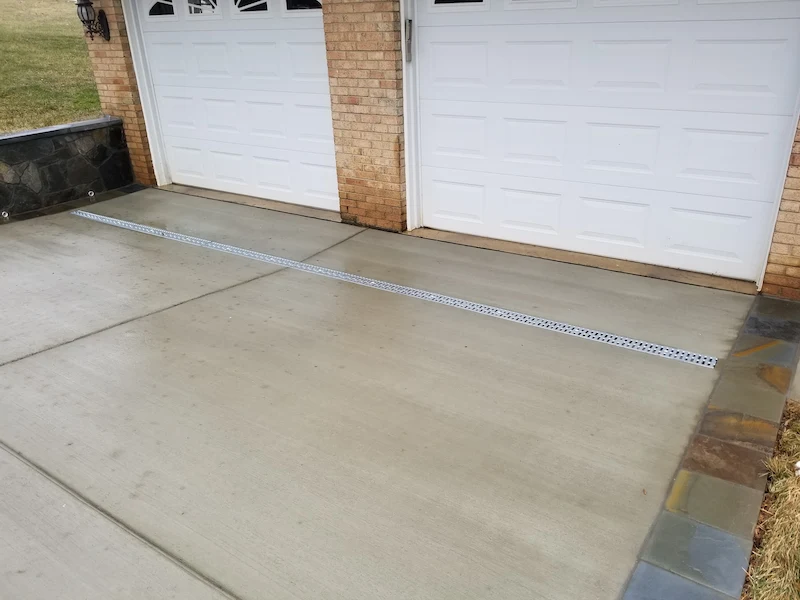
Concrete doesn't have to mean a plain gray slab. Our standard is a slip-resistant broom finish; as options, we pour exposed aggregate for a textured surface and integral color to soften the gray, and we plan the control-joint layout as a deliberate design grid. Control joints are tooled (or saw-cut) at intervals set by the slab layout. Where a new slab meets any existing (cold) slab we isolate it with an expansion joint, and if a plant delay keeps the next truck from arriving before the first batch sets, we install an expansion joint at that cold joint (see The Tuck Standard, Section 6F). Many homeowners pair any of these with a Techo-Bloc or Belgard paver border for the framed, finished look.
Complete Concrete Driveway Services in Northern VA
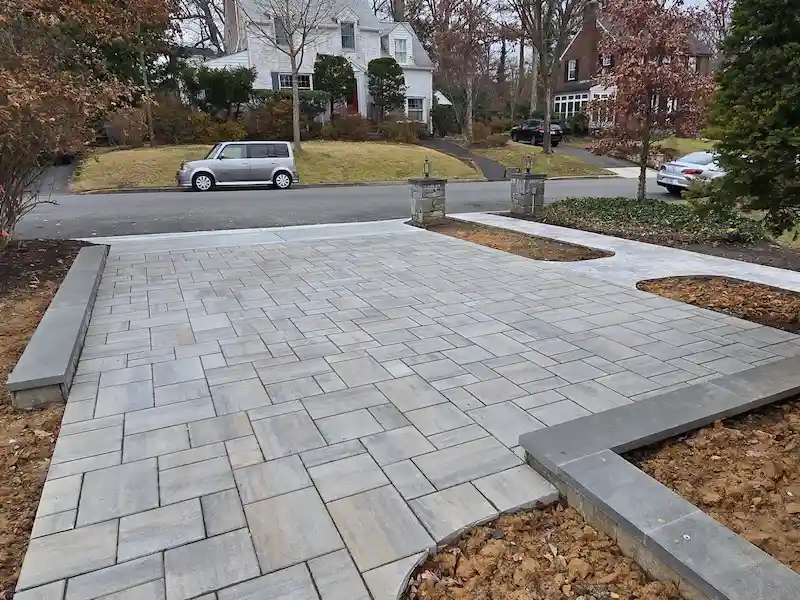
Paver Borders on a Concrete Driveway
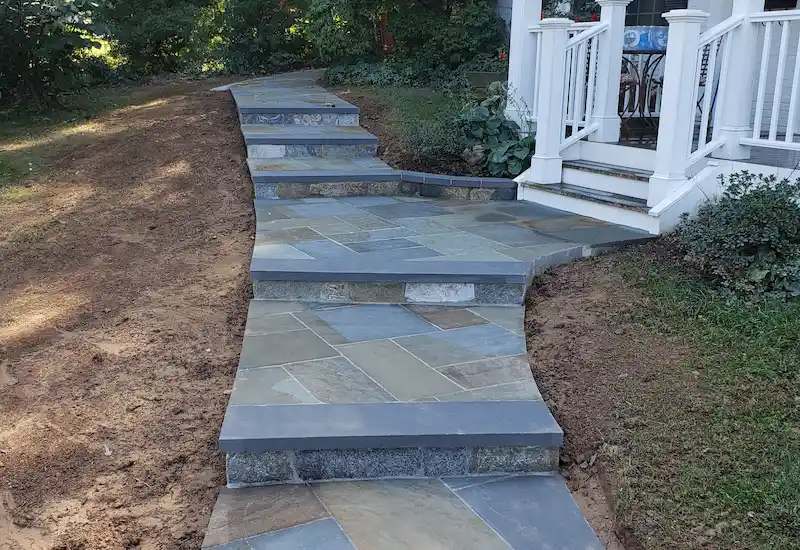
A masonry border has long been a favorite way to frame a luxury driveway in Alexandria and McLean — it gives a poured slab a finished, custom edge.
Concrete and masonry move at different rates, so hairline cracks in mortar joints over time are a normal part of any mortared work (The Tuck Standard, Section 8C).
How We Build It: A concrete edging with the border pavers wet-set in mortar.
- Modern Aesthetic: We use Techo-Bloc or Belgard pavers that mimic slate or granite, offering a cleaner look than dated red brick.
- Upkeep: Like all mortar work, the joints need periodic maintenance over the years.
Why Driveways Fail in Northern Virginia: The "Site Work" Secret
If you drive through neighborhoods in Burke, Springfield, or Fairfax Station, you will see cracked driveways everywhere. The culprit is rarely the concrete itself; it is the soil underneath.
Our region sits on "Marine Clay," a highly expansive soil that swells when wet and shrinks when dry. When a "budget contractor" pours concrete directly over this clay (or over a thin dusting of gravel), the ground moves, and the concrete snaps.
The Tuck GC Excavation Protocol
We approach driveway replacement as site work first. We remove the old driveway and the soft, disturbed soil directly beneath it: our standard 4-inch driveway gets about 8 inches of excavation and about 4 inches of compacted #21A crushed stone. Unsuitable soil found during excavation is removed and replaced by Change Order. The compacted stone gives the slab a stable platform and helps water drain away from it; a compacted stone base reduces, but cannot eliminate, the effects of clay movement (The Tuck Standard, Section 5F).
This "invisible" work costs more in labor and dump fees, but it is the base that gives a driveway its best chance at a long service life, instead of one that fails early.
Zoning & Lot Coverage Limits
In Arlington County and the City of Alexandria, you cannot simply pave over your entire front yard. Arlington caps lot coverage, and Alexandria limits paving through its open-space and floor-area rules. Exceeding these limits can result in a code violation and forced removal.
We specialize in maximizing your parking footprint within the legal limits. We perform the coverage calculations before we dig. In Arlington a widened driveway counts toward lot coverage whatever the surface, so we run the coverage math first and size the widening to what your lot has left. A permeable surface can still help with drainage and stormwater, but it does not raise the zoning cap. If your lot is at or near its limit, the options are reducing other counted coverage on the lot or seeking a variance. We confirm the coverage numbers before we quote.
What Drives the Cost of a Concrete Driveway in Fairfax & Northern Virginia
A concrete driveway is priced by scope, not by a flat per-foot rate. The factors that move your number most are square footage, demolition and haul-off of the old surface, sub-base repair over Northern Virginia's expansive Marine Clay, the thickness and PSI of the pour, and any apron or permit work in the public right-of-way. A simple remove-and-replace sits at the entry point (the majority of flatwork pours take 1 to 2 days on site, weather permitting); a wide, multi-day system with borders, drainage, or a new municipal apron sits well above it.
Because every project is scoped to your property, we price each one individually rather than by a flat rate. You'll find our project minimum and a full breakdown of what different budgets cover on our contact page.
See Our Full Pricing Breakdown
Real Northern Virginia Installations
No stock photos. Just real Northern Virginia projects.
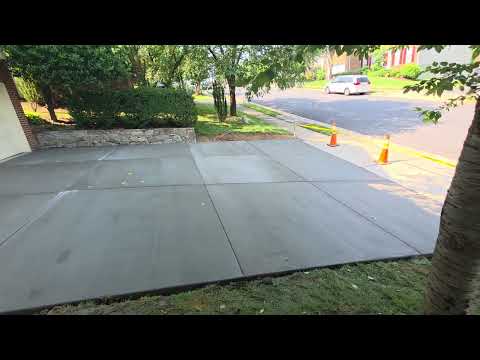
Project Walkthrough: Burke, VA
Technique: Broom Finishing a New Driveway
Common Replacement Questions
Do I need a permit to replace my driveway?
In Fairfax and Prince William counties, replacing a driveway "in-kind" (same size/location) typically does not require a zoning permit. However, touching the "Apron" (the connection to the street) requires a VDOT or County Right-of-Way permit, and disturbing more than 2,500 sq ft can trigger land-disturbance review. We pull the permits for our scope of work and coordinate the inspections.
How much does a concrete driveway cost?
Cost varies based on access, slope, and square footage. While the upfront investment is higher, a well-built concrete driveway typically serves far longer with far less upkeep than asphalt, which needs sealing every two years — so the higher upfront cost usually wins out over time.
How long until I can drive on it?
Foot traffic is permitted after 24–48 hours. Vehicle traffic is strictly prohibited for 7 days, and damage caused by vehicle traffic during the first 7 days is not covered by the warranty. Concrete reaches its specified design strength at about 28 days, and cold weather lengthens these times. Heavy loads such as dumpsters, moving vans and RVs stay off a residential driveway at any age (see The Tuck Standard, Section 6C).
Why don't you use rebar in the apron?
VDOT's approved apron details are plain, unreinforced concrete — adding steel deviates from the permitted standard, can get the pour rejected at inspection, and complicates future utility cuts in the right-of-way. We build to the approved detail, the standard the inspector checks; aprons are reinforced only where the jurisdiction's detail calls for it.
Ready to Upgrade Your Curb Appeal?
Whether you need a structural replacement or a complete design overhaul with borders and walkways, our dedicated trade crews are ready to build it.
Request Consultation