
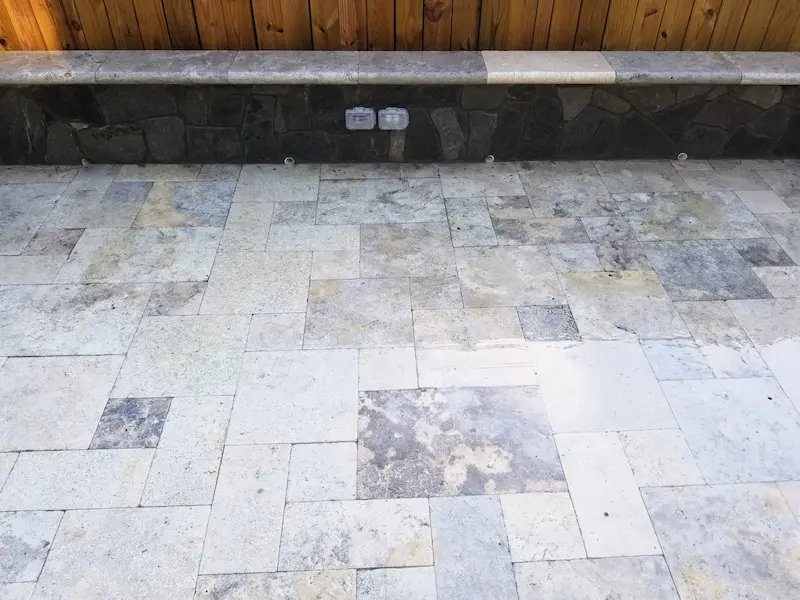
Diagnosing Luxury Hardscape Failure
Imported travertine and sandblasted marble are the cool-touch stones for a Fairfax or McLean patio or pool deck. Light-toned travertine and marble reflect more sunlight than dark stone or pavers, so they typically stay noticeably cooler underfoot — though any surface warms in extreme heat — which is why they read as resort-grade outdoor living and hardscape surfaces. The catch is the install method, and it is where most Northern Virginia jobs fail.
Most landscapers treat imported marble and travertine like ordinary concrete pavers, dry-laying them on a loose bed of sand or gravel. With these stones that approach is a defect from day one. The pieces are milled with precise, square edges, so a millimeter of movement in the sand base lifts one edge proud of its neighbor and creates a sharp trip hazard. There is no forgiving chamfer to hide the offset the way a tumbled paver would.
Then water gets into the dry-laid joints and washes the sand out from underneath. The field begins to settle, the cut stones rock underfoot, and the surface you paid a premium for is uneven within a single season. Tuck GC builds these differently. We install marble and travertine as a wet-set masonry system — the stone is mortar-bonded to a 4-inch, 4,000 PSI concrete slab with 6x6 welded wire mesh pulled up into it, which reduces shifting, rocking, and raised trip edges.
The Tuck Standard Protocol: Wet-Set Precision
With rectified-edge stone, the slab under it does most of the work. Bonding the marble or travertine to a concrete slab keeps stones from moving individually with soil subsidence and freeze-thaw heave — the field rides on the slab instead of piece by piece. The slab reduces, but cannot eliminate, the effects of clay movement (see The Tuck Standard, Section 5F). Here is the five-step install:
- Excavation to Subgrade We excavate the footprint to design depth, stripping the topsoil and any unverified fill rather than building on them. A compacted aggregate base goes in next, placed in lifts to give the slab a uniform bearing surface.
- Concrete Slab (4,000 PSI) This is the core of the system. We pour a 4-inch, 4,000 PSI concrete slab with 6x6 welded wire mesh pulled up into the slab. The slab spans soft spots rather than letting each stone track every shift in the soil below.
- Wet-Set Mortar Bedding Once the slab has cured, each stone is set in a full bed of Type S mortar, our standard mix (see The Tuck Standard, Section 8H). Hollow spots are where wet-set installations crack under point loads, which is why we set in a full bed.
- Flush Leveling Across Every Edge With square, rectified edges the setting tolerance is tight. Our dedicated trade crews and specialized trade partners, under Tuck GC's direct management, check each stone with a straightedge as they set, so adjacent stones set as flush as the material allows, minimizing the raised lippage and trip edges common to dry-laid stone.
- Joint Detailing — Tight-Fit or Mortared Two finishes, your call. Tight-fit (dry-set joint): stones are pushed together with a fine hairline gap over the bonded slab, and the joints take on a natural patina. Mortared joint: a uniform gap filled with our standard mortar for a solid surface that sheds debris. Neither is watertight, and both need the same periodic joint maintenance as any mortar joint (see The Tuck Standard, Section 8E).
Structural Comparison: Wet-Set Marble vs. Dry-Laid Systems
Paying for imported stone and then setting it on sand throws away the material premium. Here is the side-by-side on why a wet-set base is the right call for travertine and marble in our climate.
| Engineering Metric | Tuck Wet-Set Marble/Travertine | Builder-Grade Dry-Laid (The Competitor) |
|---|---|---|
| Foundation Base | 4-inch, 4,000 PSI concrete slab with 6x6 welded wire mesh pulled up. | Loose compacted sand or stone dust. |
| Trip Hazard Potential | Low. Stones are mortar-bonded and set flush. | High. Stones shift independently, raising sharp edges. |
| Thermal Properties | Noticeably cooler underfoot than dark stone or concrete pavers in summer sun. | Concrete pavers absorb and radiate intense heat. |
| Joint Integrity | Precision tight-fit or mortared joint. | Polymeric sand that quickly washes out, leaving voids. |
| Weed & Pest Resistance | Solid slab and bonded joints leave nothing to root or burrow into. | Ants excavate the sand base; weeds root in the open joints. |
The Northern Virginia Factor: Geotechnical Defense
Local soil is the reason dry-laying rectified stone is a bad bet here. Across much of McLean, Great Falls, Fairfax Station, and Arlington the subsurface is highly plastic marine clay. It swells with real hydrostatic force through a wet spring and shrinks back during a summer dry spell, and that seasonal expand-and-contract cycle is enough to warp a sand-based patio — square-edged marble and travertine lift, separate, and never settle back flat. A concrete slab spans the active clay and spreads the seasonal shrink-swell across one piece, reducing the lifting or separation of individual stones (it cannot eliminate clay movement; see The Tuck Standard, Section 5F). The same rigidity is the freeze-thaw defense: water in a sand bed freezes and jacks individual pieces upward, while a bonded slab gives frost no saturated bedding layer to work on.
Because a wet-set patio sits on an impervious slab, the surface has to be detailed to move stormwater, and local rules differ: Arlington caps total lot coverage; Fairfax limits front-yard paving and accessory structures in rear setbacks; Alexandria controls floor area and open space. We check which rules apply to your lot before design. Drawing on 20+ years of hands-on experience, we pitch the field to carry water away from the foundation, and we coordinate the municipal zoning permits the work requires. Where a jurisdiction calls for a stamped grading plan, the project's licensed Professional Engineer (PE) produces it and we build to that design. Review runs on the jurisdiction's schedule; in our experience it commonly takes 30 days or more, so we start that process early.
What Drives the Cost of a Travertine or Marble Patio in Fairfax & McLean
Imported travertine and sandblasted marble are premium materials, but a wet-set installation prices differently from a dry-laid landscaping job because most of the cost sits in the masonry, not the stone. The figure is driven by the size of the patio or pool deck, the stone and finish you select, how much demolition and excavation the site needs, and the structural base itself — a 4-inch, 4,000 PSI concrete slab, plus the flush leveling that rectified-edge stone demands. Coping and bullnose detailing around a pool, lot access for moving heavy material to the rear yard, your jointing choice (tight-fit versus mortared), and any zoning, permitting, or engineered drainage all move it as well. We scope every project individually rather than post a per-square-foot rate that ignores the slab under the surface.
Because every project is scoped to your property, we price each one individually rather than by a flat rate. You'll find our project minimum and a full breakdown of what different budgets cover on our contact page.
See Our Full Pricing BreakdownTechnical Diagnostics & FAQ
Premium Stone Requires a Premium Foundation.
Do not allow a landscaping company to dry-lay luxury imported stone on a bed of sand. If you want a flat, cool-touch patio built to resist shifting and trip edges, you need structural masonry.
SCHEDULE A SITE EVALUATION