
Structural Masonry, Not Just Curb Appeal
Tuck GC is a structural masonry contractor serving Fairfax, Arlington, and Alexandria — the crew you call when a project changes how your house carries its weight. That covers holding back tons of saturated soil with an engineered retaining wall, cutting through a foundation footing for a basement egress, and dropping a steel beam to open a load-bearing wall. Work like this needs a Class A (RBC) contractor who can build to a stamped engineering design, not a weekend mason, and that is the lane we have run for years.
Our focus is deliberate. We don't take on spot repairs, superficial brick pointing, or isolated chimney patches as standalone jobs — that work belongs with a handyman mason. What we do is heavy structural modification: projects that pull permits, carry structural steel, and put excavation machinery in your yard, where a mistake in the load path is the difference between a finished basement and a cracked facade.
Structural Masonry Master-Class Case Study
A buried basement turned into a daylit walkout — where heavy civil construction meets finished residential masonry.
Phase 1: Excavation & Underpinning
- The Challenge: At an estate in Oakton, Virginia, the client wanted to bring daylight and an outdoor exit into a fully buried, windowless basement.
- The Structural Solution: Excavating to expose the basement wall lowered the protective soil cover on that side of the house, dropping the foundation below the frost line it had relied on. Working from the stamped engineering design, we underpinned that entire elevation — extending the footing down 3 feet to re-establish proper bearing before any opening was cut.
Phase 2: 12-Foot Cutout & Shoring
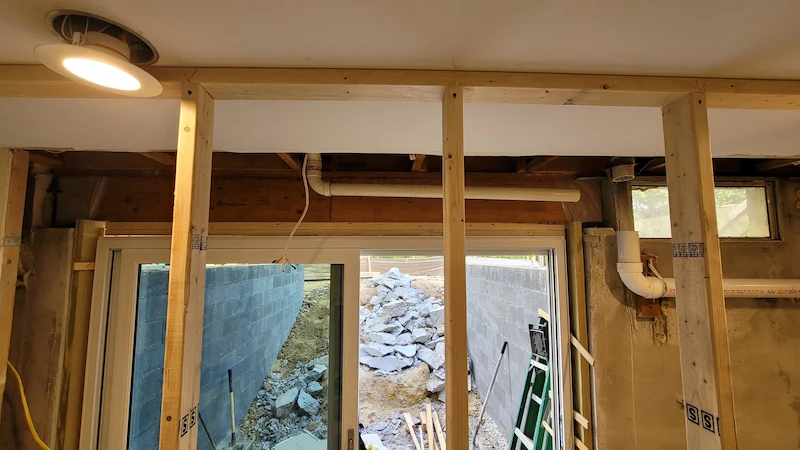
- The Support System: Following the licensed PE's stamped design, we opened a 12-foot foundational cutout carrying three stories of brick above. We set temporary shoring to take the load, then installed an exterior steel lintel tied into stacked interior LVL headers — pocketed permanently into the concrete and packed with non-shrink mortar so the assembly bears solidly on the concrete.
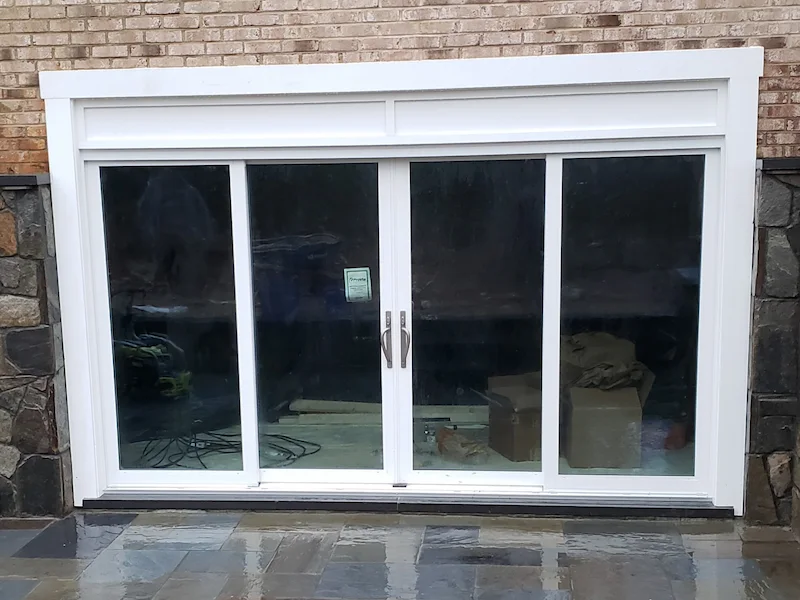
- The Finish: Into that opening we set a 4-panel, 12-foot ProVia sliding glass door, turning a dark wall into a wall of glass.
Phase 3: Critical Structures & Luxury Aesthetic
- Civil Drainage: A sunken walkout is a bowl that wants to collect water. We set high-capacity drainage boxes and hand-trenched the lines hundreds of feet out to daylight, building a fully gravity-fed system that sheds water without depending on a sump pump.
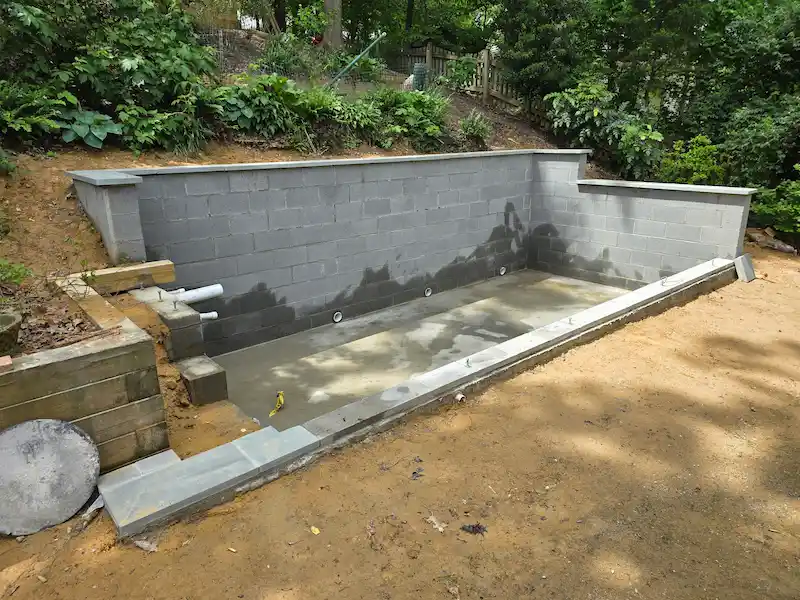
- The Retaining Structure: A tiered retaining wall holds the grade around the opening — starting over 6 feet tall at the deepest point and stepping down to 2 feet at the yard exit.
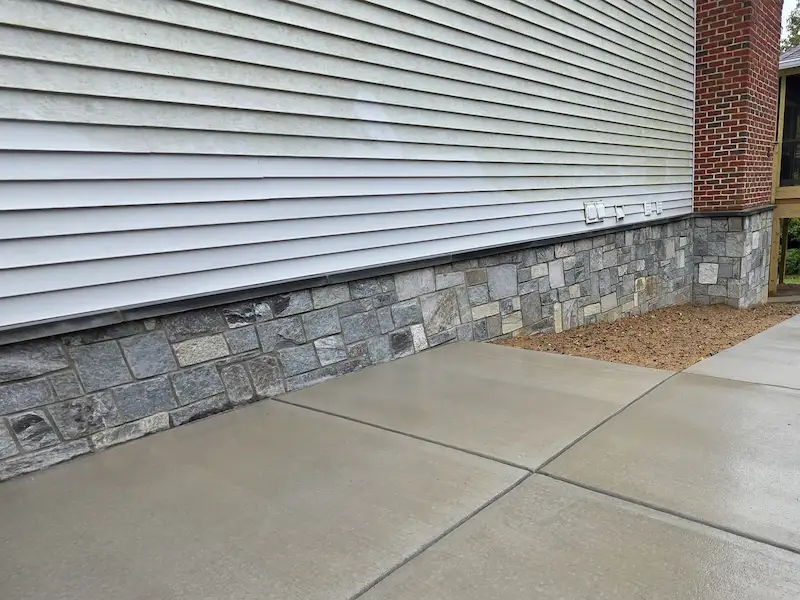
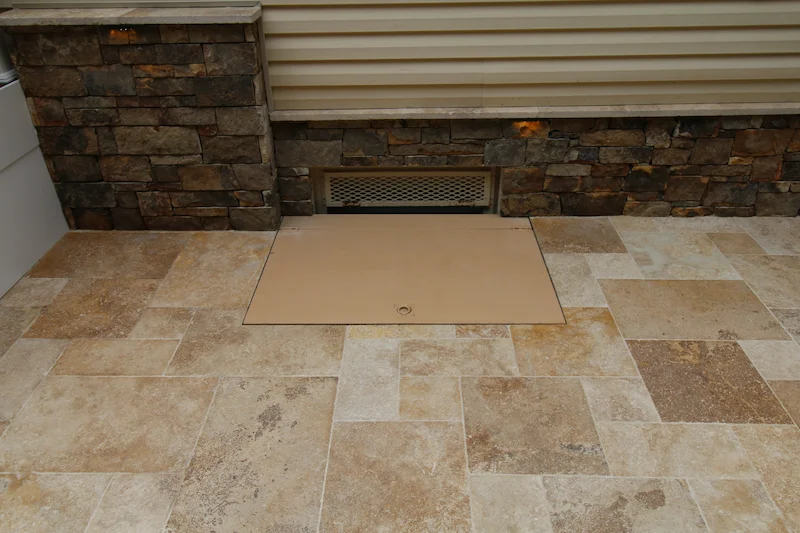
- The Finish: The patio floor was surfaced in natural cleft flagstone, and we faced the retaining walls in Chocolate Grey wall stone capped with 2-inch thermal Bluestone. A matching stone "water table" veneer wrapped the exposed foundation block, so the structural work reads as one finished material from patio to wall.
The Tuck Standard: Automated Snow-Melt & Spa Integration
The client wanted to use this new walkout year-round, including a future hot tub. We poured a dedicated structural slab to carry the spa and ran a WarmlyYours automated snow-melt system beneath the flagstone — sensors trigger the heated floor when temperature and precipitation hit at once, so the steps and patio clear themselves instead of icing over. Powering it meant a new sub-panel inside the home, installed by a licensed electrician, feeding dedicated 240-volt lines. The result ties heavy structural construction, finish masonry, and year-round usability into one space.
Explore Our Structural Services
Structural vs. Cosmetic: The "Invisible" Engineering
A lot of our calls in Arlington and Fairfax start the same way: a previous contractor's wall is bowing, cracking, or leaking. The failure is almost never the stone you can see — it's the engineering you can't. A cosmetic mason builds for how the work looks on day one. A structural mason builds for how it holds once Northern Virginia's Marine Clay swells with water and our freeze-thaw winters start prying at it. The four standards below are where that difference lives.
The Tuck Structural Standard
- Hydrostatic Relief: Water is heavy. If it gets trapped behind a retaining wall, the wall will blow out. On a typical wall we install drainage pipe and clean drainage stone backfill, as specified in your proposal or the PE's design, so water can flow through the system instead of pressing against it.
- CMU Core Filling: For load-bearing walls, hollow cinder blocks are insufficient. Block cells are reinforced and filled solid as the PE's design or your proposal specifies.
- Structural Steel Lintels: When cutting a new door or window opening in a brick home, the massive weight of the house above must be supported. We install heavy-gauge galvanized steel lintels to carry the load, helping prevent the "stair-step" cracks that undersized lintels cause.
- One Standard Mortar: Our standard mortar is the same mix on every project (see The Tuck Standard, Section 8H). A specialty mortar is used only where a governing spec requires it, by Change Order.
Tailored Solutions for Regional Challenges
1. Older Brick Homes (Alexandria & Arlington)
Much of Old Town Alexandria and North Arlington was built in the early 20th century, and the structural masonry on those homes behaves differently than modern block. When we cut a new opening or rebuild a stoop or foundation element on a period house, the detail that matters is mortar chemistry: older "soft" brick was laid in lime-based mortar, which behaves differently from modern portland mixes. Our standard mortar is the same mix on every project (see The Tuck Standard, Section 8H); where a historic-district spec calls for a lime mortar, that work proceeds under the spec by Change Order. New units and joints will still read newer than the originals until they weather in (see The Tuck Standard). (Standalone repointing we leave to specialty restoration masons — our work here is the structural alteration.)
2. Slopes & Walk-Out Basements (Lake Ridge & Clifton)
Across the rolling terrain of Lake Ridge and Clifton, a lot of homes sit on graded lots with walk-out basements or steep driveways held by timber retaining walls. Those 1980s pressure-treated timbers have a service life, and they're now rotting and leaning. We replace them with engineered segmental block systems or stone veneer over reinforced concrete block — designs that drain instead of dam, so the wall isn't fighting hydrostatic pressure the way the timber was.
The same slope that makes a walk-out possible also makes code-compliant egress windows straightforward to add. Excavating to the footing and cutting a precise structural opening in the foundation wall turns a dark, non-conforming basement room into a legal, daylit bedroom — the single change that most reliably adds usable square footage and resale value in neighborhoods like Manassas and Burke.
Material Selection: Natural vs. Manufactured
For any vertical facing — a foundation water table, a wall face, or full house veneer — the first decision is natural versus manufactured stone. It drives the look, the weight on your supporting ledge, and the budget. We install both over metal lath on concrete or masonry (our usual case), or per the county's requirements, which normally include a weather barrier, on wood sheathing, and we stay brand-neutral so the choice is yours: depending on the project we work in Techo-Bloc, EP Henry, Belgard, and a range of natural quarried stone.
- Natural Stone Veneer: Real quarried stone, so every piece is unique in texture and color, with a naturally UV-stable finish. It costs more per square foot and weighs more, which can call for a heavier supporting ledge — the trade you make for a material that reads as authentic up close.
- Manufactured Stone: Concrete cast in molds taken from real stone. It's lighter and more consistent in color, often easing the footing requirement, and it covers large foundation runs efficiently — the practical pick when you're wrapping a long, exposed block wall on a budget.
What Drives the Cost of Structural Masonry
Structural masonry and stonework are priced by the scope of the work, not by a flat rate. The drivers are how much heavy excavation and machinery the job requires, whether steel and a licensed-PE-coordinated stamped design are needed, your jurisdiction's permitting, and the materials you select — so standalone structural work like wall removal, egress, and foundational door cuts carries a higher entry point than cosmetic veneer.
Permits, Steel & Engineering
What Pushes Standalone Projects Up.
Typical Scope: Simple Load Bearing Wall Removal (Demo/Steel Only), Basic Egress installations, or foundational Door Cut-Outs — each carrying permits, structural steel, and stamped engineering.
Full Structural Transformation
Where Scope Scales Up Most.
Typical Scope: Basement Walkout with Concrete Stairs & Drainage, Complex Retaining Wall Systems, or Multi-Wall Open Concepts.
Because every project is scoped to your property, we price each one individually rather than by a flat rate. You'll find our project minimum and a full breakdown of what different budgets cover on our contact page.
*Note: Smaller masonry tasks (like veneer or front brick steps) are most economical when bundled with a larger Patio or Driveway project.
Structural vs. Cosmetic Masonry: When You Need a PE Stamp & County Permit
The single most important question before any masonry project is: does it change how your house carries its weight? If the answer is no, it's cosmetic — a finish applied to a surface, and it almost never needs a structural permit or an engineer. If the answer is yes, it's a structural alteration, and in Fairfax, Prince William, and Arlington that triggers a county building permit and a beam or lintel sized for the load — from the code's prescriptive tables or, for longer spans, masonry walls and point loads, a licensed-PE-stamped design. Tuck GC coordinates that engineering with a licensed PE — we never produce structural calculations in-house — then build to the stamped plan under our Class A (RBC) license #2705160024. Here's how this hub's services sort:
A finish, not a load path
These services dress up or rebuild a surface without altering how the house transfers load. Typically no structural permit and no PE stamp — just sound installation over a proper drainage plane and footing.
- Foundation Veneer — stone facing over existing block
- Stone Veneer — architectural facade upgrade
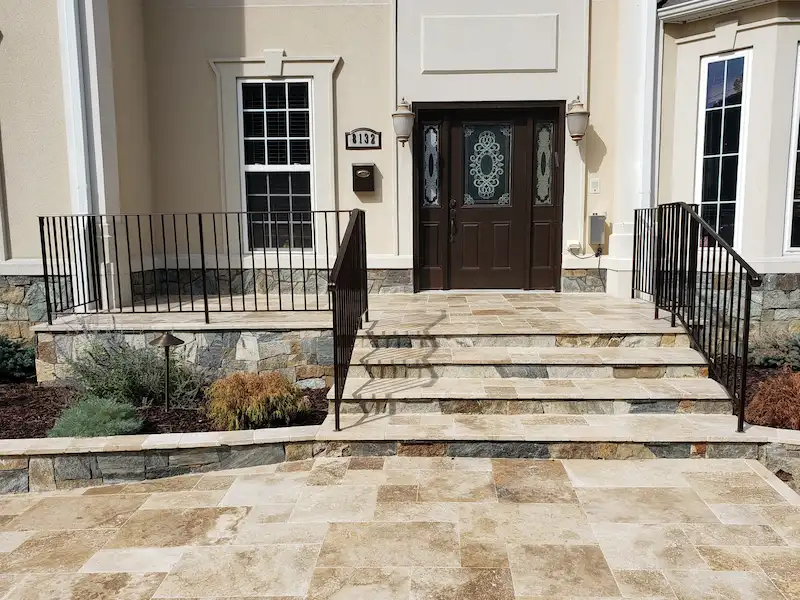
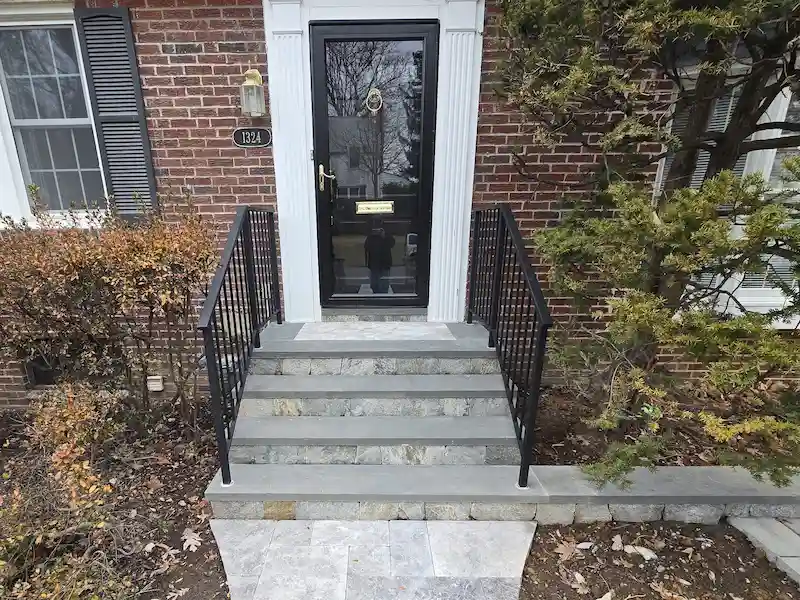
- Brick & Stone Stoops — rebuilding entry steps & landings
Changes how the house holds
These change the load path or hold back tons of soil. Expect a county permit and a beam, lintel, or wall design sized for the load — PE-stamped where the span, masonry or loads call for it, which Tuck GC coordinates — this is the "dangerous kind" you don't want done on a guess.
- Load-Bearing Wall Removal — beam carries the floors above
- New Door & Window Openings — lintel cut into masonry
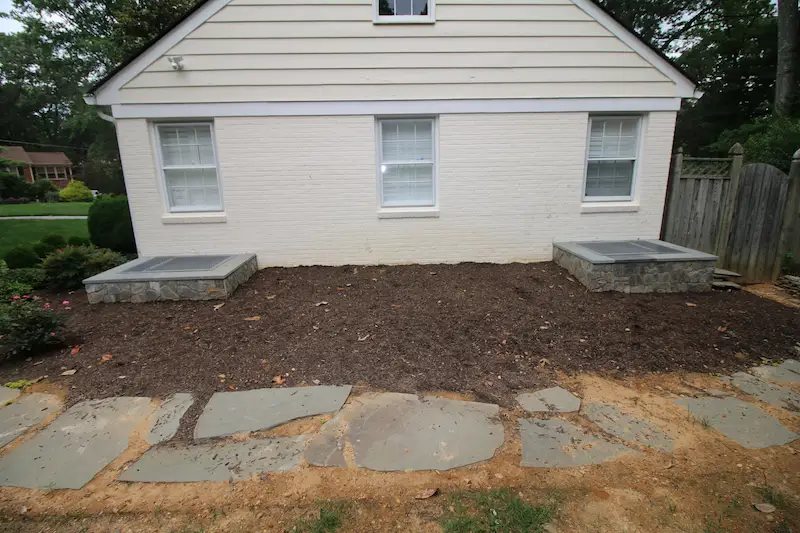
- Egress Windows & Walkouts — opening cut in the foundation wall
- Tall Retaining Walls — past the jurisdiction's height threshold or carrying a surcharge
Not sure which category your project falls into? That's the first thing we settle on a site visit — if it's structural, we line up the stamped engineering and the permit before any wall comes down.
Masonry & Structural FAQ
Do I need a permit and an engineer to remove a load-bearing wall or cut a new opening in Northern Virginia?
Almost always, yes — to both. Removing a load-bearing wall, or cutting a new door or window opening into masonry, changes how the house carries its load, and Fairfax, Prince William and Arlington treat that as a structural alteration that requires a building permit. The building department needs the header or lintel sized for the load — from the code's prescriptive tables or, for longer spans, masonry walls and point loads, from a licensed PE. On structural openings we coordinate a licensed Virginia PE for stamped calculations, then build to that design under our Class A (RBC) license #2705160024 and call for the required inspections. We don't do this kind of work without the permit and the sizing in hand.
How do I tell if a wall is load-bearing before planning an open-concept renovation?
There are clues, but no clue is proof — which is exactly why guessing is dangerous. Walls that run perpendicular to the floor joists, walls stacked directly above a beam or a foundation wall in the basement, and walls near the center of the house are the usual load-bearing suspects, while a short wall parallel to the joists is often (not always) a partition. The only reliable answer comes from tracing the load path from the roof down to the footing, and on an open-concept reno that's a judgment call we hand to the engineer we coordinate. We'd rather confirm it on paper than have you design a kitchen around a wall that turns out to hold up the second floor.
Can a basement egress window turn a non-conforming room into a legal bedroom, and what makes it code-compliant?
Yes — a properly built egress is usually what stands between a basement room and a legal, sellable bedroom. Virginia code requires a bedroom to have a code-sized emergency escape opening, and in a basement that means cutting the foundation wall for a window with the right minimum clear opening, set at a reachable sill height, served by a window well big enough to climb out of (with a ladder if it's deep). Cutting that opening into the foundation is a structural alteration, so it's permitted work with a steel or precast lintel carrying the wall above. We excavate to the footing, cut the opening, set the lintel, install the window and well, and tie in drainage to help keep the well from filling with water — which is what makes the room legal. Drainage is water mitigation, not a waterproofing guarantee.
Stone veneer vs. natural vs. manufactured stone — which should I choose, and how does cost differ?
It comes down to look, weight, and budget. Natural stone veneer is real quarried stone — every piece is unique, its color is naturally UV-stable, and it carries the highest material cost and the most weight, which sometimes means a heavier supporting ledge. Manufactured stone is concrete cast from real stone molds: lighter, more consistent in color, and easier on the budget for covering large areas, which is why it's popular for wrapping long foundation runs. Both are installed over metal lath on concrete or masonry (our usual case), or per the county's requirements, which normally include a weather barrier, on wood sheathing — we deliberately avoid pushing one brand so you can choose the product that fits your home. For the exact spread on your project, send us the scope on the contact page.
Why do retaining walls fail, and what makes one 'engineered'?
Most failed walls fail for the same two reasons: water and no real footing. Soil holds water, water is heavy, and if there's nowhere for it to go the hydrostatic pressure pushes the wall over or bows it out — so a well-built wall has a drainage system, with drainage stone and pipe as specified in the proposal or the PE's design, that relieves that pressure instead of fighting it. The second half is the structure: a reinforced footing, the right block or reinforced concrete, and geogrid where the wall system calls for it. In Virginia a taller wall (past your jurisdiction's height threshold, or shorter walls carrying a surcharge like a driveway above) crosses into territory where the county wants a PE-stamped design — engineering Tuck GC coordinates rather than performs in-house, then builds to the stamped plan.
Does Tuck GC do small repairs like brick pointing or chimney patches?
Generally no — our focus is structural modification, not spot repair. We don't take on superficial brick pointing, small chimney patches, or isolated cosmetic fixes as standalone jobs, because mobilizing for that kind of work isn't where we add value. Where small cosmetic masonry does make sense is when it's bundled into a larger project we're already on site for — facing exposed foundation block on a walkout, or rebuilding a stoop as part of a front-entry job. If you need a quick repair on its own, a local handyman mason is usually the better and more economical call; if it's part of a bigger structural plan, that's squarely what we do.
What does a structural masonry project cost, and is there a minimum?
Cost depends on the scope — wall height and length, how much excavation and shoring is involved, whether steel and a stamped engineering design are required, and your jurisdiction's permitting, so we quote every project individually rather than post a misleading per-square-foot number. We're a structural, permitted, design-build contractor, and standalone structural work — wall removal, egress, foundational door cuts — carries a higher entry point than cosmetic veneer because of the permits, steel, and engineering involved. Smaller cosmetic masonry is most economical when bundled with a larger project. Tell us your scope on the contact page and we'll give you a real figure.
What's your warranty, and are you licensed and insured?
Yes — Tuck GC holds a Virginia Class A (RBC) Contractor License, #2705160024, and we're fully insured. Our workmanship on the work we install is warranted for one year from Substantial Completion — covering defects caused by installation error, with the exclusions listed in The Tuck Standard, Section 12. Materials like stone, windows, and waterproofing membranes carry their own separate manufacturer warranties, with terms set by the manufacturer; we hand off the product information at completion so you can register it with the manufacturer. Our Standards page lays out exactly what the workmanship warranty covers and how a claim is handled.
Need a Site Evaluation?
Don't let cracks or water damage get worse. Schedule a site visit with Tuck GC.
Request Consultation