
Add a Legal Bedroom
A basement room does not legally count as a bedroom in Virginia unless it has a code-compliant egress opening — a window or door large enough for an occupant to escape a fire and for a firefighter in full gear to enter. Cutting that opening is what converts unfinished square footage into a legal, appraisable bedroom, which is why an egress window is one of the highest-return structural improvements you can make to a home in Arlington, Alexandria, or Fairfax.
It is also a genuinely structural project. The egress opening has to be cut through the load-bearing concrete foundation that carries the floors and roof above it, so the work is governed by a building permit, a structural header, and a county inspection — not a weekend kit. Because the cut is load-bearing, we coordinate a licensed Virginia Professional Engineer (PE) to produce the stamped header design and build the opening to that stamped drawing. The well is built in masonry or from a manufacturer's prefab well system (Bilco is one example), as your contract specifies, with the drainage your grade calls for; drainage is water mitigation, not a waterproofing guarantee.
1. The Diagnostic: The Failure of Cheap Kits
Many contractors sell "quick" egress installations using a light-gauge corrugated or thin pre-formed window well dropped into the hole with no regard for the soil. The failure mode is predictable. Northern Virginia's marine clay is an expansive soil — it swells when it absorbs water and exerts steady lateral pressure on anything buried in it. When you excavate a six-foot hole against a foundation in Fairfax or Burke, that saturated clay pushes back with thousands of pounds of force. A thin, light-duty shell has little to resist it: over a few freeze-thaw seasons the well warps, cracks, and bows inward against the window, defeating the very escape path it was supposed to create.
The second failure mode is water. A quick kit is typically set over a shallow gravel pit on the assumption that rainwater will percolate away. In clay, it does not — the pit has nowhere to drain. During a heavy Virginia downpour the well fills like a bucket, water rises above the sill, breaks the window seal, and floods the finished basement. A well that holds water also loads the glass hydrostatically, which is how egress windows get cracked from the outside. Building it correctly means a well that holds back the soil — masonry or a manufacturer's prefab system — and a drainage outlet, not a pit that hopes the water disappears.
2. The Tuck Standard Protocol: Structural Egress Construction
We approach an egress project with the same rigor as building a new foundation, whether the scope is a single window cut or a multi-tiered structural walkout stairwell. The walkout is the larger undertaking — far more excavation, a taller retaining system, and an exterior staircase — but the protocol does not change:
- Structural Demolition & Header Integration Before any concrete is cut, we temporarily shore the floor joists inside the home so the structure is supported while the wall is open. Using hydraulic diamond wall saws, we cut a clean, square opening through the 10-inch poured-concrete or block foundation wall. A steel or LVL header — sized by the licensed PE to carry the load above — is then set across the top of the opening so the weight that was bearing on that section of wall transfers around the new void to the sides of the cut.
- The Well (Masonry or Manufacturer Prefab) The well has to hold back the soil around the opening. As your contract specifies, it is either built in masonry — Concrete Masonry Units (CMU block) laid up to the approved plans — or installed from a manufacturer's prefab well system (Bilco is one example) per the manufacturer's instructions.
- Well Drainage We do not rely on a passive gravel pit. A drain at the lowest point of the well gives water an outlet. Depending on the grade of your property in Great Falls or Clifton and what your contract specifies, that line runs downhill to daylight or, where included, ties into the home's interior foundation drain tile or feeds a sump pump installed by our licensed trade partners. On clay sites, where water cannot percolate, an outlet matters — but drainage is water mitigation, not a waterproofing guarantee (see The Tuck Standard, Sections 10 and 3L).
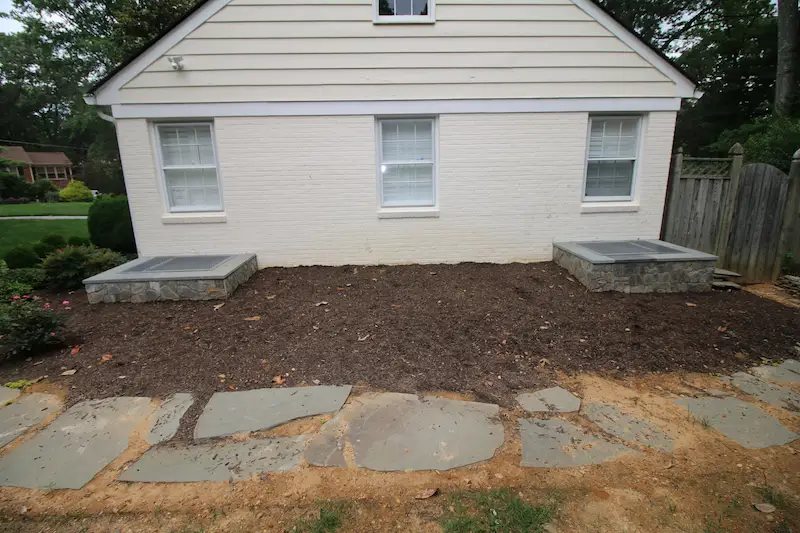
- Finishing (Stone Veneer & Custom Covers) A well built this way can be finished to look like part of the house rather than a utility pit. On a masonry well, our dedicated masonry crews can face the inside of the CMU with natural stone veneer or brick chosen as the closest commercially available match to the foundation (new units read newer than weathered originals and won't be identical; see The Tuck Standard, Section 8L), and, where the design includes them, build code-compliant masonry steps into the well instead of a bolt-on metal ladder. The well can be capped with a custom iron safety grate or a polycarbonate cover rated to bear weight while still passing daylight into the basement — and the cover must not impede egress from the inside.
- The Window / Door Installation We finish the opening with an energy-efficient casement or inswing window (such as Andersen or Marvin) sized to meet the egress clear-opening requirement, not just to fill the hole. For a full walkout, we hang an exterior-grade French or entry door (such as ProVia) integrated with PVC trim and a sill pan flashed per the door manufacturer's instructions so the new opening sheds water.
3. Material Science: Egress Methods Compared
| Construction Method | Structural Integrity | Drainage Reliability | Aesthetic Impact |
|---|---|---|---|
| CMU Block + Stone Veneer (Masonry Well) | High. A masonry wall built to the approved plans resists lateral soil pressure. | Outlet to daylight, or a sump pump by licensed trade partners where included; water mitigation, not a guarantee. | Stone or brick finish; reads as a planned architectural feature. |
| Corrugated Steel Well | Moderate. Rusts and slowly bows over the decades. | Usually a passive gravel pit. High flood risk in clay. | Industrial and utilitarian. |
| Light-Duty Plastic Kits | Poor. Warps and cracks as marine clay expands against it. | Pit clogs with silt; no active outlet, so water backs up. | Reads as a plastic bucket bolted to the foundation. |
4. The Northern VA Factor: Zoning, Utilities, and Code Compliance
Excavating six feet deep against a home on a tight lot in Arlington or Alexandria is where most of the risk lives. The trench for an egress well frequently lands on top of buried gas lines, sewer laterals, and electrical mains, so before any digging starts we file the Miss Utility (Virginia 811) locate and observe the required waiting period for the public lines to be marked. With 20+ years of hands-on experience on heavy structural sites, Tuck GC works the dig around those marked utilities and coordinates any rerouting needed to open a safe path for the well or walkout.
The opening itself has to satisfy specific egress parameters that Fairfax County and Prince William County inspectors will check. The window must provide a minimum net clear opening of 5.7 square feet — the actual hole an occupant fits through once the sash is open, not the rough-frame size (windows opening at grade level may qualify at 5.0 square feet). The bottom of that opening can sit no higher than 44 inches above the interior floor so it is reachable without a ladder, and the exterior well must be at least 9 square feet with no dimension under 36 inches so a person can stand in it and climb out. We size the cut, the window, and the well to clear all three at once, build the header to the licensed PE's stamped drawing, and carry the project through permitting and the final county inspection so the room is documented in the county's permit records as a code-compliant bedroom.
5. What Drives the Cost of an Egress Window in Arlington & Alexandria
An egress project is priced by how much structure and excavation the cut demands, not by the window alone. The real cost drivers are the depth of excavation (a deeper basement means a taller well), the wall material being cut (10-inch poured concrete is harder and slower to saw than block), the structural header the licensed PE sizes to carry the load above the opening, the drainage solution your grade requires — a gravity line to daylight is simpler than a dedicated exterior sump pump — the well finish (stone or brick veneer over the CMU costs more than bare block), any utility conflicts with buried gas, sewer, or electric that have to be rerouted, and the permit and PE-stamped engineering every jurisdiction requires for a foundation cut. A full basement walkout, with its larger excavation and exterior staircase, sits well above a single window.
Because every egress is scoped to your foundation cut, stamped header, well finish, and drainage, we price each one individually rather than by a flat rate, and full walkouts are a larger structural undertaking. You'll find our project minimum and a full breakdown of what different budgets cover on our contact page.
See Our Full Pricing Breakdown6. Egress Window FAQ
Because the well is built in masonry or from a manufacturer's prefab well system, as your contract specifies, the price follows the structure the cut demands: the depth of excavation, whether you are cutting 10-inch poured concrete or block, the header the licensed PE sizes for the load, the drainage your grade needs, the well finish, and any buried utilities that have to be rerouted. A full basement walkout — with its larger excavation, retaining walls, and exterior staircase — is a much bigger undertaking than a single window. You'll find our project minimum and what different budgets cover on our contact page.
The cut is engineered, not guessed: a licensed Virginia PE sizes a structural header — steel or engineered wood — to span the opening. We shore the floor above, make the cut, and set that header so the load bridges around the new opening to the sound wall on either side. Any structural alteration to a foundation carries some inherent risk of minor settling or drywall cracking (see The Tuck Standard), which is why the work runs under a stamped design and county inspection.
Yes — it is the part most often skipped. In Northern Virginia's clay, water cannot percolate out of a gravel pit, so without an outlet the well can fill during heavy rain, rise above the sill, and flood the basement or load the glass until it cracks. Each egress gets the drainage your contract specifies for your grade: a line to daylight or, where included, a tie-in to the interior foundation drain tile or a sump pump installed by our licensed trade partners. Drainage is water mitigation, not a waterproofing guarantee (see The Tuck Standard, Sections 10 and 3L).
Yes. Cutting a structural opening in a foundation wall requires a local building permit and inspection from your county or city building department, and because the cut is load-bearing we coordinate a licensed Virginia Professional Engineer (PE) to produce PE-stamped drawings and calculations for the header. We then build the opening to the stamped design and carry it through the final county inspection so your new bedroom is legally recognized.
A basement room only counts as a legal bedroom when it has a code-compliant egress opening. Virginia code requires a minimum net clear opening of 5.7 square feet (windows opening at grade level may qualify at 5.0 square feet), a sill no higher than 44 inches above the interior floor, and an exterior well of at least 9 square feet with no dimension under 36 inches. We size and build the egress system to meet those parameters so the room can pass inspection and be recognized as a legal bedroom.
7. Unlock Your Basement's Potential
A code-compliant egress is what turns a finished basement into a legal, appraisable bedroom — and it is structural work that rewards doing it carefully. From precision concrete cuts on tight Falls Church lots to multi-tiered stone walkouts for McLean estates, Tuck GC builds every opening to the licensed PE's stamped design, with a masonry or manufacturer prefab well and the drainage your contract specifies.
Egress work is one branch of our broader masonry & structural program. If the opening you need is above grade rather than below it, see our new door & window openings service, and for interior projects that open up a floor plan, review load-bearing wall removal. Whenever a cut carries structural load, we coordinate a licensed Virginia Professional Engineer (PE) for stamped drawings and build to that design. Contact us to plan your project.