
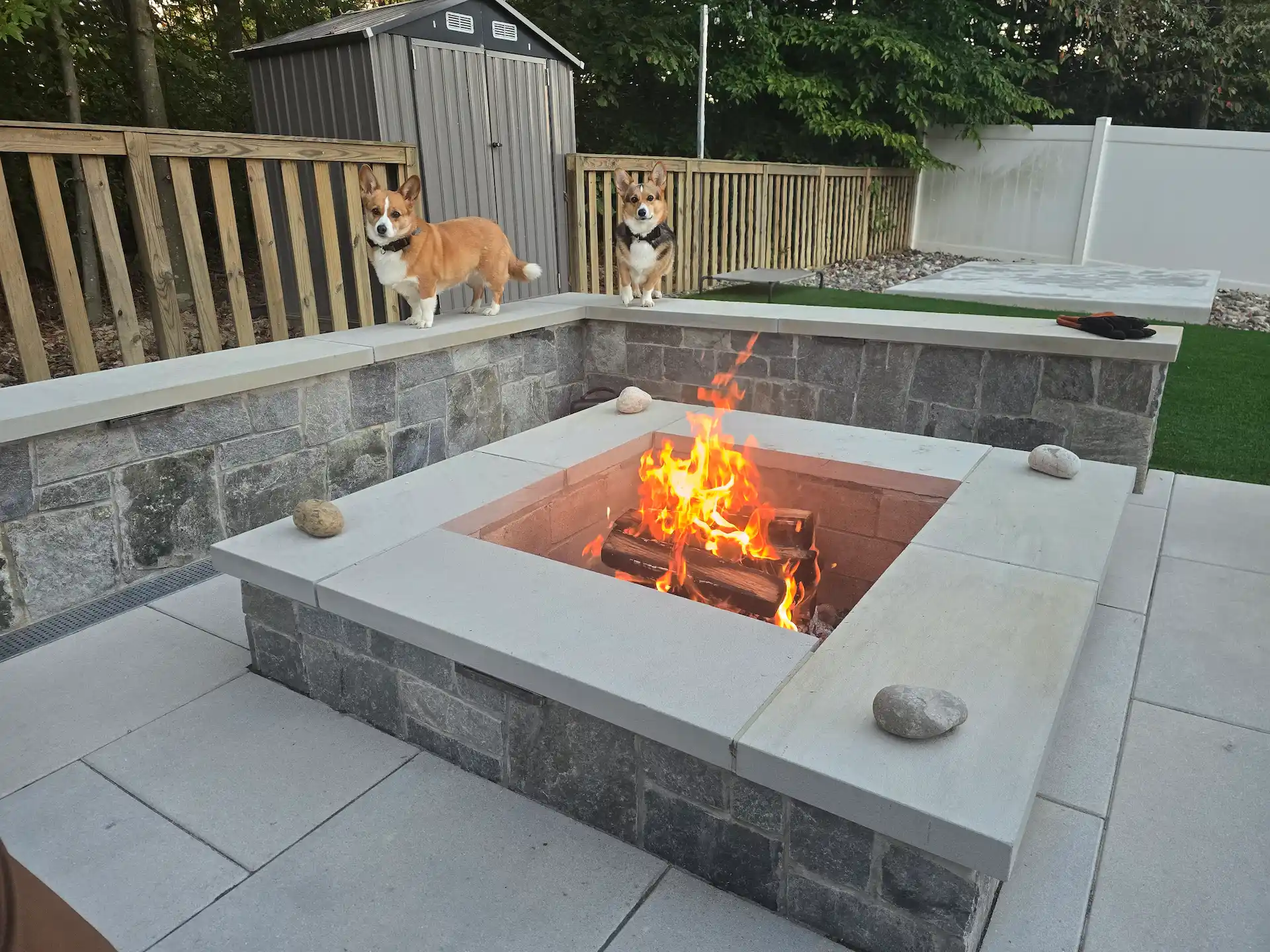
The Gathering Spot
A permanent masonry fire pit or outdoor fireplace is a structural element, not a yard accessory. We build both kinds in Fairfax, Arlington, and Burke: wood-burning pits with smokeless secondary-combustion steel inserts, and hard-piped natural gas burners that light at the turn of a key (the gas line is run and connected by a licensed plumber/gas fitter). The construction underneath is the same either way — a footing down to the frost line, a solid-filled block core, and a fire-brick lining — because that is what separates a well-built feature from one that cracks in a season.
Building one into a Northern Virginia hardscape takes more than stacking stones in a circle. A firebox runs from several hundred degrees during a burn to freezing ambient air the same night, and that swing drives constant thermal expansion and contraction. Without a fire-brick lining, a solid structural core, and a footing carried down to the frost line, the feature can crack or settle. We draw on 20+ years of hands-on masonry experience to build for long-term use — and when a fireplace's scale and chimney height call for it, we build to the stamped design of the project's licensed Professional Engineer (PE).
1. The Diagnostic: Why Standard DIY & Landscaper Fire Features Fail
Most of the failing fire pits we replace across Fairfax and Prince William counties share the same root causes: non-refractory materials in the firebox, no real foundation, and no drainage. The common shortcut is a pre-cast concrete "kit" set with ordinary mortar or construction adhesive. Standard concrete and mortar were never made to sit against an open flame — they expand unevenly under direct heat, then spall (flake apart at the surface) and crack through, often inside the first burning season.
A pit set on topsoil instead of a poured footing is the next failure. Virginia's freeze-thaw cycle heaves the unsupported structure over the winter, and the masonry leans and splits. The third is drainage: with no drainage, the basin holds standing rainwater and becomes unusable.
2. The Tuck Standard Protocol: Combustion & Structural Construction
A Tuck GC fire pit or outdoor fireplace is built from the inside out. Heavy masonry construction carries the load; a fire-brick lining shields the structure from the heat. Here is our standard build, below grade to coping.
- Footing to the Frost Line Every fire feature begins below grade. We excavate and pour a concrete footing down to the frost line, sized to the structure (from a 36-inch fire pit to a 15-foot chimney) and built on its own, isolated from the patio slab.
- Block Core with a Bond Beam The skeleton of our fire features is block construction with a rebar bond beam, and the cores are solid-filled with concrete. That core carries the weight of the natural stone veneer and heavy stone coping.
- Fire-Brick Lining The interior firebox is the most critical zone. We line the inner walls with fire brick, which takes the direct heat and helps protect the block core and stone veneer from it.
- Drainage For drainage we fill the center with #57 gravel down to the footing, topped with river rock, so rainwater drains down instead of pooling inside the pit.
- Fuel System, Veneer & Caps Once the core is secure, we integrate your chosen system: a natural gas burner (we handle the trenching; a licensed plumber/gas fitter runs and connects the gas line) or a secondary-combustion steel insert for a smokeless wood burn. We face the exterior in premium natural stone (flagstone, fieldstone, or ledgestone) and set the stone caps so they don't overhang into the fire pit, to limit heat exposure. Very large, hot fires can still crack stone caps, so keep fires to a reasonable size.
3. Material Science: The Tuck Fire Feature vs. Builder-Grade Kits
| Specification | The Tuck Standard Fire Feature | Standard Landscaper / DIY Kit |
|---|---|---|
| Firebox Lining | Fire-brick lining. | Standard concrete block with regular mortar (cracks easily). |
| Structural Core | Block core with a rebar bond beam; cores solid-filled with concrete. | Single-wall construction; exterior stones take direct heat. |
| Water Management | #57 gravel center fill down to the footing, topped with river rock. | Solid bottom; acts as a bucket holding stagnant rainwater. |
| Airflow Dynamics | Smokeless secondary-combustion steel insert available for wood-burning pits. | Open pit with no combustion design; smokes heavily. |
| Foundation | Concrete footing down to the frost line. | Built directly on top of existing patio pavers or topsoil. |
4. The Northern VA Factor: Navigating Zoning & Soil
Building a fire feature in our primary service zones—such as Fairfax County, Arlington, and Alexandria—means working within both local zoning and the fire code. The statewide fire code sets clearance distances for open wood fires (for recreational fires, generally 25 feet from structures and combustibles), and local zoning can add placement rules — which is why a hard-piped natural gas fire feature is often the easier fit on tight Arlington and Falls Church lots. We handle the gas line trenching, and a licensed plumber/gas fitter runs and connects the line so the gas work is permitted and inspected.
In more expansive areas like Haymarket, Fairfax Station, Great Falls, and Clifton, we frequently build grand, towering outdoor fireplaces. These require navigating strict Homeowner Association (HOA) and Architectural Review Board (ARB) approvals regarding chimney heights, spark arrestors, and aesthetic matching to the primary residence.
Furthermore, the subterranean environment of Northern Virginia presents its own challenges. The highly expansive marine clay found in Burke, Springfield, and Woodbridge demands that heavy masonry structures, like fire pits and fireplaces, sit on properly sized concrete footings down to the frost line. If a 3-ton stone fireplace is built on clay without one, the winter freeze-thaw cycle can heave and fracture the entire structure.
5. What Drives the Cost of Fire Pits & Outdoor Fireplaces in Northern Virginia
A fire feature's price tracks the structure behind it, not just the stone you see. The biggest cost drivers are the size and scale (a 36-inch fire pit versus a towering 15-foot fireplace and chimney), the fuel system (wood, a smokeless steel insert, or a hard-piped natural gas line with trenching), and the footing requirements dictated by the soil — heavy marine clay in Burke or Woodbridge can call for a larger footing. From there, the fire-brick lining, the natural stone veneer and coping you select, and the permits and gas inspections on larger builds all move the number. We price each fire feature on a per-project basis after a site visit.
Because every fire feature is scoped to your property, we price each one individually rather than by a flat rate. You'll find our project minimum and a full breakdown of what different budgets cover on our contact page.
See Our Full Pricing Breakdown6. Fire Feature Engineering FAQ
Yes, provided your current structure is sound. Converting to gas means trenching a dedicated gas line from your home's meter to the fire feature, then setting a stainless steel burner pan and a burner ring sized in BTUs to the diameter of the pit, topped with fire glass or ceramic logs. A key valve set into the masonry gives you simple, match-lit operation. We handle the trenching and coordinate the permitting; a licensed plumber/gas fitter runs and connects the gas line.
A "smokeless" wood fire pit works by secondary combustion. We build the masonry pit and integrate a double-walled stainless steel insert. As the fire burns, cool air is drawn into the insert's lower vents, heated as it rises between the two walls, and injected back down into the top of the firebox. That super-heated air ignites the smoke particles before they escape, so you get a hotter, cleaner burn with far less smoke.
Standard, low-profile wood-burning fire pits often don't require a permit, provided they meet fire-code clearances and any local placement rules. Large outdoor fireplaces with chimneys, and any fire feature fed by a new natural gas line, typically require municipal permits and inspections. Review runs on the jurisdiction's schedule; in our experience it commonly takes 30 days or more. We coordinate the permitting and inspections so the build is code-compliant from footing to flue.
We build custom masonry fire features in the major segmental-wall and fire-feature systems our Northern Virginia clients ask for, including Techo-Bloc, Belgard, EP Henry, Nicolock, and Unilock, as well as full natural stone such as flagstone, fieldstone, and ledgestone. We coordinate the fire pit or fireplace with the surrounding patio, seating walls, and home so the whole hardscape reads as one cohesive design rather than a bolt-on kit.
Pricing depends on the size, fuel system (wood, smokeless insert, or hard-piped gas), and whether you want a low fire pit or a full towering fireplace with a chimney and stone veneer. Tuck GC takes on full hardscape projects, and a fire feature is usually built alongside a patio or seating-wall package. Because every structural footing, gas run, and veneer selection is different, we price each fire feature on a per-project basis after a site visit. Contact us for a detailed estimate.
7. Ignite Your Outdoor Living Space
A built-in fire feature changes how you use the backyard and pushes your entertaining season into the cold months. We build both ends of that range — a rugged wood-burning stone pit in Lake Ridge, a low remote-controlled linear gas fireplace in McLean — with the same structural masonry underneath. It's a permanent upgrade to your paver patio, not a rusting metal bowl that has to be hauled to the curb in a few years.