
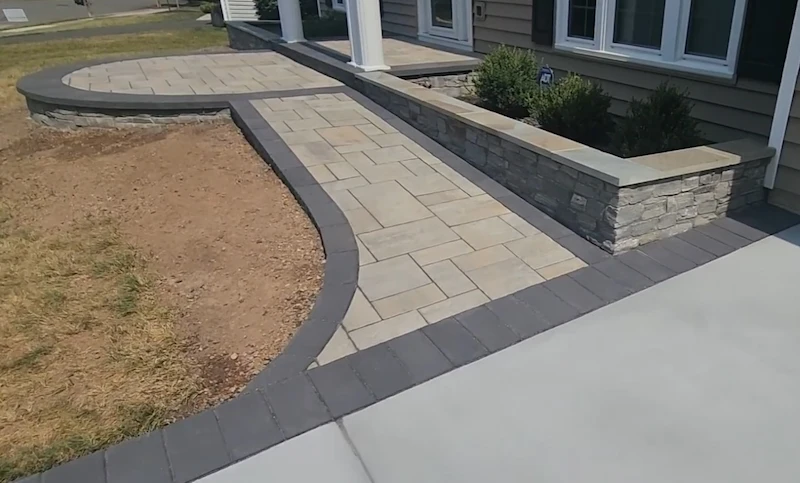
Diagnosing Interlocking Pavement Failure
A paver patio is only as strong as the base you cannot see. Across Fairfax and Northern Virginia, almost every paver patio that fails does so for the same reason: the surface looks finished while the structure underneath was never built for the soil. This page explains how our standard paver patio (pavers wet-set in mortar on a concrete base) and our open-graded option are built, why most local failures trace back to the base rather than the brick, and how Tuck GC builds a base meant to stand up to freeze-thaw.
Interlocking concrete pavers give you a range of looks that mortared stone cannot. Large-format slabs read clean and modern; tumbled cobble matches an older Northern Virginia streetscape; clay brick ties into a colonial facade. Just as important, pavers are modular: a damaged unit or a utility repair means cutting out and re-setting individual pavers rather than replacing a whole surface (repairs read differently at first; see The Tuck Standard, Section 8K).
Most paver failures here are not material defects; they are base failures. When a contractor under-excavates to save a day or backfills with the wrong material, the outcome is predictable within three to five years: the field develops sunken ruts that pond water, the unrestrained edges creep and separate, and the joint sand opens up to let weed roots in. These failures are preventable. At Tuck GC, we are experienced installers of Techo-Bloc, EP Henry, and Nicolock, alongside Belgard, Cambridge Pavingstones, Unilock, and Hanover, plus clay brick and natural stone across our full patios & hardscapes line. We do not lay premium pavers on a compromised subgrade, and we never set them on a bed of sand.
Our Standard Build: Pavers Wet-Set on a Concrete Base
Because structural concrete is our core trade, our standard paver patio is built on a concrete base. We excavate to design depth, install a compacted aggregate base, pour a 4-inch, 4,000 PSI concrete slab with 6x6 welded wire mesh pulled up into the slab, and wet-set the pavers in mortar on top, with polymeric sand joints (see The Tuck Standard, Section 8D). A concrete base reduces, but cannot eliminate, the effects of clay movement (see The Tuck Standard, Section 5F).
The Option: An Open-Graded Stone Base
For clients who prefer a flexible, aggregate-based system, we offer an open-graded design built to the paver manufacturer's guidance and the guidelines published by the Interlocking Concrete Pavement Institute (ICPI). The principle is simple: a flexible pavement depends on the layers below it being separated from the subsoil and compacted in controlled lifts. Here is how that option goes together:
- Excavation & Subgrade Separation We excavate the patio footprint to the depth the manufacturer's and ICPI guidance call for, sized to the soil. Geotextile fabric goes over the subgrade per the manufacturer's guidance to help keep the base stone from mixing into the soft clay.
- Compacted Open-Graded Stone Base We install a base of crushed, open-graded stone, placed and compacted in lifts. We do not use round river gravel, which rolls and shifts; crushed angular stone locks together when it is mechanically compacted.
- ASTM No. 8 Stone Bedding Layer Over the compacted base we screed a bedding layer of ASTM No. 8 crushed stone to seat the pavers evenly. We do not use sand or stone dust as a bedding layer: fines hold water, freeze over a Northern Virginia winter, and can push the pavers above them out of plane.
- Interlocking Placement & Edge Restraint Pavers from Techo-Bloc, EP Henry, or Nicolock are laid tight in the specified pattern. The whole system depends on the perimeter holding, because once the outer course is free to creep, the joints behind it open in sequence. To lock the edge, we restrain the entire perimeter with the edge restraint the manufacturer's guidance calls for, such as a troweled concrete edge hidden below the soil line.
- Polymeric Jointing & Mechanical Consolidation We sweep polymeric sand into the joints and run a vibratory plate compactor over the surface to work the sand into the joints. The sand is then activated with water and cures into a firm joint that discourages weeds and insects (see The Tuck Standard, Section 8D).
Structural Comparison: Tuck Standard vs. Builder-Grade
Two patios can look identical on install day and diverge completely by year five. What separates them is the work below the surface. The line items below compare our open-graded option with a builder-grade job: where a builder-grade crew cuts corners and where an ICPI-guided build spends its time. (Our standard build replaces the loose base and bedding with a concrete slab and a mortar setting bed.)
| Engineering Metric | Tuck GC Open-Graded Option (ICPI-Guided) | Builder-Grade Landscaping (The Competitor) |
|---|---|---|
| Subgrade Separation | Geotextile fabric per the manufacturer's guidance to limit soil mixing. | No fabric. Base stone slowly sinks into mud over time. |
| Base Depth & Material | Compacted crushed open-graded stone to the depth the manufacturer's and ICPI guidance call for, sized to the soil. | 2-4" of poorly compacted dirt or round gravel. |
| Bedding Material | ASTM No. 8 crushed stone; never sand or stone dust. | Sand or stone dust (traps water, freezes, and heaves stones). |
| Edge Restraints | Hidden concrete edge, or another restraint the manufacturer's guidance allows. | Flimsy plastic edging that pulls out after one winter. |
| Paver Quality | Techo-Bloc, EP Henry, Nicolock (High-density, color-thru). | Big-box store blocks (Low-density, color fades rapidly). |
The Northern Virginia Factor: HOA Approvals & Marine Clay
A paver patio in this region has to clear two local hurdles that crews from outside the area routinely underestimate: the soil and the HOA. Geotechnically, a band running from Centreville and Chantilly down to Gainesville and Bristow sits on expansive marine clay. This clay swells when it takes on water and shrinks as it dries, so it never holds a stable elevation. On an aggregate-based patio, a shallow base or one without separation from the clay lets that movement pump stone down into the subgrade through a wet spring, and the field sags in the middle. That is a big reason our standard build puts a concrete slab under the pavers; on the open-graded option, proper excavation depth and geotextile per the manufacturer's guidance help limit it. Neither build can eliminate clay movement (see The Tuck Standard, Section 5F).
Aesthetically, neighborhoods in Ashburn, Leesburg, South Riding, and Burke answer to Architectural Review Boards, and a submission built around generic big-box pavers is an easy rejection. Working from premium lines like Techo-Bloc, we hand clients full product catalogs, color swatches, and a detailed design plan formatted for the kind of detail an ARB packet asks for, so the submission reaches the board review-ready.
What Drives the Cost of a Paver Patio in Fairfax & Northern Virginia
No two paver patios price the same, because the cost is driven by the things you cannot see in a photo. The biggest factors are square footage, the paver line you choose (a large-format Techo-Bloc slab and a tumbled EP Henry cobble carry very different material costs), how much demolition and haul-off the old surface requires, and how deep we have to excavate for the base your soil calls for. On top of that, machine access to the back yard, which base you choose (our standard concrete base or the open-graded option), any permitting or HOA review, and structural add-ons like seating walls, steps, fire pits, or integrated drainage all move the number. We quote each patio against your actual site rather than post a per-square-foot rate that ignores it.
Because every patio is scoped to your property, we price each one individually rather than by a flat rate. You'll find our project minimum and a full breakdown of what different budgets cover on our contact page.
See Our Full Pricing BreakdownTechnical Diagnostics & FAQ
Build on a Foundation That Doesn't Compromise.
A premium paver laid on a shortcut base still fails. If you want a paver patio across Fairfax and Northern Virginia built on a real foundation, the base is where the work goes: a concrete slab under wet-set pavers as our standard, or an open-graded base built to manufacturer and ICPI guidance as the option. That is the part we never skip.
SCHEDULE A SITE EVALUATION