
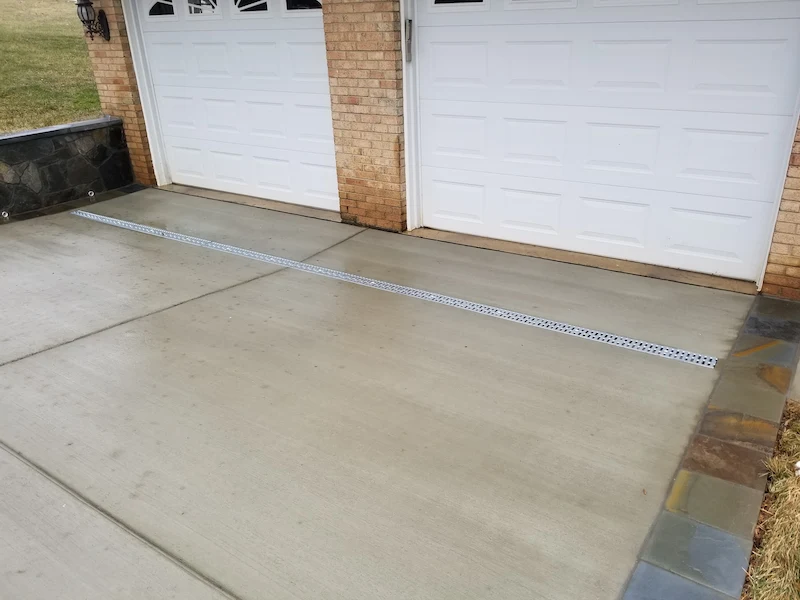
The Diagnosis: The "Negative Slope" Nightmare
When a driveway slopes down toward the garage, the slab becomes a funnel. During the intense summer downpours common across Fairfax, Arlington, Alexandria, and Prince William, that grade directs thousands of gallons of water straight at the garage door, and every storm aims it at the same low spot.
The rubber seal at the bottom of a garage door is not built to hold back standing water. Once the water ponds against it, it works under the seal, swells drywall, and feeds mold inside the slab edge. The fix is a linear channel drain (trench drain) set across the driveway to intercept the sheet of water and route it away. We set the channel a few feet out from the garage door, placed to suit site conditions, so the surface between the drain and the garage slopes away from the garage.
The Installation Protocol: Bedded in Concrete
Many channel drain failures trace back to one shortcut: the plastic channel was bedded directly on soil. With nothing structural under it, a heavy SUV rolling over can deflect the channel, crack the grate seat, and settle the drain below grade so water skips past it. We bed the channel in concrete per the manufacturer's detail:
- 1. Placement & Saw Cutting We set the channel a few feet out from the garage door, placed to suit site conditions, so the surface between the drain and the garage slopes away from the garage. We saw-cut the trench across your driveway, remove the asphalt or concrete, and excavate to the depth the manufacturer's detail requires.
- 2. Concrete Bedding We set the channel in a concrete bed per the manufacturer's installation detail, so the drain is supported by concrete, not dirt.
- 3. Polymer-Concrete Channels We skip the black plastic big-box kits. We install polymer-concrete or fiber-reinforced channels (ACO is one example), from manufacturers whose ranges extend to heavy commercial load classes. Polymer concrete barely moves with temperature, which helps it stay seated in the surrounding slab through Northern Virginia's freeze-thaw cycles.
- 4. Concrete Encasement (The Haunch) Per the manufacturer's detail, we pour concrete along the sides of the drain (the haunch) to lock it in place laterally. This helps keep the drain from shifting or popping up when vehicles brake or turn on top of it. Cracking around items embedded in the slab, caused by differential movement, is excluded under The Tuck Standard, Section 12B.
- 5. Discharge Piping A channel is only as good as where it sends the water. We trench a rigid, smooth-wall PVC discharge line set to a continuous fall to carry the captured flow away from the house, to a daylight exit downhill or a dry well system. Tie a high-volume drain into an undersized outlet and it simply backs up at the next storm.
Material Science: Professional Grade vs. Big Box Store
Why we don't install hardware-store plastic drains.
| Feature | Light-Duty Plastic Kit | Tuck GC System |
|---|---|---|
| Material | Thin HDPE Plastic | Polymer Concrete / Fiber Reinforced |
| Load Class | Typically EN 1433 Class A15 grates | Channel and grate rated to the traffic (EN 1433 B125 minimum for driveways; C250 for heavier vehicles) |
| Installation | Laid on dirt/sand | Bedded in concrete per the manufacturer's detail |
| Grate Locking | Snap-in (Pops out easily) | Bolted or locking grate system |
| Lifespan | Commonly cracks or warps within a few seasons | Rated for vehicle traffic (not a warranty term) |
The Northern Virginia Factor: "Micro-Burst" Storms
The volume problem: Fairfax, Arlington, and Prince William see summer "micro-bursts"—cells that drop 2 to 3 inches of rain in an hour. A narrow 2-inch or 3-inch channel cannot move that flow fast enough, so water over-tops the grate and sheets right past the drain it was supposed to stop.
The capacity solution: We typically install wider channels than big-box kits, with heavy-duty grates, then size the discharge line to match. We start from the square footage of driveway draining into the channel, so the system is sized to the flow your slope delivers rather than a generic kit rating.
A channel drain is one piece of a complete water-management plan. For roof runoff that overwhelms the surface, we pair it with buried downspouts, and for saturated lawns we add yard drainage. See the full range of our driveway and apron services for the surface that carries it all.
What Drives the Cost of a Driveway Channel Drain in Northern Virginia
A channel drain is priced as the system it is, not by the foot of grate. The biggest drivers are the length of channel needed to span your driveway, the saw-cutting and demolition to open a trench in existing asphalt or concrete, and the concrete bedding and haunch we pour around the channel per the manufacturer's detail. The grade of channel (heavier polymer-concrete channels and heavy-duty grates cost more than light-duty units), the length and routing of the discharge line to a daylight exit or dry well, and overall site access all move the number. We size the system to your driveway's runoff and quote each project individually.
Because every project is scoped to your property, we price each one individually rather than by a flat rate. You'll find our project minimum and a full breakdown of what different budgets cover on our contact page.
See Our Full Pricing BreakdownFrequently Asked Questions
Protect Your Garage Before the Next Storm
A garage that floods every hard rain costs you in mold remediation, ruined storage, and a slab edge that erodes over time. A heavy-duty channel drain bedded in concrete is built to intercept the everyday storm flow your slope delivers — extreme storms can overwhelm any system, and grates need seasonal cleaning (see The Tuck Standard, Section 10). Do it right the first time.
Request a Drainage Evaluation