
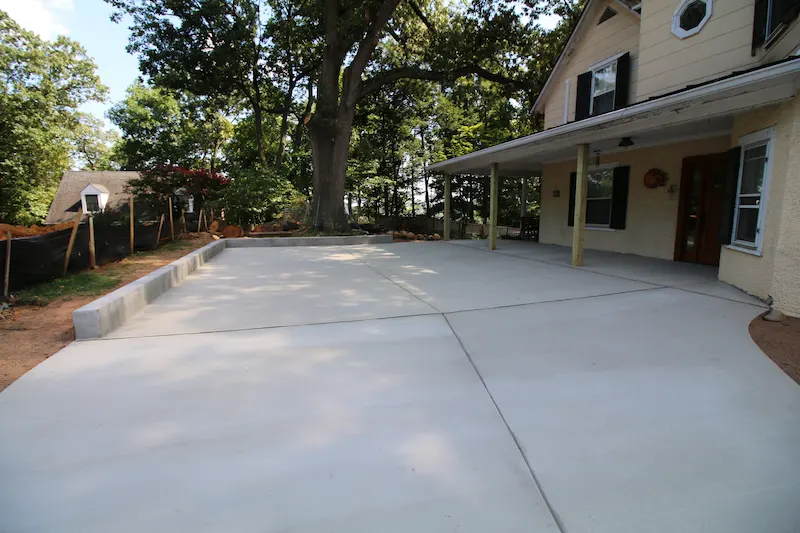
The Diagnosis: The "Morning Car Shuffle"
Driveway widening adds a full parking lane to an existing drive — most often turning a single-file driveway into a two-car pad so a household with teenage drivers, multiple generations, or more vehicles than the builder planned for stops shuffling cars every morning. The work is more demanding than a fresh pour: a new strip has to match the grade of the old slab, meet it at a clean expansion joint, and drain without trapping water at the seam.
Homeowners often try to solve crowding by parking on the grass (which kills the lawn and usually violates HOA rules) or pushing cars onto the apron — the slab in the public right-of-way that was never built to be a parking spot. The lasting fix is a structural driveway expansion: not dumped gravel, but a full-depth addition on compacted stone. With 20+ years of hands-on experience across Fairfax, Arlington, and Springfield, we build the extension to read as part of the original home, not a patch tacked onto the edge.
The Widening Protocol: Structural Integration
The whole job hinges on the joint between the new strip and the old slab. Get that joint, the base depth, and the grading right and the addition sits cleanly beside the original; get them wrong and the new strip settles, cracks, or traps water at the seam. Here is the Tuck Standard, step by step:
- 1. Zoning & Utility Location Before we dig, we check the coverage rules for your lot. Fairfax County caps how much of a front yard can be parking surface, other Northern Virginia jurisdictions cap lot or impervious coverage, and a widening counts toward those limits. We calculate the width you can add within them, and we file the Miss Utility (811) locate for public lines before digging; private lines such as irrigation and pet fences must be marked by the owner (see The Tuck Standard, Section 3D).
- 2. Excavation & Tree Roots We build the widening strip to the same section as our standard 4-inch driveway: about 8 inches of excavation and about 4 inches of compacted #21A crushed stone. Unsuitable soil found during excavation is removed and replaced by Change Order. Where tree roots from nearby landscaping are in the way, root protection is done as the permit, arborist or inspector requires, and priced in your scope.
- 3. The Isolation Joint Your existing slab has already settled; the new strip hasn't, and the two will move differently through the seasons. So we build the widening as a full-depth structural strip on compacted #21A stone, isolated from your existing slab with an expansion joint, so each slab moves on its own. A slight seasonal step at that joint is normal and not a defect (see The Tuck Standard, Section 6M). Where an engineered plan or governing standard requires a doweled connection, we build to it by Change Order.
- 4. Base Compaction We compact the #21A crushed-stone base before the pour. This is where most "tacked-on" widenings fail: skimp the base and the new strip can settle below the old slab, cracking the seam. Northern Virginia's Marine Clay makes this worse — it swells when wet and shrinks when dry — and a compacted stone base reduces, but cannot eliminate, the effects of that seasonal movement (see The Tuck Standard, Section 5F).
- 5. Material Choice We can pour the widening in concrete finished to the same spec — same broom finish and edge profile; the new strip reads brighter for several years and the contrast softens as it weathers (see The Tuck Standard) — or install a contrasting paver border — a concrete edging with the border pavers wet-set in mortar — to turn the widening into a deliberate design feature.
Material Science: Integrated vs. "Tacked On"
Why does one driveway addition read as a cheap patch while another reads as a deliberate part of the drive? It comes down to five things — the joint, the base, and the drainage are structural; the connection and aesthetics are what you see.
| Feature | "Cheap Patch" Expansion | Tuck Structural Widening |
|---|---|---|
| Connection | Poured tight to the old slab, no joint | Isolated by an Expansion Joint |
| Settlement Risk | High (thin base lets the strip sink) | Reduced (full-depth strip on compacted stone) |
| Base Depth | 2-3 inches (skimped) | About 4 inches compacted #21A (about 8-inch dig) |
| Drainage | Traps water at seam | Graded away from seam |
| Aesthetics | Seam left as an afterthought | Paver Border / Same-Spec Finish |
The Northern Virginia Factor: Zoning & HOA
Front-Yard Coverage Limits: Fairfax County limits front-yard parking surface to 25% of the front yard in R-1/R-2 and 30% in R-3/R-4 (on lots up to 36,000 sq ft) — and permeable pavers count as surfaced area under that rule. We measure your front yard before designing the widening.
HOA approval: Many HOAs in Burke, Centreville, and Gainesville reject bare "asphalt wings" bolted onto a driveway, but the same boards routinely approve a hardscape border. Presenting the widening as a Belgian-block edge or a paver border — a design feature rather than an afterthought — is often the difference between an approval and a denial. The HOA application is yours to file; we provide the drawings and project data for it with that framing in mind.
Widen the Driveway, Widen the Apron
The driveway is yours. The apron — the slab where your driveway meets the street — is not. It sits in the public right-of-way. Widen a single-car driveway to two cars and the existing curb cut is too narrow to swing both vehicles in; to use the parking you paid for, the apron has to grow with it.
The apron follows different rules than your lot. In Fairfax, Loudoun, and Prince William counties, the street out front is almost always VDOT's, so widening the curb cut requires a VDOT Land Use Permit for the new entrance — a set slab thickness, an approved width, and the inspection the permit calls for (VDOT typically performs a final acceptance inspection rather than a pre-pour one). Our VDOT driveway apron page walks through exactly how that permit works.
Arlington is the exception. Arlington maintains its own local streets, so most apron work goes through Arlington's Department of Environmental Services (DES) for a right-of-way permit — homes fronting a state route such as Glebe Road, Lee Highway or Route 50 fall under VDOT instead. We confirm which authority owns your street and pull whichever permit your address requires; see our Arlington driveway apron page for the local process.
We price the driveway and apron as one job, so you don't end up with a wider parking pad you can't pull into.
Worried the county, your HOA, or the right-of-way permit will trip you up? We run the lot-coverage math and handle the permits before a single shovel hits the ground.
Check My Widening OptionsWhat Drives the Cost of Driveway Widening in Fairfax, Arlington & Springfield
Widening cost depends on the size of the addition and how cleanly it meets what you already have. The main drivers are the square footage you are adding, the material — same-spec concrete or a contrasting paver border — and the excavation and base work, since a true structural strip gets about 8 inches of excavation and about 4 inches of compacted #21A crushed stone, is isolated from the existing slab by an expansion joint, and is built rather than skimmed in. Permits and zoning matter too: a widening counts toward your jurisdiction's coverage limits, and if the curb cut has to grow with it, the apron carries a separate VDOT or Arlington right-of-way permit. Site access and tree-root protection on older Arlington and Springfield lots round out the figure. We price the driveway and apron as one job and quote each project individually.
Because every project is scoped to your property, we price each one individually rather than by a flat rate. You'll find our project minimum and a full breakdown of what different budgets cover on our contact page.
See Our Full Pricing BreakdownFrequently Asked Questions
Reclaim Your Morning Routine
End the morning car shuffle with a structural expansion that adds usable parking — and resale value — to your home. We handle the lot-coverage math, the zoning review, and the apron permit, then build a widening that meets your existing driveway at a clean expansion joint.
Request a Widening Estimate