The Entrance Work Most Contractors Won't Touch
VDOT aprons, driveway skirts, and curb cuts are jobs most contractors won't touch — very few crews in Northern Virginia will take them on. The reason is simple: the permitting is difficult, the bonding is expensive, and the inspections are unforgiving.
Tuck GC, Inc. loves to install driveway entrances. We run the VDOT permit process start to finish. VDOT still sets the review timeline—in our experience these reviews commonly take one to two months—but once your permit is approved, the installation itself, like the majority of flatwork pours, typically takes 1 to 2 days on site, weather permitting.
Case Study: An Annandale Estate Entrance
The Generational Home: Building the Maximum Allowed Entrance & Luxury Hardscape.
Phase 1: The Maximum CG-9D Entrance
- The Vision: The clients were building a "Generational Home" in Annandale, VA—a fully accessible estate designed to accommodate their elderly parents today, and eventually be passed down to their children. They needed an entrance built on the base that gives it its best chance at a long service life.
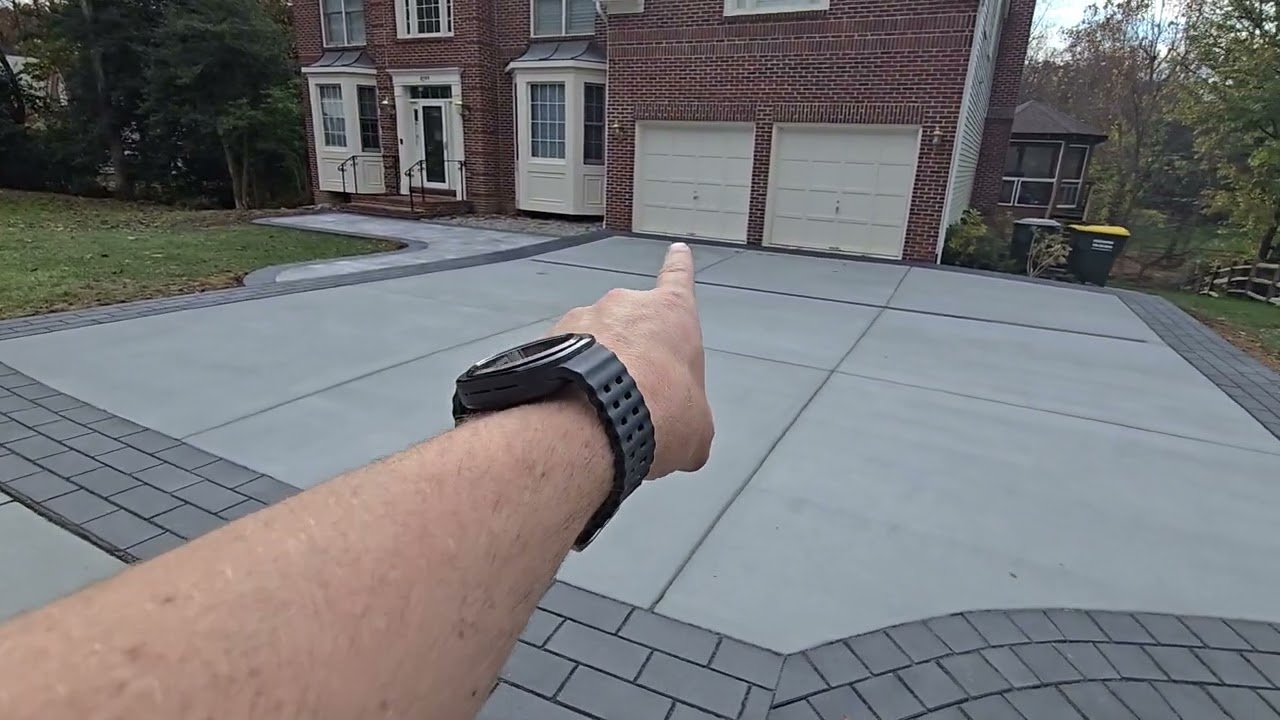
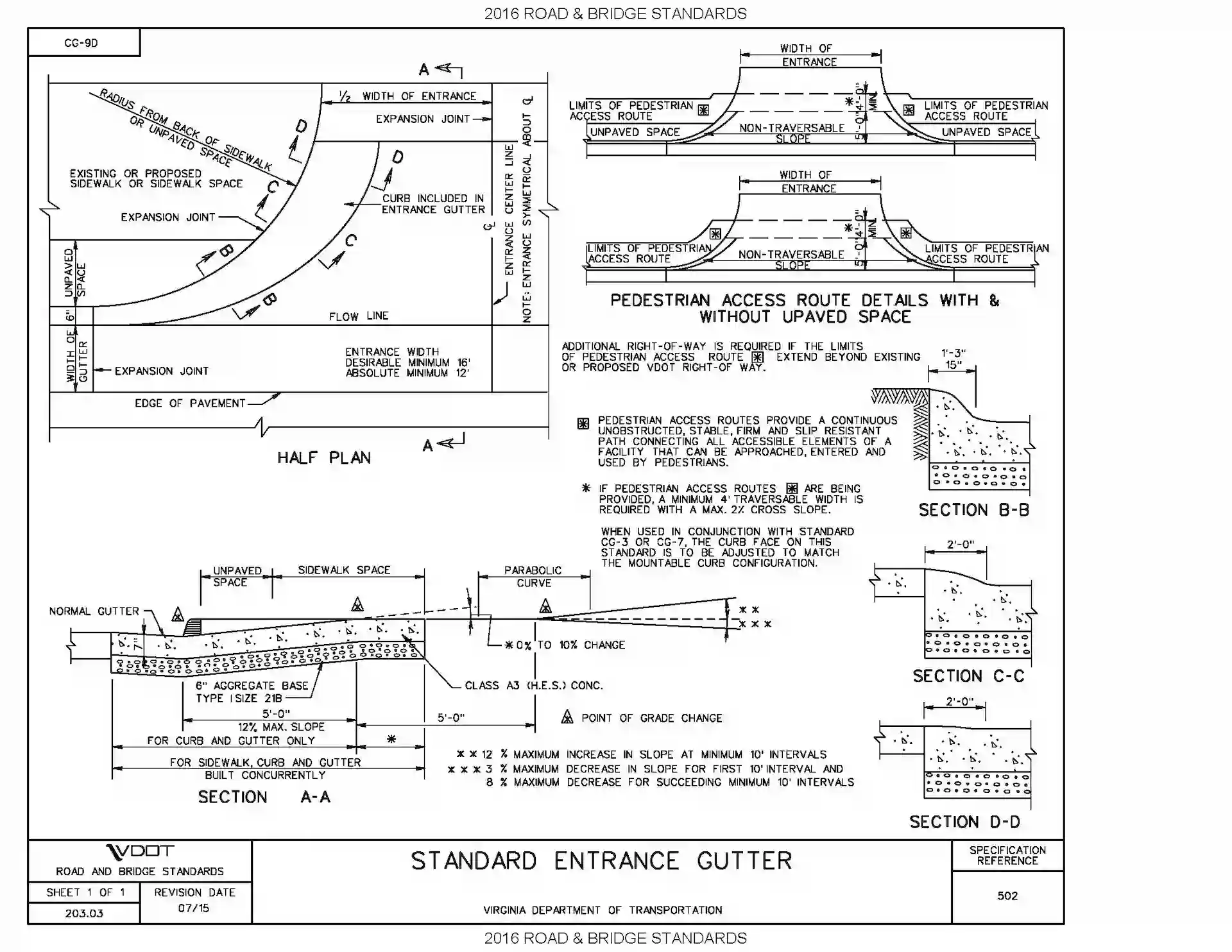
- The Permit Victory: To accommodate the family's needs, we designed and permitted the full 24-foot width — the maximum VDOT's standard private-entrance detail allows without a special exception. We poured a massive, commercial-grade CG-9D concrete apron measuring 24 feet wide with 10-foot radius returns on each side — about 44 feet across at the curb line.
Phase 2: Triple-Wide Driveway & Civil Drainage
- The Driveway: The apron opens into a sprawling, triple-wide concrete driveway capable of comfortably parking three cars wide and three deep.
- The Aesthetic: To elevate the massive slab, we framed the entire perimeter with a bold, 4-row (over 2 feet wide) Onyx Black Techo-Bloc border.
- Critical Drainage: Because the driveway slopes downhill toward the garage, water management was critical. We installed a heavy-duty ACO channel drain set on a massive structural concrete footer to intercept sheet flow before it could ever reach the house.
Phase 3: Tundra Gray Marble & The "Invisible" Dam
- The Walkway: We carried the Onyx Black border (slimmed to a single row) to the front walkway. For the center, we utilized a spectacular, new-age material: Tundra Gray Marble. This marble has a textured, slip-resistant finish. Set on a structural concrete base, we deliberately pushed the stones tightly together with zero grout joints, allowing a beautiful, natural patina to develop over the years.
- Water Management: The area between the driveway, walkway, and stoop was a major water trap. We built an "underground dam" at the edge of the walkway to intercept and deflect water away from our sub-base. We then regraded the area away from the foundation, installed a French drain system, tied in all the downspouts, and finished it with decorative river rock. The water now safely exits the property.
The Tuck Standard: The Phase 2 Estate Expansion
The ultimate proof of our quality is a returning client. Just six months after completing this generational front entrance, the homeowners called us back to transform the rear of the estate. (Watch the Phase 2 Backyard Transformation Here). We executed a massive rear expansion featuring an expansive Tundra Gray Marble patio, a custom foundation stone veneer, integrated planter boxes, accessible slope-managed walkways, and a leveled patio utilizing a secondary ACO drainage system. From the street to the backyard, we delivered a complete, unified estate transformation.
⚠️ The Split-Contractor Trap
We hear this constantly: A homeowner signs a contract with a landscaper or paving company for a new driveway, only to find out afterward that their contractor "doesn't do VDOT aprons" because they don't handle right-of-way permitting, sureties, or VDOT's entrance standards. You are then forced to hire a specialist like us just to finish the entrance. This is a massive financial and logistical trap. Here is exactly why you must pour your main driveway and your VDOT apron together:
-
Loss of Economy of Scale: By doing the massive driveway and apron together, we spread out the heavy equipment mobilization, permit running, and concrete delivery overhead, offering you a significantly better blended rate. Isolating the apron into a standalone project destroys that efficiency, driving the cost of the apron alone much higher.
-
The Risk of Heavy Damage: Building the apron to VDOT's profile often means cutting back into your private driveway: the cut is set where the grades tie in, the curb and gutter are cut or replaced as the entrance standard requires, and the tie-in distance is shown in your scope. If another contractor comes in after us to pour the main driveway, they have to drive heavy excavation equipment directly over your brand-new concrete apron, risking cracks and damage to the fresh work.
-
Mismatched, Patchwork Finishes: When we tackle the entire project at once, you get one crew, one mix design, one broom-finish technique, and the tightest practical pour window, with the apron separated from the curb, sidewalk and your driveway by expansion joints (The Tuck Standard, Section 6M). Splitting the job between two contractors means two specs, two finishing hands, and months of cure difference — the surest way to end up with an apron and driveway that read as two unrelated slabs.
-
Extended Timelines & Penalties: Aprons require complex VDOT grade checks, deep excavation, and heavy forming. Doing it separately triggers expensive "short load" delivery fees from the concrete plant and extends a project that typically takes 1 to 2 days on site into weeks of start-and-stop delays.
The Solution: Hire a licensed contractor who specializes in VDOT entrances to build and execute the entire system at once for the best value, safest logistics, and cleanest final product.
Avoid the split-contractor trap entirely — request your turnkey VDOT apron estimate →
Driveway Entrance Widening & Curb Cuts
Most of our clients aren't just replacing concrete; they are solving a parking problem. Here are the two most common reasons to upgrade:
1. Adding Off-Street Parking (New Curb Cut)
Are you looking for off-street parking in Arlington or Alexandria? Many older homes never had a permitted entrance built to today's standard. By installing a permitted driveway entrance, you gain valuable parking. A legal, permitted entrance is a real value-add in these desirable locations.
2. Expanding to a Double-Car Entrance
Many homes with two-car garages suffer from a "choke point"—a narrow single-car apron that forces you to shuffle cars constantly. We specialize in expanding the curb cut to roughly 20 feet at the street’s edge. This creates a grand double-car entrance that matches your garage width.
⚠️ Local Width Limits:
• Arlington County: Maximum width is 17 feet for a single-family entrance (10 feet each when a lot has two), per Arlington DES standard detail DW-2.0.
• Town of Herndon: Driveways must sit at least 2 feet off the property line and can cover no more than 35% of the front yard.
• Town of Leesburg: Width is set by the Town's design standards — we confirm the current figure with Public Works.
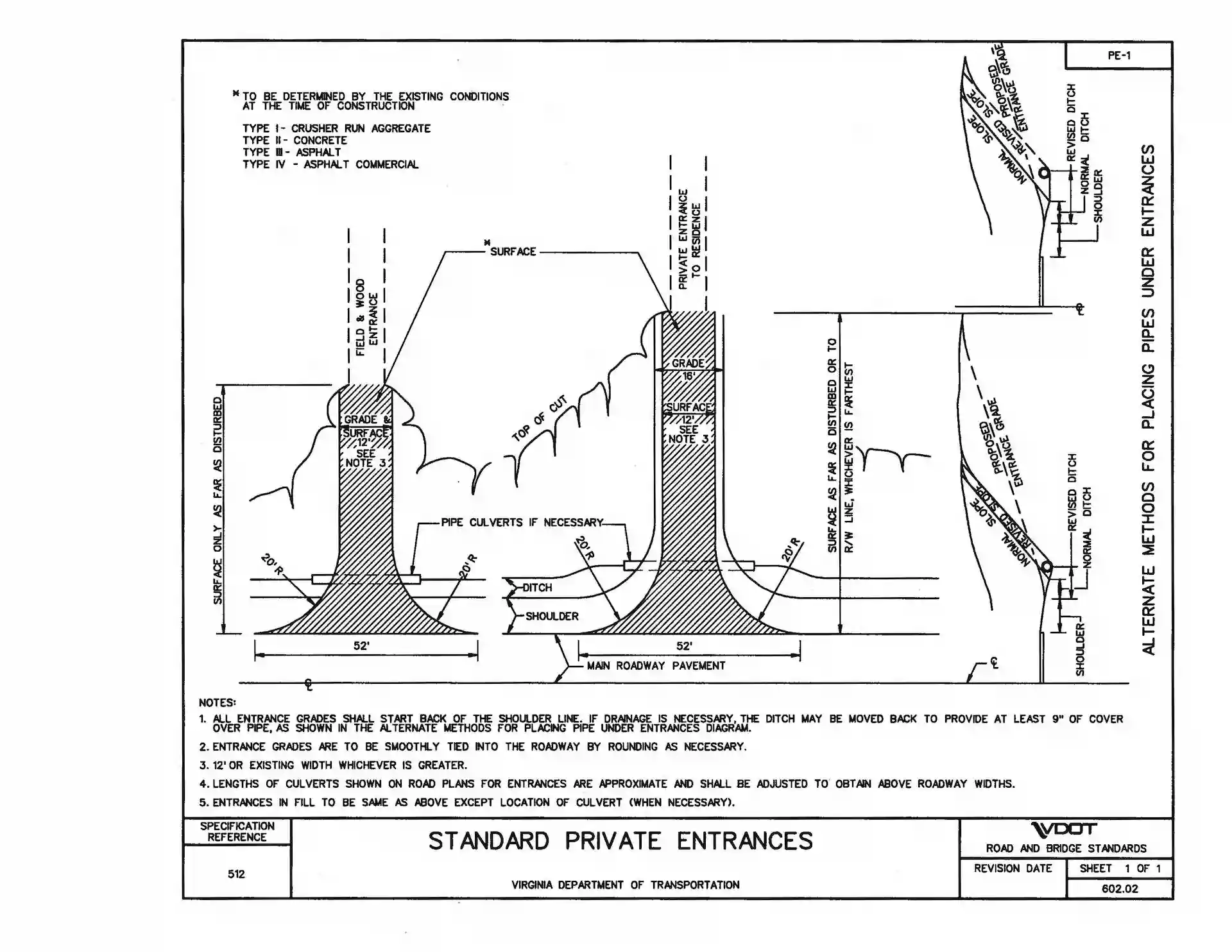
• Fairfax County: On VDOT-maintained streets the standard private-entrance detail allows a surfaced width of 12 to 24 feet; anything wider needs specific VDOT engineer approval.
Relocation & Second Entrances
Relocation for Efficiency: If you are moving your driveway to align with a new garage, we can handle the new curb cut and close the old entrance with curb and gutter as the entrance standard requires.
Second Entrances: VDOT's access-management policy generally allows one entrance per parcel, and the NOVA district has grown reluctant to approve second (circular-driveway) aprons — approval is case-by-case and has tightened in recent years. We check current VDOT practice on every submission to see what is approvable today.
Apron Bonding Options
VDOT charges a $100 application fee and sets a refundable surety based on the estimated cost of the work in the right-of-way, released after VDOT's final inspection and acceptance. The surety protects the public road from damage.
What the surety typically runs: VDOT sets the amount on each permit. In our experience over the last few years, a standard single-entrance apron has typically carried a surety of about $3,000. More involved jobs — removing an existing apron, working in more than one area, or working near a storm drain — can carry a higher amount, and VDOT can change its practice at any time, so we confirm the figure on your permit before you budget for it.
There are three ways you can secure the surety:
-
Cash or Credit Bond: You post the surety amount VDOT sets using a credit card or cashier's check. This is our top recommendation because the bond is refundable after the work passes VDOT's final inspection; VDOT sets the release timing.
-
Surety Bonding Company: You can utilize a bonding company to offer a bond for a nominal fee. We rely on SuretyBonds.com for this service.
-
Bank Letter of Credit: Funds are placed in an escrow account. This is less common due to bank complexity.
The Permitting Process
Without a precise grasp of what VDOT wants — the CG-9D specs, the erosion-control plan, the traffic-safety details — a submission can bounce back for corrections and stall. In our experience these reviews commonly take one to two months even when the package is clean, so getting it right on the first submission is what keeps your project moving instead of sitting in a review queue.
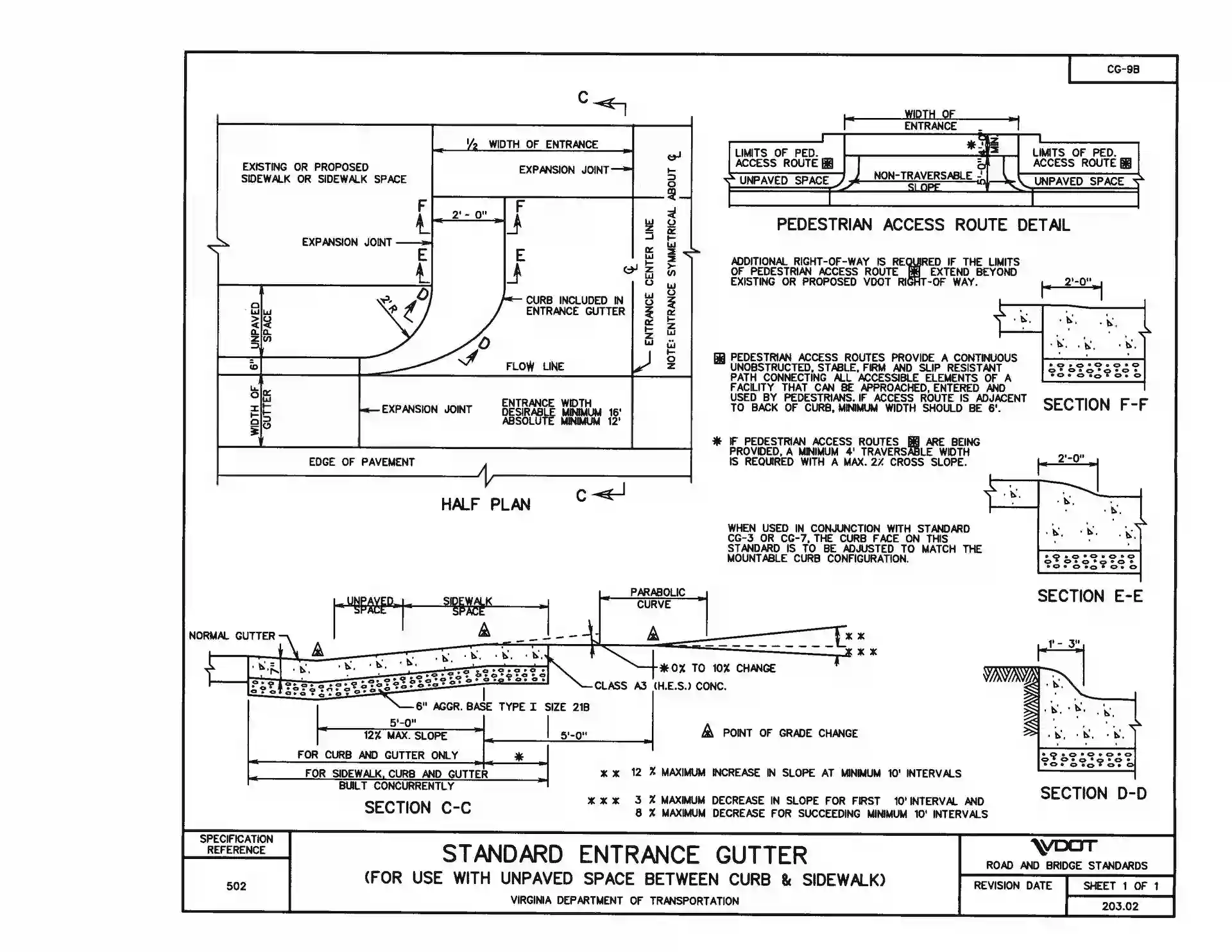
A big part of packaging it correctly is the drawing itself. We generate your apron detail with our own custom drawing system — the throat width, flare radius, gutter, curb, sidewalk PAR, and ADA slopes all dimensioned to the exact VDOT CG-9B or CG-9D geometry — so the reviewer sees a clean, to-scale plan of precisely what we intend to pour. A submittal that already speaks VDOT's language draws fewer review comments and resubmittals.
Will Tuck GC pull a permit without a contract?
While we do offer permit assistance without a project contract, it is expensive. Our schedules are occupied with turnkey projects. Therefore, for permit-only services:
Starting Fee: Approximately $2,000.
This covers multiple trips to take measurements and site photos, as well as spending about 8 hours preparing paperwork. We believe this fee is reasonable considering the administrative workload.
VDOT Design Standards
These are the VDOT entrance standards we build to. On curb-and-gutter streets VDOT uses its entrance-gutter standards (CG-9B or CG-9D, with CG-9A for some sidewalk conditions); on open-shoulder roads the PE-1 standard applies, which permits gravel, concrete or asphalt surfaces.
Local Jurisdiction Specs
Several towns adhere to VDOT standards, but Arlington County, Vienna, Herndon, and Leesburg have their own specs. We build to the standard each jurisdiction's inspector checks.
The Technical Details: Why VDOT Inspects Us
When VDOT issues the land use permit (applied for on form LUP-A under the LUP-PE private-entrance process), they are authorizing us to work on state property. The standards for the apron are significantly higher than the standards for your private driveway. This is because the apron is built to the thickness the entrance standard sets for the public loads that use it, such as trash trucks and delivery vans turning in your entrance.
1. CG-9D Engineering Specs
A standard residential driveway is typically 4 inches thick. A VDOT apron (specifically the CG-9D spec used in Fairfax and Prince William) must be a minimum of 7 inches thick. We use VDOT Class A3 concrete (min 3000 PSI), or the jurisdiction's mix, and we typically upgrade to a 4,000 PSI air-entrained mix.
The Gravel Sub-Base: Concrete is only as strong as what sits beneath it. We install VDOT #21A crushed stone to the depth the entrance standard and permit require (or as the permit specifies), compacted in lifts rather than all at once.
Reinforcement & Joints: We reinforce an apron only where the jurisdiction's detail calls for it. Control joints are tooled (or saw-cut) at intervals set by the slab layout. Where a new slab meets any existing (cold) slab we isolate it with an expansion joint, and if a plant delay keeps the next truck from arriving before the first batch sets, we install an expansion joint at that cold joint (see The Tuck Standard, Section 6F).
2. Erosion & Sediment Control (E&S)
VDOT is extremely strict about mud tracking onto public roads. Erosion and sediment control measures are put in place as the permit or inspector requires, and priced in your scope.
3. The Bond Release Reality
Posting the bond is easy; getting it back requires passing the "Final Acceptance" inspection. VDOT will not release your bond until two conditions are met:
- Hardscape Integrity: The concrete must meet VDOT's acceptance criteria — we build it to the standard VDOT's inspector checks, and our one-year workmanship warranty applies as described in The Tuck Standard.
- Vegetative Stabilization: The disturbed ground around the new apron has to be restored and stabilized with established grass before VDOT signs off and releases the surety.
Scope of Work: Grading vs. Restoration
To ensure total clarity regarding the bond release:
- Tuck GC's Role: We perform a "Rough Grade" around the new apron. We backfill the edges with native soil to ensure the ground is flush with the new concrete.
- Homeowner's Role: The Client is responsible for Final Restoration. This includes applying topsoil, seed, straw, and watering the grass. VDOT will NOT release the bond until you have successfully grown grass at the apron edges. We build the structure; you grow the green.
Don't Risk Your Right-of-Way
An unpermitted apron can surface as a problem later — VDOT can require corrections, and it can come up during a sale. Do it right the first time.