
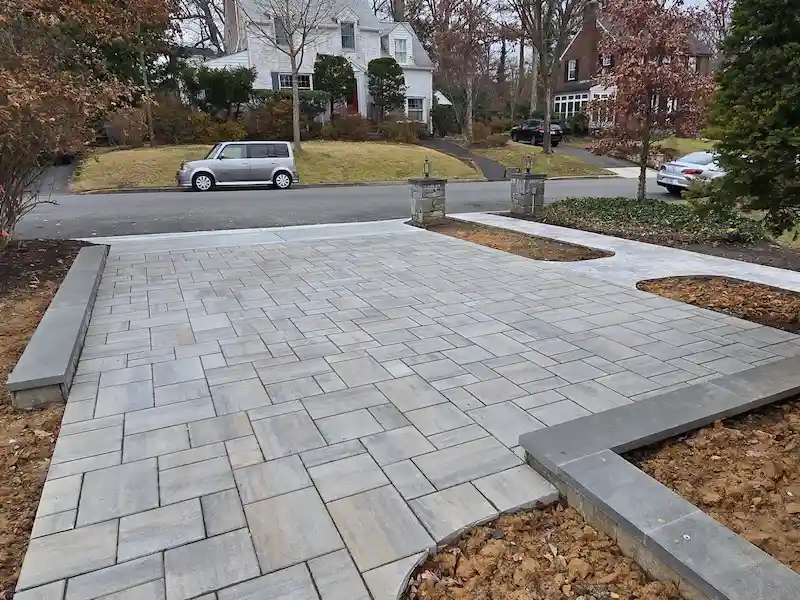
The Diagnosis: The "Wavy Driveway" Syndrome
A paver driveway is one of the most durable driveway surfaces you can install in Fairfax, Arlington, or Alexandria — when it is built on the right base. The failures you see around Northern Virginia (ruts in the tire tracks, settling bricks, weeds in the joints, edge pavers tilting into the lawn) almost never come from the paver. They come from what is underneath it.
Modern interlocking pavers from Techo-Bloc and EP Henry meet ASTM C936, which requires an average compressive strength of at least 8,000 PSI (no single unit below 7,200) and limits water absorption — a denser unit than poured slab concrete. The unit is rarely the weak point. The base is. Many installers build a driveway base the way they would a patio's, and skimp on it. A driveway is not a patio: it carries 5,000- to 6,000-pound SUVs every day, and our Marine Clay subsoil swells and shrinks under it through every freeze-thaw cycle. Skimp on the base and it moves; the pavers simply ride the failure of the base below them.
Two Ways to Build a Paver Driveway — and the One We Recommend
The base does the structural work; the paver is the wear surface. There are two legitimate ways to build that base, and we install both — drawing on 20+ years of hands-on structural concrete and hardscape experience. Most paver crews only offer the aggregate system. Because Tuck GC is a structural concrete company, not just a landscaping outfit, our standard build sets the pavers over a poured concrete foundation. Here are both systems, top to bottom, with the honest pros and cons of each.
System 1: The Concrete-Base Build (Our Standard & Recommendation)
Think of it this way: we first build you a normal concrete driveway like the ones we pour across Northern Virginia — then add a layer of strength and beauty on top of it.
- 1. Excavation & Compacted Stone Bed We excavate for the full section, stripping the topsoil and soft surface material, then install about 4 inches of compacted #21A crushed stone — the same base as our standard 4-inch concrete driveway. Unsuitable soil found during excavation is removed and replaced by Change Order.
- 2. The 4,000 PSI Concrete Foundation Over the stone we pour approximately 4 inches of 4,000 PSI concrete. This slab is the structure: it carries the load and bridges soft spots in the subgrade, so the surface resists the rutting and washout that a loose aggregate bed can develop.
- 3. Wet-Set Mortar Bed Each paver is set into a wet mortar bed bonded to the slab, so the finished surface acts as one monolithic assembly instead of thousands of floating pieces.
- 4. Polymeric Sand Joints & Mortared Edge We typically finish the joints with high-grade polymeric sand and run mortar along the outer edge of the perimeter course to contain it. There is no bond beam on this build because none is needed — the concrete slab itself is the edge-to-edge foundation.
Why we lean this way: tire paths resist rutting, individual pavers are bonded to the slab instead of floating free, and the base is far more resistant to the settlement that sends aggregate systems in for re-leveling and resetting years down the road. And because structural concrete is our core trade, it is the build we know best. The honest tradeoffs: it is a rigid system, so mortar and joints behave like the rest of exterior masonry (see The Tuck Standard), and it is an impervious surface, so it is not the right fit where a project calls for permeable pavers.
System 2: The Open-Graded Base Build (Our Option)
The traditional flexible method: the pavers sit on a compacted base of open-graded stone instead of a concrete slab. Built correctly, it is a proven, legitimate system — and an open-graded stone bed is what permeable paver driveways require, since they must drain freely through the stone (you cannot put permeable pavers over concrete). We build it to the paver manufacturer's and ICPI guidance:
- 1. Excavation We excavate to the depth the paver manufacturer's and ICPI guidance call for, stripping the organic topsoil and the soft, disturbed material sitting over the Marine Clay that underlies Fairfax, Prince William, and the older Arlington and Alexandria neighborhoods. Unsuitable soil found during excavation is removed and replaced by Change Order.
- 2. Geotextile Fabric Where the paver manufacturer's detail calls for it, geotextile fabric goes down over the clay before any stone, as a separation layer that helps keep the stone base from working down into wet clay.
- 3. The Open-Graded Stone Base We place and compact a base of open-graded crushed stone — clean, angular stone without the fines of a dense-graded mix — in lifts, so the vehicle load is carried by the stone.
- 4. ASTM No. 8 Stone Bedding Layer The pavers are set on a bedding layer of ASTM No. 8 stone — never sand.
- 5. Concrete Bond Beam (The Edge Restraint) Pavers tend to fail at the edges first. Plastic edging spiked into the ground can heave loose in a hard frost, and the perimeter pavers start drifting into the lawn. Instead, Tuck GC pours a concrete bond beam: we trowel wet concrete along the full perimeter, locking the outer course of pavers into a continuous wedge of cured cement. That haunch gives the driveway its lateral restraint and helps hold the field in place.
- 6. Polymeric Sand Joints We sweep polymeric sand into the joints and vibrate it down. Misted with water, the binders set up firm but semi-flexible. Polymeric sand discourages weeds, but some growth in shaded joints is normal and the joints want a top-up every 2–3 years (see The Tuck Standard, Section 8D).
The honest tradeoffs: a flexible system moves with frost, and individual pavers can be taken up and re-set (repairs will read differently at first; The Tuck Standard, Sections 8K and 8L) — but the stone bed is doing all the structural work under every tire, and even a well-built aggregate driveway can eventually develop wheel-path settlement that calls for lifting and re-leveling sections. It is the right system for permeable projects and for designs that specifically call for a fully flexible surface.
Which system is right for you? For most paver driveways we recommend — and typically install — the concrete-base build. We steer you to the open-graded build when the project is permeable, when zoning pushes you toward a pervious surface, or when the design calls for a flexible system. Either way, the same workmanship standards and the same warranty in your contract apply.
Material Science: Pavers vs. The Rest
How interlocking concrete pavers (ICP) compare to asphalt on the specs that actually matter in a freeze-thaw climate — strength, how the surface handles ground movement, and how it repairs.
| Feature | Interlocking Pavers | Asphalt |
|---|---|---|
| PSI Strength | 8,000+ PSI (Very High) | Flexible (Low) |
| Base System | Rigid (wet-set on concrete, our standard) or open-graded stone base (option) | Flexible (Will Crack) |
| Repairability | Individual units cut out & re-set (repairs read differently at first) | Visible patch marks |
| Winter Safety | Textured / Slip-Resistant | Varies with surface wear |
| Aesthetics | Custom Colors/Patterns | Industrial/Plain |
Choosing a brand: We are a multi-brand paver installer, so we match the manufacturer to your home rather than to our warehouse. We are an experienced installer of Techo-Bloc (our primary line for driveways, with the deepest catalog of thick, freeze-thaw-tough driveway pavers), as well as EP Henry and Nicolock. We also install Belgard, Cambridge Pavingstones, Unilock and Hanover, plus traditional clay brick when a colonial or estate look calls for it. For a driveway the key specs are paver thickness and shape — we generally steer clients to each manufacturer's thicker driveway-rated units.
The Northern Virginia Factor: Zoning & Permeable Pavers
The "Lot Coverage" Issue: In crowded areas like Arlington, Falls Church, and Vienna, zoning laws limit how much of your lot can be covered by "impervious" surfaces (concrete/asphalt) to prevent flooding. If you want to widen your driveway, you might hit this limit. In Arlington, driveways and parking pads count toward lot coverage whether the surface is concrete, pavers, gravel, or a permeable system.
Permeable Pavers (PICP), a Stormwater Tool: We build Permeable Interlocking Concrete Pavers to the manufacturer's, ICPI and project engineer's specifications. These systems use open-graded stone bases that allow rainwater to drain through the driveway and into the ground. Permeable pavement is a recognized stormwater "Best Management Practice" (BMP) in Virginia, which can help with stormwater and water-quality requirements in Fairfax County. Fairfax still counts a pervious surface toward its front-yard parking limit like any other parking surface. In Arlington, a permeable system can help satisfy stormwater requirements on larger permitted projects, but it does not raise the zoning cap.
Note that the impervious-surface and lot-coverage limits above are local county and city zoning rules governing the private driveway surface itself. The driveway apron — the section that ties into the public road — is a separate right-of-way slab with its own permit; see our Driveways & Aprons hub for the apron permit pathway in your jurisdiction.
What Drives the Cost of a Paver Driveway in Fairfax, Arlington & Alexandria
Paver driveways carry more cost than poured concrete because every unit is laid by hand, and the price tracks the labor and the build beneath the surface. The biggest drivers are the square footage and the paver line you choose — Techo-Bloc, EP Henry, Belgard, Cambridge Pavingstones, Nicolock, Unilock, Hanover, or clay brick all price differently, and driveway-rated thicker units cost more than patio-weight pavers. Demolition and excavation, and the structural base beneath — compacted 21A stone topped with a 4,000 PSI concrete foundation on our standard build, or a compacted open-graded stone base with an ASTM No. 8 stone bedding layer and a bond-beam edge on the open-graded option — are where most of the material goes. Pattern complexity, borders, demolition of an old surface, permits for any apron or widening, and site access on older Arlington and Alexandria lots round out the estimate. We quote every paver driveway individually rather than post a misleading per-square-foot price.
Because every project is scoped to your property, we price each one individually rather than by a flat rate. You'll find our project minimum and a full breakdown of what different budgets cover on our contact page.
See Our Full Pricing BreakdownFrequently Asked Questions
A Driveway Built on the Right Base
Built on a properly constructed base — in our standard build, a 4,000 PSI concrete foundation — a paver driveway is the rare hardscape that gets repaired rather than replaced: individual pavers can be cut out and re-set (repairs will read differently at first; The Tuck Standard, Sections 8K and 8L). That is why a properly installed paver driveway across Fairfax, Arlington, and Alexandria is built on the base that gives it its best chance at a long service life, all while reading as the most finished surface on the street.
Request a Design Consultation