

The Handshake of Your Home: Utility Meets Curb Appeal
The driveway apron is the strip where your driveway crosses the VDOT right-of-way and meets the public road. In unincorporated Fairfax County, that strip is public land, so widening it, cutting the curb, or swapping asphalt for concrete is permitted work — not a job you can simply pour over a weekend. Many homeowners here are boxed in by narrow, builder-grade aprons: 10-foot single-file entries that no longer fit two cars, an SUV, and a teenage driver's sedan.
Tuck GC widens those aprons to the maximum width your frontage and VDOT's field review allow, then builds them to the entrance standard. We don't just pour concrete. We grade the apron to the entrance standard's profile so runoff stays in the gutter line, and carry the VDOT Land Use Permit through for you so the expansion is built legally and to the standard VDOT's inspector checks.
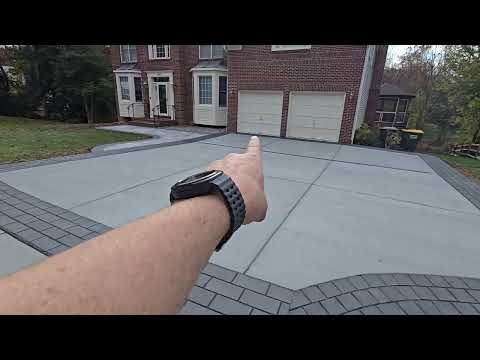
Stop the "Fairfax Car Shuffle" (Solving the Parking Crisis)
Many Annandale, Burke, and Springfield neighborhoods were platted in the 1970s and 80s with 10-foot aprons sized for one car. They can't absorb a second vehicle, an SUV, or a teenager's car, so families end up rotating who parks where every morning and clipping the lawn edge backing out.
The fix is widening, but only as far as the right-of-way allows. We start by locating your water meter, gas service, and the VDOT right-of-way line, then check how VDOT's field review treats your entrance location and sight lines. In our experience, many lots have room to widen the apron enough to turn a single-file bottleneck into a side-by-side, two-car entry that keeps tires off the grass.
Our Widening & Conversion Solutions
- Maximum legal width: We calculate the widest apron your frontage, drainage pipe location, and VDOT's field review of your entrance location and sight lines permit, then build to that line.
- Curb cuts & reshaping: The cut is set where the grades tie in; the curb and gutter are cut or replaced as the entrance standard requires, and the tie-in distance is shown in your scope.
- Asphalt-to-concrete conversion: We remove crumbling asphalt skirts and replace them with VDOT-spec concrete that holds a clean, defined edge at the property line.
- Estate entrances (CG-9D): On larger McLean and Great Falls lots, the CG-9D detail uses a wider radius so longer vehicles can swing in without dropping a wheel off the apron.
Curb Cuts & Extra Parking: The Engineering Details
Adding room for an extra car means modifying the VDOT curb-and-gutter line, and that changes how water runs along the street. Where the gutter flow line moves, the apron has to be graded to the entrance standard's profile so runoff stays in the gutter line and carries to the inlet — the grade requirement VDOT inspects for.
Where new meets old: Where a new slab meets any existing (cold) slab we isolate it with an expansion joint, and if a plant delay keeps the next truck from arriving before the first batch sets, we install an expansion joint at that cold joint (see The Tuck Standard, Section 6F). Control joints are tooled (or saw-cut) at intervals set by the slab layout, and we reinforce an apron only where the jurisdiction's detail calls for it.
Asphalt to Concrete Conversion: The ROI Calculation
The reason Fairfax County homeowners keep converting asphalt aprons to concrete is lifecycle cost. Asphalt is a flexible pavement bound by oils that dry out and stiffen under UV. At the apron — where vehicles turn under full load and plows scrape the edge every winter — that flexibility works against it.
How asphalt fails here: The edges ravel and crack within a handful of years, opening "alligator" cracking that lets water into the stone base. Once the base saturates and pumps out fines, the apron loses support and settles, and the dip pools water at the gutter.
Why concrete: Concrete is a rigid pavement rather than a flexible one. We typically pour a 4,000 PSI air-entrained mix, the industry-standard mix for freeze-thaw climates (spalling and scaling are addressed in The Tuck Standard, Section 5).
The "Grading Secret": Why Apron First?
Fairfax County sits on tough topography, and the VDOT curb, gutter, and sidewalk along the street often sit higher than the driveway behind them. That sets up a decision most homeowners never hear about until it's too late: do you pave the driveway first, or the apron first?
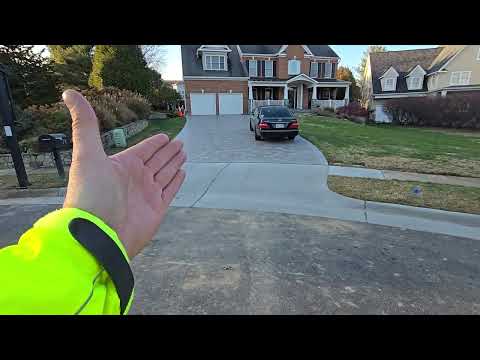
The ramp effect: In the video below, another contractor laid a paver driveway before the apron was touched. With the driveway height already locked in, the apron couldn't be dropped to ease the steep grade off the street. Had we controlled the whole excavation, we could likely have taken the entire entrance down several inches and removed the hump that bottoms cars out.
The Tuck Strategy: Economy of Scale
Doing the apron and driveway in one excavation is about grade control, not looks. When we set both elevations together, we can tune the slope across the whole run — easing the transition off the street within the entrance standard's profile and pitching water away from the garage instead of toward it. Running it as one job also gives our equipment room to work, which trims the hand labor a phased patch-in would cost.
Navigating the VDOT LUP-PE Permit Process
Because the streets in unincorporated Fairfax County are state-maintained, the apron sits in the VDOT right-of-way and the work is authorized through a VDOT Land Use Permit (LUP-PE, applied for on form LUP-A). VDOT ties that permit to the deed, so the property owner has to be the named applicant — a contractor can't pull it in their own name. What overwhelms most homeowners is everything attached to the application: a scaled site sketch showing the entrance and right-of-way, the surety bond that guarantees the work, and, on more involved entrances, a traffic-control plan.
We act as your authorized agent on your permit. Tuck GC assembles the packet — when stamped drawings are required we coordinate with the project's licensed Professional Engineer, we prepare the cost estimate VDOT uses to set the surety (and can post the surety as your agent), and we prepare the full application for your signature. We then submit to the VDOT Northern Virginia District Office and work the review and inspections through. Review sits with VDOT and runs on their schedule — in our experience these reviews commonly take one to two months, longer when their queue is full — so we file early and keep you posted; we don't promise a date we can't control. We build to the standard VDOT's inspector checks, from the aggregate base depth to expansion-joint placement, and we pull the permits for our scope of work.
Fairfax County LUP-PE Technical Requirements
Inside the VDOT right-of-way, the apron has to meet VDOT Road & Bridge Standards, and the inspector signs off against them. These are the specs the inspector checks, and how we build to them:
| Specification | VDOT / Fairfax County Standard |
|---|---|
| Concrete Strength & Thickness | Class A3, min. 3,000 PSI, 7 in thick per CG-9D (we typically upgrade to 4,000 PSI air-entrained) |
| Base Material | Compacted VDOT #21A crushed stone, placed in lifts, to the depth the entrance standard and permit require (or as the permit specifies) |
| Utility Separation | Clearance from hydrants & utility poles as directed by VDOT/utility owners at field review |
| Entrance Grade | Must not direct water onto the public roadway |
| Pipe Sizing | Material and size set by the job design and the VDOT permit after field review (often galvanized steel, sometimes HDPE), with the end treatment the permit requires, if a culvert is required |
What Drives the Cost of a VDOT Driveway Apron in Fairfax County
No two aprons price the same, because the cost is set by what your lot and the VDOT right-of-way require. The largest drivers are the width and square footage of the new apron, whether we're converting asphalt to 4,000 PSI concrete or pouring fresh, and how much demolition and subgrade remediation the old entrance needs. From there it scales with the curb-cutting and saw work, the VDOT Land Use Permit, surety bond, and any PE-stamped drawings the application calls for, whether a culvert pipe has to be extended or replaced, and how tight site access is for our equipment.
Straightforward Pricing
Because every apron, curb cut, and permit package is scoped to your property, we price each one individually rather than by a flat rate. You'll find our project minimum and a full breakdown of what different budgets cover on our contact page.
See Our Full Pricing BreakdownFrequently Asked Questions
Related Apron Resources
Explore our full Driveways & Aprons hub for the complete range of entrance and surface options. For the broader engineering and permitting overview, see our VDOT Apron service page. Building in a neighboring VDOT county? See VDOT Aprons — Loudoun County.