
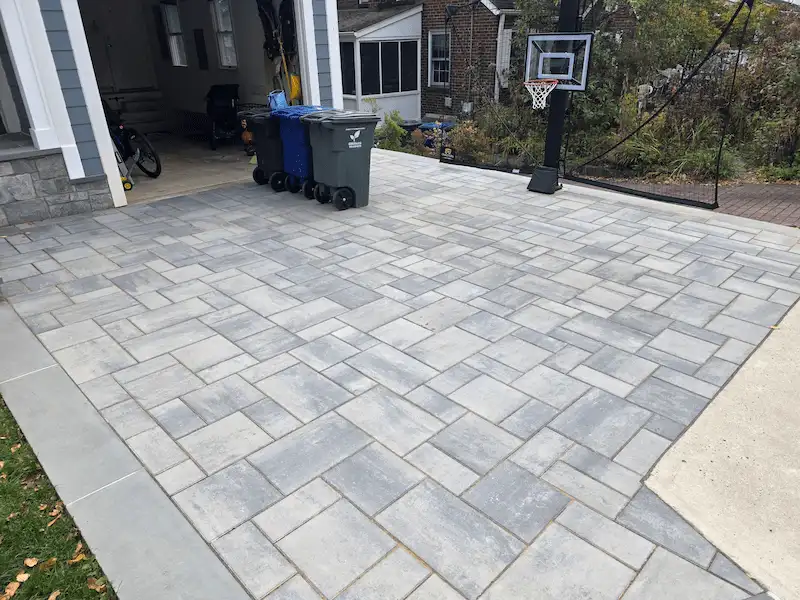
Lot Coverage vs. Stormwater: What Permeable Pavers Can Do
A permeable paver driveway lets water drain straight through the surface into a stone reservoir below, instead of shedding it to the street. That single difference is why homeowners in Arlington, Vienna, and McLean look at permeable pavers when their lot is near its coverage limit. The honest answer is that it helps with stormwater, not with the zoning cap: in Arlington and Vienna a driveway still counts toward lot coverage whatever the surface.
When you want to widen the driveway, build a pool, or add a patio, stormwater and lot-coverage review can both become sticking points. Permeable Interlocking Concrete Pavers (PICP) can help on the stormwater side. Unlike a standard driveway that runs rainwater off into the gutter, a Tuck GC permeable driveway works as an underground stormwater facility — managing the water on your own lot, beneath a finished paver surface.
⚠️ Zoning Warning: Arlington & Vienna
Arlington County and the Town of Vienna both enforce lot-coverage limits: Vienna caps lot coverage at 25% in its single-family zones, while Arlington's caps run from 40% in R-6 (up to 43-45% with porch/garage bonuses) to 53% in R-5 — and in both, your driveway counts toward the total. Pushing coverage past that cap — or paving without a permit — can draw code-enforcement fines and an order to tear it out. In some jurisdictions a permeable surface earns a partial coverage reduction or stormwater credit; in Arlington and Vienna it still counts toward lot coverage. In Arlington, driveways and parking pads count whether the surface is concrete, pavers, gravel, or a permeable system. If your lot is at or near its limit, the options are reducing other counted coverage on the lot or seeking a variance. We confirm the coverage numbers before we quote.
Not Just "Pavers on Gravel"
A permeable driveway is a civil-engineering project, not a finish material. The whole assembly has to work as a storage-and-infiltration system: every layer is open-graded, clean, washed stone so water can move down through it freely, and the depth is sized to hold a design storm and release it slowly into the soil. That means deep excavation and aggregate chosen for void space, not just compaction — which is why it prices well above a standard paver job and why the geology under your lot decides the whole design.
A Typical Permeable Section
We build to the ICPI / CMHA permeable interlocking concrete pavement guidance, the paver manufacturer's details, and the project engineer's design. A typical PICP system stacks open-graded, washed aggregate in graded sizes — joint chips, bedding, base, and reservoir — over a geotextile-lined subgrade, so water is designed to move down through each layer instead of ponding at the surface. The typical section is shown below; final depths and any overflow are set by the project engineer, and we build to it.
-
LAYER 1
Top SurfacePermeable Pavers
The manufacturer's vehicular-rated permeable pavers, with widened joints. These joints are filled with ASTM No. 8 or No. 9 Stone Chips—not sand—to let water pass through. -
LAYER 2
BeddingBedding Layer (ASTM No. 8)
A layer of clean crushed stone that the pavers are set on, while allowing vertical drainage. -
LAYER 3
BaseBase Layer (typically ASTM No. 57)
An open-graded stone layer between the fine bedding and the large reservoir stone. -
LAYER 4
Per DesignThe Subbase "Reservoir" (typically ASTM No. 2 Stone)
This is the layer that does the real work. Large angular stone carries vehicle loads while leaving open void space between the rocks. That void stores storm water underground and releases it into the soil as conditions allow; its depth is set by the project engineer. -
LAYER 5
SubgradeGeotextile Fabric
Filter fabric, per the manufacturer's and engineer's specification, separates the stone from the clay soil.
The "Perc Test" Variable
The single factor that drives the design — and the cost — is your soil's infiltration rate, which is measured with a perc (percolation) test before the system is designed. The slower the native subsoil drains, the deeper the reservoir has to be to hold the same storm, because the water leaves the stone more slowly than it arrives. The project engineer sets the final reservoir depth; typical ranges:
- Free-draining soil (sand / loam): high infiltration rate, so a 12-18 inch reservoir can store and release the design storm.
- Heavy marine clay (common across Northern Virginia): infiltration can fall near zero. The reservoir has to grow deeper — often 24-36 inches — to bank the water while the clay drinks it back slowly. This is why a McLean or Arlington lot on clay costs more to build than the same square footage on sandier ground.
Note: In extreme failure cases (where water won't drain at all), the project's licensed PE details an overflow pipe connected to the municipal storm sewer or a dedicated pop-up emitter, and we build to that stamped design.
Inspection & Permitting
A permeable driveway in Arlington or Fairfax can be a permitted stormwater installation, not a surface swap. When the job crosses the county's land-disturbance threshold (2,500 sq ft in Arlington) or is enrolled as a stormwater credit, it runs on the county's plan-review clock — often 30-plus days before approval — and inspection of the open excavation is part of that sequence.
1. Engineering Plans
We partner with the area's licensed engineering firms to produce the stamped CAD drawings—showing slope, stone depths, and gallon retention capacity—and submit them to the Zoning department.
2. Mid-Point Inspection
On jobs in that plan-review sequence, the county inspects the open excavation to verify we used the correct clean stone (washed aggregate) and Geotextile fabric before we lay a single paver.
What Drives the Cost of a Permeable Paver Driveway in Arlington & Fairfax
A permeable driveway is a civil-engineering project, so it prices above a standard paver job — and the cost lives mostly below the surface. The biggest drivers are the square footage, the perc-test result that sets how deep the stone reservoir must go (good soil may need 12-18 inches; heavy marine clay can push it to 24-36 inches of excavation and washed aggregate), and the permeable paver line you choose — Techo-Bloc Aquastorm, EP Henry ECO, Belgard's Aqua-series (Aqua-Bric, Aqua Dublin), Unilock Eco-Priora, or Nicolock. Engineered drawings, any required open-pit county inspection, demolition, and any overflow tie-in to a storm sewer or pop-up emitter add to the scope, as does site access on tighter Arlington and Vienna lots. The project engineer sizes the system from your perc test, and we quote each project individually rather than post a misleading per-square-foot price.
Because every project is scoped to your property, we price each one individually rather than by a flat rate. You'll find our project minimum and a full breakdown of what different budgets cover on our contact page.
See Our Full Pricing BreakdownMaintenance: The "Vacuum" Myth
Many homeowners worry about maintenance. The reality is simple: Keep the joints clean.
Can I power wash it?
No. High-pressure washing can blast the stones out of the joints. We recommend using a leaf blower regularly to keep organic debris (leaves/mulch) off the surface.
What if it clogs?
Every 3-5 years, the joints may need "regenerative maintenance": vacuuming out the top layer of sediment and replacing it with fresh, clean #8 stone chips, which helps restore the system's infiltration.
Will a permeable driveway help with my lot coverage limit in Arlington or Vienna?
Usually not in the way people hope. Arlington and Vienna count a driveway toward lot coverage whether it's paved, gravel or permeable. A few jurisdictions — the City of Falls Church, for example — give a partial reduction for pervious surfaces. Where a permeable system does help is stormwater: it can reduce runoff and may earn stormwater-utility or stormwater-review credit. We confirm your lot's coverage math with the zoning office before design. In Arlington, if your lot is at or near its limit, the options are reducing other counted coverage on the lot or seeking a variance.
Which permeable paver brands do you install?
We are a multi-brand installer and build permeable systems with the major manufacturers' permeable lines, including Techo-Bloc Aquastorm, EP Henry ECO pavers, Belgard's Aqua-series (Aqua-Bric, Aqua Dublin), Unilock Eco-Priora, and Nicolock permeable pavers. We are an experienced installer of Techo-Bloc, EP Henry, and Nicolock, and we match the paver to your soil's infiltration rate and the look you want. Prefer a solid surface? Compare a standard paver driveway instead.
What happens if my soil drains poorly during the perc test?
Heavy marine clay drains slowly, so the stone reservoir usually has to be deeper, sometimes 24 to 36 inches, to hold the water until it can soak in. In extreme cases where water will not drain at all, the project engineer details an overflow connection to the municipal storm sewer or a pop-up emitter, and we build to it. If your real problem is concentrated surface runoff, a driveway channel drain can be paired with the system. The project engineer sizes the system from your perc-test results, and we route final pricing through a site consult.
Ready to Expand Your Driveway Legally?
Work with a Class A contractor who builds permeable driveways to the engineering — perc test, reservoir sizing, inspection, and all — so the system is built to the approved design and the standard the inspector checks.
Request a Site Consult