
The #1 Cause of Basement Leaks
Burying your downspouts means piping roof runoff underground through rigid PVC to a discharge point well away from the house, instead of letting it spill out of a splash block a few feet from the wall. The reason it matters: an inch of rain on a typical Northern Virginia roof sheds hundreds of gallons, and a downspout concentrates all of it at one spot against the foundation. A two-foot plastic splash block just dumps that flow back into the backfill zone — the looser, more permeable soil that was disturbed when the basement was dug and refilled. Water follows that backfill straight down along the wall.
Once that soil saturates, it loads the wall with hydrostatic pressure — water standing against concrete pushes inward and works its way through pores, cold joints, and hairline cracks. The visible results are flooded basements, efflorescence and damp block, bowed foundation walls, and slabs that crack as the ground beneath them moves. At Tuck GC, we hard-pipe the runoff to a controlled discharge point well away from the foundation so the water is carried off instead of pooling against the wall. We treat roof runoff as a structural problem, not a landscaping nuisance.
1. The Diagnostic: We Do Not Use "Black Corrugated"
Most crews that bury downspouts reach for cheap, flexible black corrugated pipe because it's fast to lay and needs no glued fittings. The problem is its thin, accordion wall has almost no crush resistance. Settling soil, a riding mower, or foot traffic flattens a section, and a single flat spot becomes an underground dam that holds water exactly where you were trying to move it away from.
The ribbed interior is the second failure mode. Every corrugation is a ledge, so the leaves, roofing granules, and shingle grit that wash off the roof catch and build up instead of flushing through. Within a few seasons the line packs solid. The joints are the third: corrugated runs are taped or snapped together rather than sealed, and tree roots find those gaps, grow into the standing water, and choke the line off. The compounding problem is that a corrugated pipe can't be rescued — there are no cleanouts and the ribbed wall won't pass a snake, so once it clogs or crushes the only fix is to dig the whole run up and start over.
2. The Tuck Standard Protocol: Rigid PVC Drainage
We build buried downspout lines with rigid, smooth-wall PVC and glued joints to carry roof water away from the foundation. Here is how the system goes in:
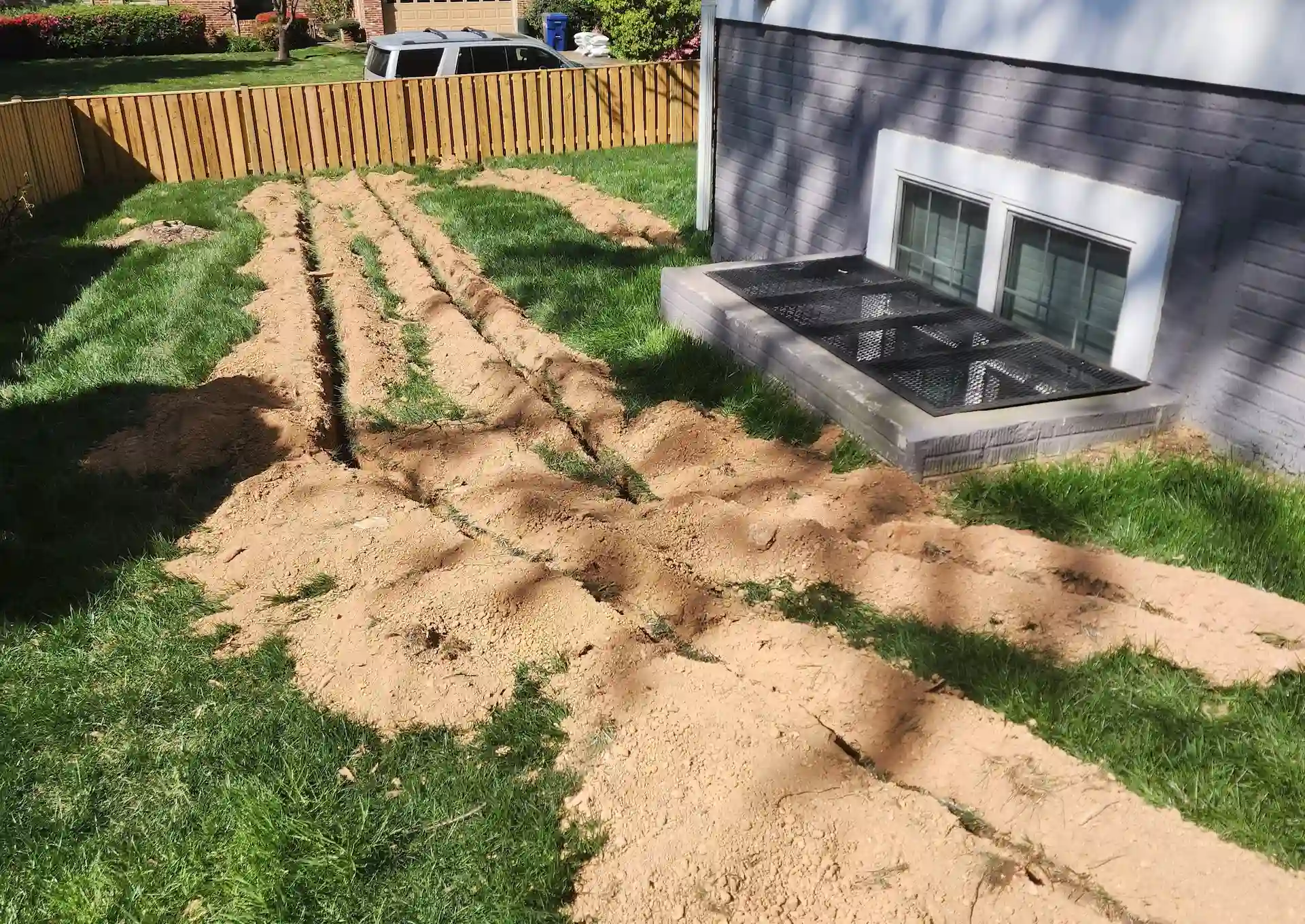
- Grade Check & Trenching The system runs entirely on gravity, so the grade has to be right before anything goes in the ground. We check the grade along the line and set the trench to a continuous fall to the discharge point to keep water moving instead of sitting. We then dig the trench deep enough to protect the pipe from mowers and lawn equipment while holding a continuous fall to the discharge point, cutting and setting aside existing sod to relay over the finished run where practical; otherwise we backfill and rough-grade, and new seed or sod is a contract line item.
- Rigid PVC Installation We run rigid, smooth-wall PVC pipe that resists crushing far better than corrugated pipe. Just as important, the bore is smooth instead of ribbed, so the leaves and shingle grit that catch in corrugated pipe are more likely to stay in the flow and move on through. A continuous fall in a smooth pipe helps carry debris toward the discharge.
- Glued & Sealed Joints Joints are primed and solvent-welded — the cement chemically fuses the two pieces of PVC rather than just gluing a surface. That resists root intrusion and leaks far better than taped or snapped fittings, though roots and clogs remain possible over time (The Tuck Standard, Section 10E).
- Clean-Outs Integration We install surface-level cleanouts so the line can be serviced. If heavy autumn debris or shingle grit builds up, you or a maintenance pro can drop a hose or a plumber's snake straight in and flush it — something a corrugated line makes very hard to do.
- Discharge Options Where the water exits is dictated by your lot's slope and your jurisdiction's discharge rules. Pop-Up Emitters are a discreet lawn-level lid that lifts under flow and snaps shut when dry to keep debris and critters out — the default where the yard falls away from the house. Curb Coring, where the local jurisdiction permits it, cores through the street curb so the line discharges into the public gutter. Dry Wells handle flat lots with nowhere to daylight: a stone-filled pit set well away from the foundation that stores storm surge underground and releases it into the soil as conditions allow.
3. Material Science: Rigid PVC vs. Corrugated Plastic
| Specification | The Tuck Standard (Rigid PVC) | Standard Landscaper (Corrugated) |
|---|---|---|
| Pipe Wall Strength | Rigid, smooth-wall PVC; resists crushing far better than corrugated pipe. | Paper-thin plastic; easily crushes under mowers. |
| Interior Surface | Smooth interior; debris flushes more easily. | Ribbed; catches leaves and clogs constantly. |
| Joint Integrity | Solvent-welded joints; resist roots and leaks far better than taped fittings. | Taped or snapped; roots easily penetrate. |
| Maintenance | Cleanouts for flushing and snaking. | No cleanouts; very hard to snake without digging it up. |
| Lifespan | Long service life with basic maintenance. | Commonly fails within a few seasons in our clay. |
4. The Northern VA Factor: Soil Saturation and Local Codes
Downspout burial matters more here than in most of the country because of what's under the lawn. Across Fairfax County, Prince William County, Burke, Springfield, and Woodbridge, the native subsoil is heavy marine clay — a dense, expansive soil that swells as it takes on water and shrinks as it dries. When a downspout keeps feeding water into the clay against your foundation, the soil expands and presses laterally on the wall; that swelling pressure is what bows a block wall inward and opens the stair-step cracks foundation crews get called out for. The freeze-thaw cycles our winters add only make it worse, since saturated clay heaves as it freezes. Carrying the roof water well away from the foundation to a pop-up emitter or dry well removes the single largest source of that saturation before it can load up against the wall.
In the tighter jurisdictions — Arlington, Alexandria, Falls Church, and the Town of Vienna — lots are small and you can't legally push your bulk roof runoff onto a neighbor's property or off-site without a sanctioned discharge point. There we lean on dry wells that help keep the water on your own parcel, or curb-coring where the jurisdiction allows a tie-in to the public gutter. We confirm the local zoning and stormwater rules first so the system discharges somewhere it's actually allowed to.
5. What Drives the Cost of Buried Downspout Drainage in Northern Virginia
Every yard prices differently because the work is driven by your site, not a flat per-foot rate. The biggest factors are the number of downspouts being tied in, the length and depth of trenching to reach a safe discharge point well away from the foundation, and the discharge method your topography demands — a simple pop-up emitter is far less involved than a deep dry well excavated and filled with washed stone, or permitted curb-coring through a public gutter. Soil and access matter too: heavy marine clay and tight Arlington or Alexandria lots add labor, and any work that ties into a public system carries its own local coordination. We confirm the requirements with your county or city and quote each system individually.
Because every project is scoped to your property, we price each one individually rather than by a flat rate. You'll find our project minimum and a full breakdown of what different budgets cover on our contact page.
See Our Full Pricing Breakdown6. Downspout Burial FAQ
Freeze damage is rare in a properly built system, and gravity is the reason. We set the trench to a continuous downward slope, so water drains out instead of sitting in the pipe — a line that empties between rains leaves little or nothing behind to freeze. No one controls the weather, which is why we also install cleanouts: if an outlet ever ices over in a hard freeze, the line can be checked and cleared instead of dug up.
We cannot defy gravity, but we can build around it. If your yard lacks the necessary slope to run a pipe to a pop-up emitter at the curb, we will install a subterranean Dry Well system. We excavate a pit well away from the foundation, line it with geotextile fabric, fill it with clean washed stone, and pipe the downspouts directly into it; the dry well stores storm surge underground and releases it into the soil as conditions allow.
Yes. We install a transition adapter that connects your rectangular aluminum or copper downspout to the round PVC pipe just above the soil line, for a clean, architectural finish.
Burying downspout piping on your own private property is typically handled as a private drainage improvement, but several Northern VA jurisdictions regulate where the water can discharge and how it ties into a public system. Local county and city zoning and stormwater rules govern things like impervious-surface limits and discharge points, and any work that connects to the street curb or a public gutter is a separate matter from the apron in the public right-of-way. We check the local requirements that apply before we dig, and we pull the permits for our scope of work.
Yes. Roof runoff is only one part of a wet-yard problem. We routinely combine buried downspout piping with broader yard drainage grading and with surface collection like driveway channel drains so that roof water, surface water, and driveway runoff all move to the same discharge point. We lay out the full system together so the components work with one another.
7. Stop the Saturation Today
Repairing a flooded basement or a bowed foundation wall runs into the tens of thousands of dollars; a buried downspout system costs a fraction of that and works on the cause — roof water soaking into the soil beside the wall. From the dense clay of Manassas to the tight curb codes of Arlington, Tuck GC installs rigid, smooth-wall PVC drainage — a companion service to our full Driveways & Aprons work, scoped and contracted as its own line item. Stop relying on plastic splash blocks and move your roof water away from the foundation.