
The Engineering of a First Impression
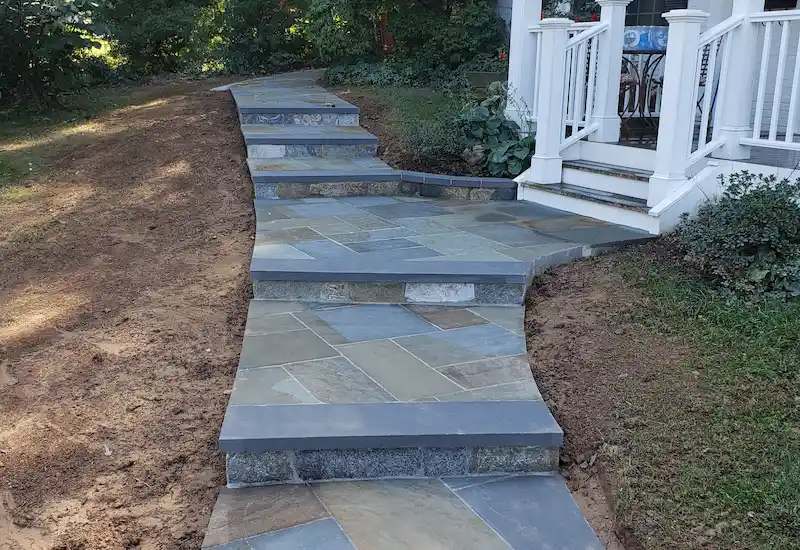
A stone or paver walkway is the first thing a guest reads about your home. When you replace a cracked builder-grade concrete sidewalk with hand-set flagstone, bluestone, or brick, the goal is a path that improves curb appeal and is built on the base that gives a walkway its best chance at a long service life. We lay out walkways that follow the grade of your lot, with the curves, landings, and integrated lighting that make a front entrance walk safely after dark. For softer, informal routes through a backyard or garden bed we also build garden pathways; a front entrance demands the structural wet-set masonry detailed below.
Across McLean, Great Falls, Arlington, and Fairfax Station, Tuck GC builds structural stone walkways designed to resist settling, shifting, and cracking. In Northern Virginia, a front walk is not a cosmetic surface — it is a structural element. It has to carry foot traffic over expansive Marine Clay that swells when wet and shrinks when dry, shed water away from your foundation, and absorb the freeze-thaw cycling that defines a Mid-Atlantic winter, where the ground can thaw and refreeze dozens of times between December and March. Every detail below exists to manage those three forces.
The Diagnostic: Why NoVA Walkways Fail
Walkway failure is almost always a base failure that shows up at the surface. The stone itself rarely fails; what moves underneath it does. Most installers in Fairfax and Prince William County treat a walk as a light-duty job, and the defects follow a predictable pattern:
- Insufficient subgrade compaction: Stone set over loose backfill consolidates unevenly, opening up the low spots ("birdbaths") that pond water and trip guests, often within the first two seasons.
- No geotextile separation: Without a woven separation fabric between subsoil and base, the crushed-stone aggregate slowly pumps down into the soft clay every time the soil saturates, and the base thins until the path sinks.
- Improper water management: A walk that isn't pitched to shed water traps water against the slab and the foundation. In Northern Virginia that trapped water freezes, expands, and jacks the path — the same freeze-thaw mechanism that ruins a dry-set walk also turns a flat one into an ice sheet by January.
The Tuck Standard Protocol: 5-Step Path Engineering
- Structural Excavation & Soil Analysis We excavate to design depth, pulling out the topsoil, roots, and organic matter that hold water and rot away under a path. We check the exposed subgrade before anything is built on top of it — soft ground turns up in areas like Clifton or Oakton — and unsuitable soil found during excavation is removed and replaced by Change Order (see The Tuck Standard, Section 3G).
- Compacted Base & Concrete Slab Over a compacted aggregate base we pour a 4-inch, 4,000 PSI concrete slab with 6x6 welded wire mesh pulled up into the slab. The pad behaves as one continuous element: instead of a frost lens lifting a single stone, the slab carries the walk, which reduces (though it cannot eliminate) the stone-by-stone heaving and settling a sand-set walk sees (see The Tuck Standard, Section 5F).
- Hand-Cut Stone Geometry Our dedicated trade crews and specialized trade partners, under Tuck GC's direct management, hand-cut each piece of Pennsylvania Bluestone, full-color flagstone, or brick to fit. We work to tight joints, which take far more cutting and layout skill than the wide, grout-heavy joints that erode and weed out — but they read cleaner and give water less surface to attack.
- Full-Bed Mortar Bond Each stone is set in a full bed of our standard mortar on the cured slab, then the joints are packed solid. Bonding the stone to the concrete — rather than floating it on sand — is what helps it ride out the repeated temperature swings common in Loudoun and Fairfax; mortar is rigid, so expect hairline joint cracks over time and periodic joint maintenance (see The Tuck Standard, Sections 8C and 8E).
- Finishing We finish with the appropriate jointing compound, keeping a slip-resistant natural texture underfoot. We don't apply a sealer as part of the install.
Material Comparison: Structural Performance
| Material Path | Tuck Standard (Wet-Set Masonry) | Standard Landscaper (Dry-Set/Sand) |
|---|---|---|
| Base Foundation | 4" Concrete Slab (4,000 PSI) with Welded Wire Mesh | 2" of loose sand or stone dust |
| Movement Profile | Rigid Masonry (moves with the slab, not stone by stone) | Flexible (Subject to Frost Heave) |
| Weed Prevention | Solid Mortar Joints | Sand joints (requires constant weeding) |
| Longevity | Built for long service life | Shifts and needs resetting far sooner |
The Northern Virginia Factor: HOAs & Marine Clay
In planned neighborhoods like South Riding, Ashburn, and Burke, the Homeowner Association governs front-facing masonry, and a change to your entrance path usually needs Architectural Review Board (ARB) approval before work starts. We support that submission with material samples, a layout, and the technical specifications the board asks for, so the path you want is the path that gets approved.
The harder problem is the soil. Much of Gainesville and Bristow sits on Marine Clay — a fine, expansive soil that swells as it takes on water and shrinks as it dries, moving enough through the seasons to lift and crack anything set directly on it. A compacted base under a concrete slab spreads that movement across the whole walk instead of letting it concentrate under one joint; it reduces, but cannot eliminate, the effects of the clay cycling with Virginia's humidity (see The Tuck Standard, Section 5F). A front walkway is one piece of our broader patios & hardscapes practice, so we can tie the path into coordinated landings, steps, and terraces in a single design.
What Drives the Cost of Stone Walkways in Fairfax & Arlington
A wet-set stone walkway is a structural build, not a surface dress-up, so the price is driven by the real work underneath. The biggest cost drivers are the linear footage and width of the path, the stone you select (Pennsylvania Bluestone, full-color flagstone, or clay brick), and the amount of demolition and site prep needed to remove a failing concrete sidewalk. Beyond that, the concrete slab base and full-bed mortar setting, any landings, steps, or curves that add hand-cutting, integrated lighting, and site access on tight Arlington or McLean lots all move the number. We price every walkway individually rather than quote a misleading per-square-foot figure.
Because every walkway is scoped to your property, we price each one individually rather than by a flat rate. You'll find our project minimum and a full breakdown of what different budgets cover on our contact page.
See Our Full Pricing BreakdownTechnical FAQ: Stone Walkways
Build a Walkway That Outlasts the Soil Under It.
Tuck GC builds wet-set stone and paver walkways across Fairfax, Arlington, Alexandria, Springfield, and Gainesville. If you want a front entrance built on a real foundation for the freeze-thaw and the clay, start with a site evaluation.
SCHEDULE A SITE EVALUATION