
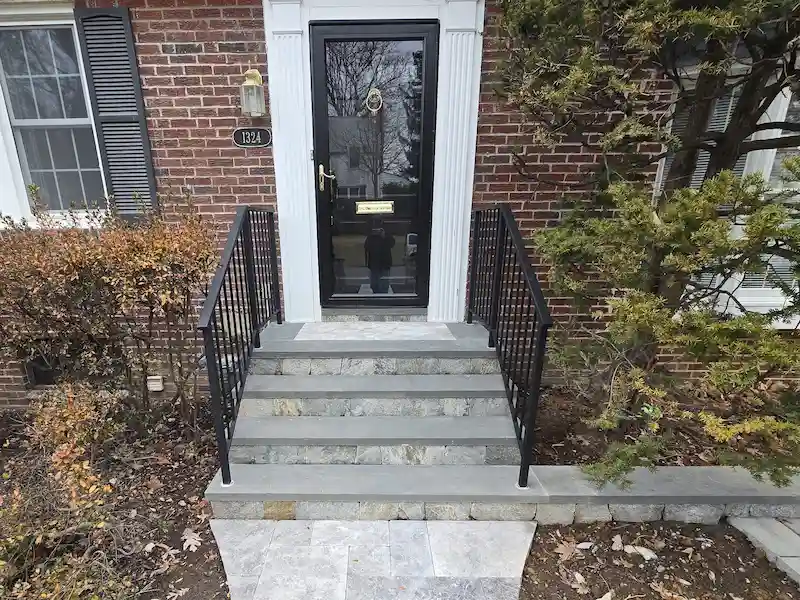
Safety Starts at the Front Door
A brick or stone front stoop is the most punished masonry on the house. It takes daily foot traffic, package deliveries, and the full freeze-thaw cycle, and it does it on stairs where a single loose brick or pitched tread becomes a fall. The reason most front steps in Alexandria and Arlington fail is structural, not cosmetic: the original steps were set on a shallow base that settles, so the whole stoop tips forward and pulls away from the threshold. Patching won't fix that. Where the structure has failed, we demolish the stair and rebuild it from a frost-depth footing up, with a concrete masonry unit (CMU) core, brick or stone facing selected to suit the house, and thick thermal stone treads that carry the walking surface in as few solid pieces as practical. Where the structure is sound, restoration is also a legitimate choice (see The Tuck Standard, Section 3S).
In the historic districts of Alexandria and the older neighborhoods of Arlington, a front stoop also has to read correctly against the architecture of the house, and street-facing masonry is often reviewed by a Board of Architectural Review. The build below holds to modern code for rise, run, and handrail loads while sourcing brick to suit the existing facade and tooling the joints to the period profile. Fresh mortar always reads brighter than aged joints at first — we use one standard mix and never tune mortar color (see The Tuck Standard) — and the difference generally softens as the work weathers; how much and how quickly depends on exposure.
1. The Diagnostic: The Poured Concrete Trap
Most tract homes in Northern Virginia — especially those built in the 1980s and 90s across Fairfax County, Springfield, Burke, and Annandale — sit on pre-cast or hollow-poured concrete front steps. Those steps were set on a shallow pad poured well above the frost line, so the soil under them moves with the seasons. Virginia's heavy, water-holding Marine Clay swells when wet and shrinks when dry, and it heaves when the moisture in it freezes. Each cycle nudges the slab, and because the mass sits high on unstable fill, it rotates forward and away from the house. That opens a gap at the threshold and lets water and pests track straight into the subfloor and band joist behind the stair.
The common "fix" is to cap the old concrete with thin slate or flagstone set in thinset over the existing steps. It fails for a simple reason: the substrate underneath is still cracking and shifting, so it telegraphs every movement up through the thin tile. Water wicks into the hairline joints, freezes, expands roughly nine percent, and shears the stone off the riser — usually inside one winter. A cap treats the surface and ignores the footing that actually failed. When the footing is what failed, the durable repair is to remove the failed structure and rebuild on a footing that sits below the frost line.
2. The Tuck Standard Protocol: Solid Thermal Stone Treads
Two principles drive the build: the stoop has to bear on its own footing set below the frost line over a properly prepared, compacted base, isolated from the house and any adjacent slab, and the walking surface has to shed water with as few seams as possible. Every joint is a place water can enter, freeze, and pry the assembly apart, so we keep the horizontal surfaces close to monolithic. The sequence:
- Demolition and Frost-Line Excavation We remove the failing structure and excavate below the local frost line, to the depth and size the approved plans and soil conditions call for (the published minimum footing depth in Northern Virginia, Fairfax and Loudoun, is 24 inches below grade), stripping out the loose, soft surface material as we go. We compact the base and pour a concrete footing sized to spread the stoop's load across that prepared bearing surface, so the stair bears on a prepared base instead of the loose fill the old one failed on. The stoop sits on its own footing, isolated from the house and any adjacent slab. A footing below the frost line reduces the risk of the rebuilt stoop heaving or rotating forward through a Northern Virginia winter; everything above it depends on getting this depth right.
- CMU Core and Solid Fill The core of the stoop and stairs is built in concrete masonry units (CMU block) on the footing, with the cells filled solid as your proposal specifies, so the core carries the brick facing and stone treads.
- Thick Thermal Stone Treads Treads are 1.5-inch to 2-inch thick thermal-treated stone slabs — typically Pennsylvania Bluestone or premium flagstone — custom-cut to span each step in as few pieces as the step width and stone sizes allow. A thermal finish is flame-textured for traction underfoot, which matters on stairs in ice. Running each tread in large pieces removes the field of mortar joints that thin patchwork stone depends on, so there is almost nothing on the walking surface for water to get into. The slab thickness also gives the step a true stone edge, or bullnose, instead of a thin applied lip.
- Brick and Stone Risers The risers and sides are faced in masonry chosen to suit the house — historic red brick on an Arlington or Alexandria colonial, or a dry-stacked natural stone veneer where that suits the architecture. The facing is selected so the stoop reads as part of the building, not an add-on, while the stoop itself stays isolated from the house foundation. Where the stoop meets an exposed block foundation, we often carry the same foundation veneer across the adjacent wall so the entry reads as one continuous stone face.
- Pitch and Drainage Each tread and the top landing are set with a slight forward pitch so rain sheets off the nose of the step instead of pooling. That keeps water from standing on the treads, soaking back toward the threshold, or freezing into a glaze on the landing where people stand.
3. Material Science: The Tread Comparison
| Tread Material | Aesthetic Impact | Durability & Longevity | Seam Density |
|---|---|---|---|
| Thick Thermal Slab (Tuck Standard) | Massive, luxurious, clean horizontal lines. | Excellent. 2-inch thick stone shrugs off everyday impact and frost far better than thin material. | Minimal. Large solid pieces span the opening. |
| Thin Irregular Flagstone (Patchwork) | Busy, highly textured, "crazy paving" look. | Poor on stairs. Thin pieces easily pop loose under foot traffic. | Extremely high. Dozens of vulnerable mortar joints. |
| Standard Paver Blocks | Commercial or driveway aesthetic. | Prone to settling and shifting on vertical applications. | High. Requires constant re-sanding of joints. |
| Poured Concrete | Utilitarian, basic builder-grade. | Will eventually crack and spall from de-icing salts. | N/A (Solid pour, but prone to cracking). |
4. The Northern VA Factor: Historic Compliance and Code
Rebuilding a front stoop in Northern Virginia usually means working inside two sets of rules at once. In the City of Alexandria and the older districts of Arlington and Falls Church, a Board of Architectural Review governs changes to street-facing masonry, so the brick and the joint profile have to suit the period of the house. Where the district calls for it, we source reclaimed or historic-style brick (sourcing outside our standard supply is priced by Change Order; see The Tuck Standard, Section 8A) and tool the joints to the profile the district requires, so the stoop can go to review while sitting on a modern footing the eye never sees; no brick match is promised. Mortar is our standard mix — we do not use pigmented or color-tuned mortars, no mortar color match is guaranteed, and the difference typically softens as the joints weather. Structural rebuilds — new footings, changed heights, attached landings — also need a local building permit and inspection in most Northern Virginia jurisdictions, while simple like-for-like repairs often don't; we confirm and file when required, and permit review runs on its own timeline, separate from the few days the install itself takes.
The building code also fixes the geometry of the stair. Rise and run have to stay consistent within tight tolerances — the code limits the variation between the tallest and shortest riser in a flight to 3/8 inch, because an uneven step is exactly what catches a toe. Under the IRC adopted across Fairfax and Arlington, a flight of four or more risers needs a graspable handrail. We lay out the rise and run before any block is set so the finished stair is uniform and compliant. Handrails are supplied and installed by our railing trade partner (see The Tuck Standard, Section 3Q).
5. What Drives the Cost of Brick & Stone Stoops in Alexandria & Arlington
A rebuilt stoop is priced by what the structure underneath demands, not by the square footage you see. The biggest cost drivers are the size and number of steps and the depth of the top landing, the tread material (thick thermal bluestone or premium flagstone slabs cost more than thin patchwork stone), the demolition and frost-line excavation needed to reach stable subsoil, the brick or stone facing you choose for the risers and sides, any required handrails and code work on stairs over three steps, and permitting through your county or city — heavier in the historic districts of Alexandria and Arlington where the Board of Architectural Review governs street-facing masonry.
Because every stoop is scoped to your steps, landing, and the stone you select, we price each one individually rather than by a flat per-step rate. You'll find our project minimum and a full breakdown of what different budgets cover on our contact page.
See Our Full Pricing Breakdown6. Front Stoop & Stair FAQ
If the issue is purely cosmetic (a few localized cracked mortar joints) and the structure is sound, we can restore the stoop, including re-pointing the brick, as part of the project; restoration keeps the existing structure and its risks (see The Tuck Standard, Section 3S). However, if the steps are physically sagging, pitching forward, or if multiple bricks are totally loose, the underlying foundation has failed, and patching won't fix that. For safety we recommend a rebuild.
Use deicers sparingly and shovel first — chloride salts, including rock salt and especially magnesium and calcium chloride, can attack concrete and mortar joints. For new steps, use sand for traction or follow the stone and mortar manufacturers' deicer guidance.
Yes. Many older homes feature narrow, dangerous top landings that force you to step backward while opening the storm door. When we demolish the old stoop, we routinely extend the footprint of the new CMU core outward, creating a deep, expansive top landing that provides plenty of safe room to greet guests and handle packages.
Structural rebuilds — new footings, changed heights, attached landings — need a local building permit and inspection in most Northern Virginia jurisdictions, while simple like-for-like repairs often don't. We confirm what your county or city building department requires and file when required. For standard steps we build to prescriptive code for rise, run, and handrail loads. If your project involves a structural element such as a tall landing on piers or a foundation tie-in, we coordinate a licensed Virginia Professional Engineer (PE) for stamped drawings and build to the stamped design.
We install 1.5-inch to 2-inch thick thermal-treated stone slabs, typically Pennsylvania Bluestone or premium flagstone, custom-cut to span each step in as few pieces as practical so there are few mortar joints on the walking surface. For the risers and sides we source the closest commercially available match to your existing facade — clay brick from makers such as Pine Hall Brick or Glen-Gery, reclaimed or historic-style brick, or a dry-stacked natural stone veneer. New brick reads newer than weathered originals until it weathers in; no exact match is promised (see The Tuck Standard).
7. Command Your Curb Appeal
A failing front stoop is both the first thing a visitor sees and a real trip hazard, and it rarely fixes itself. From wide bluestone entryways in Springfield and Burke to tight, historic brick stoops in Old Town Alexandria and Arlington, Tuck GC rebuilds front steps on a frost-depth footing with thick thermal stone treads that hold up to the freeze-thaw cycle. Explore our full range of masonry & structural services, or pair new steps with a covered front portico to finish the entryway.