
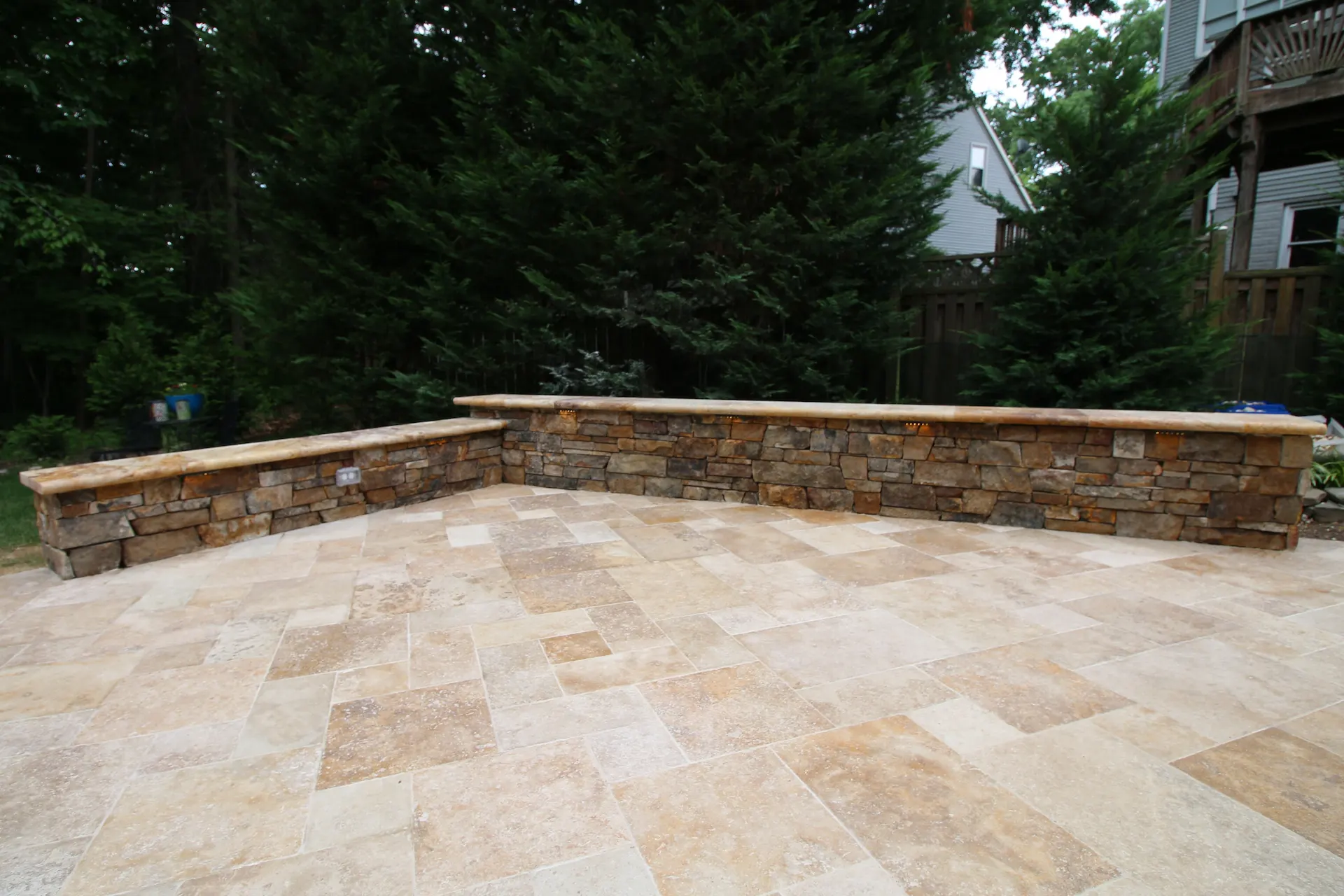
More Than Just a Border
A low stone wall serves a dual purpose: it clearly defines the edge of your patio, separating it from the lawn, and provides built-in outdoor seating for entertaining, designed to stand up to the weather. We design and build custom freestanding seat walls (typically 18-21 inches high) using natural flagstone, brick veneer, or modern architectural block with smooth, comfortable caps for your guests.
A seating wall adds permanent capacity along the edge of the patio without consuming usable floor space the way furniture does. Built into the perimeter, it frames conversation zones around a fire pit, doubles as a low retaining face where the grade steps down, and houses the wiring for integrated low-voltage lighting. The result is an outdoor room with a defined edge rather than a flat slab ringed by chairs that get dragged around, blown over, and replaced every few seasons.
1. The Diagnostic: Why Builder-Grade Walls Lean and Crack
A seat wall looks simple, but it carries a real load and fights gravity, lateral pressure, and moisture every day. The common failure is treating it as decorative: blocks stacked and glued onto shifting soil or onto an unreinforced patio edge that was never designed to bear a concentrated vertical load. Within a few seasons those walls lean, the joints open, and the face cracks along the mortar lines.
The coping — the flat capstone people actually sit on — is the most exposed point. The stone expands in summer heat and contracts in winter cold, water works into hairline gaps, and on a freeze-thaw cycle that water expands roughly nine percent as it turns to ice, which can pry a cap loose; any mortared cap can pop over time (see The Tuck Standard, Section 8G). A wall with no internal core has a second problem: nothing resists the lateral force of several adults leaning back against it, so it racks and loosens over time. To last, a seat wall has to be built from a stable foundation up, with a structural spine inside it.
2. The Tuck Standard Protocol: Vertical Masonry Engineering
Tuck GC builds seat walls with the same structural masonry methods we use on retaining walls. We build in the major wall and feature systems — Techo-Bloc, Belgard, EP Henry, Nicolock, and Unilock — as well as full-bed natural stone, all set over the same structural core. The veneer you pick is aesthetic; the build underneath is identical. Here is the sequence:
- Footer Construction Whether the wall goes into a new patio or retrofits an existing one, it starts with the foundation. A non-structural decorative seat wall can sit on the patio slab. Anything structural — a wall retaining soil, for example — we build on its own footing, isolated from the slab, so the heavy vertical load bears on its own foundation instead of riding on the patio.
- CMU Structural Core The strength comes from the core, not the veneer. We build a solid spine of CMU (concrete masonry unit) block, reinforced with vertical steel rebar grouted into the cells where height or lateral load calls for it. This is the same core a freestanding masonry wall is built on, sized for a seat people lean against rather than a decorative cap.
- Veneer Application Once the core sets, we apply the finish — hand-chiseled fieldstone, brick, flagstone, or modular block — bedded in our standard mortar (see The Tuck Standard, Section 8H). Because the structure is independent of the facing, you choose the look on appearance alone.
- Coping & Capstone The seat has to be smooth and dead level. We set thick-cut flagstone, bluestone, or pre-cast caps to a finished 18-to-21-inch sitting height. We set the coping in a full bed of our standard mortar. Mortar is rigid, so a cap can pop loose over time as the stone moves with the seasons (see The Tuck Standard, Sections 8G and 8H).
- Integrated Low-Voltage Lighting We run the wiring for low-voltage LED lighting inside the CMU core during the build, before the veneer goes on, so nothing is stapled to the finished face. Under-cap fixtures throw a warm downward wash that lights the patio floor and grazes the stone texture without glaring at anyone seated nearby.
3. Material Science: The Tuck Seat Wall vs. Standard Landscaper
| Specification | The Tuck Standard Seat Wall | Standard Landscaper / DIY Kit |
|---|---|---|
| Internal Structure | Solid CMU block core (steel reinforced if needed). | Hollow decorative blocks glued together. |
| Foundation | Patio slab for decorative walls; own footing, isolated from the slab, for structural walls. | Built directly on top of dirt or shifting patio pavers. |
| Coping Adhesion | Full bed of our standard mortar over a solid core (any mortared cap can pop over time; Standards §8G). | Caps glued onto hollow kit blocks. |
| Lighting Integration | Wires hidden internally within the core during the build. | Ugly wires stapled to the exterior or no lighting at all. |
| Design Geometry | Custom curves, integrated pillars, and 18-21" ergonomic height. | Rigid, straight lines dictated by pre-fab kit limitations. |
4. The Northern VA Factor: Surviving the Soil and the Code
Building vertical masonry across Fairfax County, Arlington, Alexandria, and Prince William County means building for the soil under it. Through Woodbridge, Lorton, Manassas, and Burke, the subsoil runs heavily to marine clay — a highly expansive soil that absorbs water and swells when saturated, then shrinks and pulls away during summer drought. That seasonal movement, combined with frost heave when the wet clay freezes, will lift and crack a heavy wall set on it directly. The answer is to build for that movement: decorative walls ride on the patio slab, and structural walls get their own footing carried below the frost line, isolated from the slab, so the wall bears on a uniform base that spreads the load over the clay. No wall is immune to soil movement (see The Tuck Standard, Section 5F).
In McLean, Great Falls, Vienna, Fairfax Station, and Clifton, homeowners often want larger outdoor living spaces — stone pillars, an integrated fire pit, long curved seat walls — and many of those properties answer to an HOA or Architectural Review Board before work starts. We coordinate permitting where a structure or grading triggers review, and because our walls are built on a structural CMU core rather than dry-stacked landscape block, they are built with the structural masonry methods an inspector expects to see and read as a built-in extension of the house rather than an add-on.
5. What Drives the Cost of Stone Seating Walls in Northern Virginia
A seating wall is a vertical masonry structure, so the price is driven by the build underneath the veneer. The main cost drivers are the wall's length and height, whether it is freestanding or tied into an existing patio (retrofits require saw-cutting and re-finishing the patio edge against the wall), and the footing and drainage requirements dictated by the soil — expansive marine clay in Lorton or Burke can call for a deeper footing. From there, the veneer and capstone you choose, any pillars or curves, and integrated low-voltage lighting all move the number. We price every seating wall individually rather than quote a misleading per-square-foot figure.
Because every seating wall is scoped to your property, we price each one individually rather than by a flat rate. You'll find our project minimum and a full breakdown of what different budgets cover on our contact page.
See Our Full Pricing Breakdown6. Seating Wall Engineering FAQ
For optimal ergonomic comfort, a seating wall should be built between 18 and 21 inches tall, including the capstone. This mirrors the height of a standard dining chair. The coping (the seat itself) should be a minimum of 12 inches deep to provide comfortable support, though 14 to 16 inches is preferred for maximum comfort and structural proportion.
Yes, but it takes care. We can't simply build a heavy wall on top of old pavers that weren't designed to bear that concentrated weight. We saw-cut and remove the perimeter of the existing patio, excavate a proper footing for the new wall, build the structure, and finish the existing patio edge against the new wall, isolated from it rather than tied in (see The Tuck Standard, Section 6M).
Absolutely. Terminating a seating wall with a structural stone pillar (typically 24x24 inches) is a hallmark of premium hardscape design. These pillars serve as bold architectural anchors, provide excellent platforms for large lantern-style light fixtures, and offer structural framing for entryways onto the patio.
We build seating walls in the major segmental and veneer systems — Techo-Bloc, Belgard, EP Henry, Nicolock, and Unilock — as well as full-bed natural stone such as fieldstone, flagstone, and bluestone. Every option is set over our structural CMU core rather than dry-stacked, so the look you choose is purely aesthetic; the structure underneath is the same heavy-duty masonry build. We'll coordinate the wall veneer and capstone with your patio surface during design so the seating wall reads as one continuous hardscape.
Cost depends on the wall's length and height, whether it's freestanding or tied into an existing patio, the veneer and capstone you choose, footer and drainage requirements, and add-ons like pillars or integrated lighting — so we price every seating wall individually rather than quote a misleading per-square-foot figure. We're a structural design-build hardscape contractor, and most seating-wall packages are built as part of a larger patio scope. Send us your project details on the contact page and we'll give you a real number.
7. Build Permanent Seating Into Your Patio
A stone seating wall turns a flat backyard patio into a defined outdoor room with built-in capacity. The same structural build wraps a fire pit in Burke, adds lit seating to a pool deck in Arlington, or matches a run of garden planter walls in Springfield — permanent masonry instead of furniture you replace every few seasons. If you're scoping a seat wall as part of a patio in Fairfax, Alexandria, or Annandale, we'll design the wall, footer, and lighting as one package.