
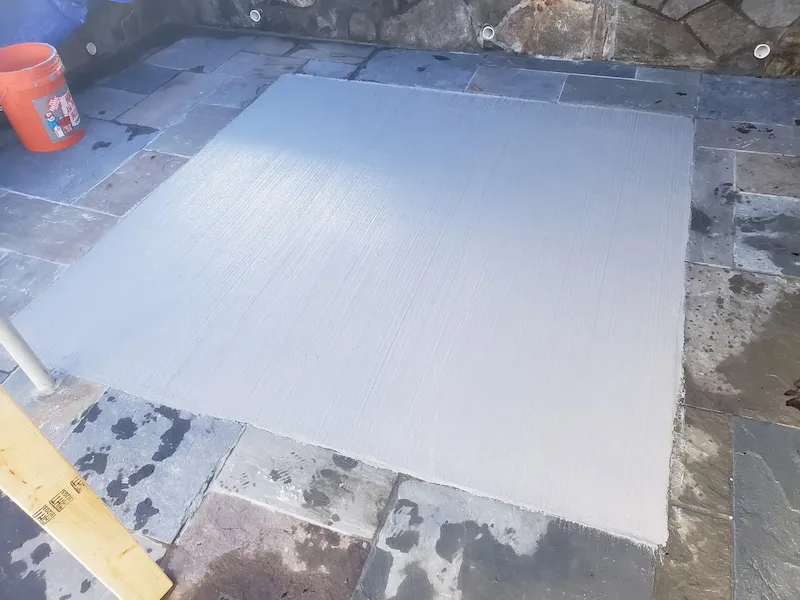
What Resurfacing Is — and What It Isn't
Concrete resurfacing puts a thin new cosmetic surface over an existing slab. At Tuck GC it has one purpose: a budget-friendly short-term cosmetic fix. The typical case: you're selling a house, we pour a new driveway and walkway, and the existing structural stoop is sound but you don't want to demolish it — a coat of ARDEX over the stoop dresses it up so it reads closer to the new concrete. It can also help a worn surface present better for a sale. It is not a structural repair, not a long-term solution, and not a substitute for replacement.
Most pitted, flaking driveways in Fairfax and Arlington are showing surface spalling: the thin top layer breaking apart. Common causes are chloride from road salt working into the pores, or a weak, over-troweled "cream" layer left during the original pour. Resurfacing covers that damage cosmetically; it does not change the slab underneath or the conditions that caused it. When a slab is failing — heaved, sunk, cracked through, or deeply deteriorated — we recommend replacement with new concrete driveways. We only offer resurfacing where a visual site assessment shows the slab is a candidate for a cosmetic coat. Building over an existing slab keeps that slab and its risks — its movement isn't covered by our warranty (see The Tuck Standard, Section 3S); a full replacement is a separate scope.
How We Resurface: ARDEX, Per the Manufacturer
The only resurfacing Tuck GC does is with ARDEX, a cementitious surface coating that reads close to the color of new concrete, as a short-term cosmetic fix. We don't stain, acid-etch, paint, or apply color coats or any other coatings to concrete — the only color we offer is integral color mixed into new concrete slabs.
- 1. Surface Preparation The existing surface is cleaned and prepared per ARDEX's instructions.
- 2. ARDEX Resurfacer We apply the ARDEX cementitious resurfacer per the manufacturer's instructions. We don't apply a sealer as part of the install; a penetrating sealer is an aftermarket option some homeowners choose later (see The Tuck Standard, Section 7).
- 3. Realistic Expectations Resurfacing is a short-term cosmetic solution. It does not repair the slab, stop it from moving, or keep existing cracks from showing through, and it is not a substitute for replacement.
Resurfacing vs. Replacement: Know What You're Buying
Resurfacing and replacement solve different problems. Resurfacing changes how a sound slab looks for now; replacement gives you a new slab.
| Feature | ARDEX Resurfacing | Full Replacement |
|---|---|---|
| Purpose | Short-term cosmetic fix | A new driveway slab |
| Structural Repair | No | New slab on a compacted #21A stone base |
| Heaved, Sunk or Cracked-Through Slabs | Not a candidate | The failing slab is removed |
| Warranty | Existing slab's movement not covered (Standards, Section 3S) | One-year workmanship warranty on the new work (Standards, Section 12) |
| Typical Use | Selling a house; dressing up an existing stoop beside new concrete | A failing slab, or a long-term driveway |
The Northern Virginia Factor: Salt & Freeze/Thaw
The salt cycle: VDOT and private plows run magnesium chloride and rock salt heavily across our region all winter. You drive through the slush, park, and the salt brine drips onto the slab. As it evaporates, salt crystals grow inside the concrete's pores and exert pressure that pops the top layer off — the same spalling you are trying to fix. Freeze-thaw compounds it: water trapped in the pores expands roughly 9% when it freezes, and Northern Virginia swings across 32°F dozens of times each winter, so the slab is loaded and unloaded again and again.
What that means for resurfacing: The same salt and freeze-thaw conditions keep working on a resurfaced driveway. A resurfacer is a thin cosmetic layer over the old slab, so treat it as a short-term fix: keep de-icing chemicals off it, and plan on replacement for a slab that is failing.
What Drives the Cost of Concrete Resurfacing in Northern Virginia
Resurfacing is priced on the work the surface actually needs, not a flat rate. The main drivers are the square footage of the slab, the condition of the existing concrete, and the surface preparation ARDEX's instructions call for on your slab. Slabs that have heaved, sunk, or cracked through aren't candidates — we recommend replacement instead. Because resurfacing stays within your existing footprint, it carries no right-of-way permit and costs well below a full tear-out and replacement — which is also why it is a short-term cosmetic fix, not a long-term one.
Because every project is scoped to your property, we price each one individually rather than by a flat rate. You'll find our project minimum and a full breakdown of what different budgets cover on our contact page.
See Our Full Pricing BreakdownFrequently Asked Questions
A Short-Term Fix, Honestly Scoped
If you need a driveway to look better for a sale, or want old and new concrete to read closer together, ARDEX resurfacing can be a cost-effective short-term cosmetic fix. Tuck GC will inspect the concrete at your Fairfax, Arlington, or Alexandria home, confirm whether it's a candidate, and tell you straight if it isn't — a slab that has heaved, sunk, or cracked through needs replacement with new concrete (or, for blacktop, an asphalt-to-concrete driveway conversion). Resurfacing is never a substitute for replacement.
Request a Site Evaluation