
Why Flagstone Patios Fail in Northern Virginia
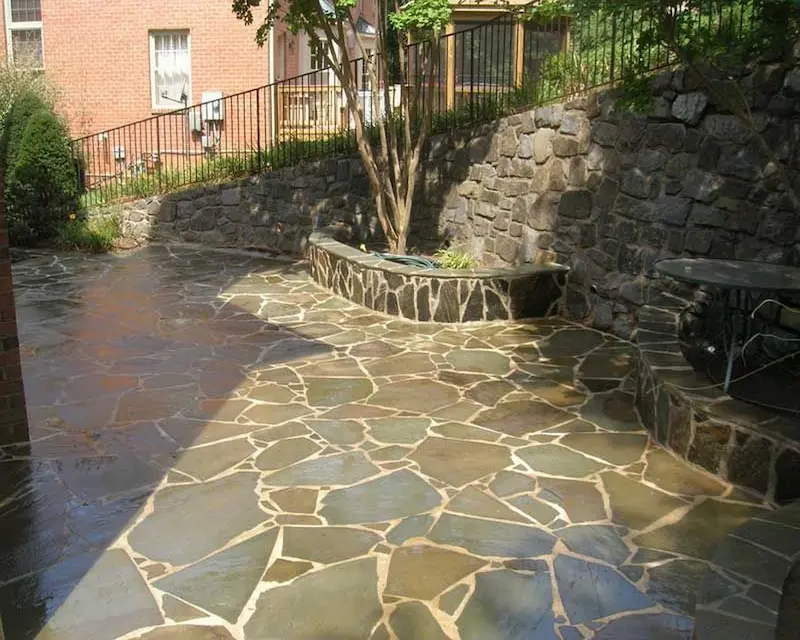
When homeowners in McLean, Alexandria, and Fairfax ask for a "stone patio," they almost always mean Pennsylvania Variegated Flagstone — a natural quarried stone with a mix of blues, greens, tans, and rust tones that suits both traditional and modern Northern Virginia homes. We build it as wet-set masonry: the stone is mortared onto a 4-inch concrete slab with welded wire mesh pulled up into it, with mortar joints between the pieces. That construction is what makes a flagstone patio solid and weed-resistant, and it reduces (though it cannot eliminate) the shifting that ruins most stone patios here.
The reason flagstone patios fail in this region is almost always the base, not the stone. Most hardscape crews are landscapers, not masons. They "dry-lay" flagstone — resting the heavy pieces on a loose bed of stone dust or sand with no concrete underneath. That approach is faster and cheaper to install, but in the Mid-Atlantic freeze-thaw climate a sand base behaves like a sponge, and the patio inherits every movement of the soil below it.
Here is the failure mechanism. Surface water seeps through the open, sand-filled joints and saturates the base. When winter temperatures drop below freezing, that trapped water turns to ice and expands roughly nine percent in volume, lifting the stones above it — the classic frost-heave cycle that repeats with every cold snap. By spring the flagstones have sunk, tipped, and separated, creating trip hazards, and weeds and ants have moved into the loosened joints. A wet-set slab closes off the open joints that let water into the base and spreads soil movement across one slab instead of letting it lift stones one by one (it reduces, but cannot eliminate, the effects of clay movement; see The Tuck Standard, Section 5F), which is why we build structural masonry rather than a surface that has to be reset every few years.
The Tuck Standard Wet-Set Protocol
A wet-set flagstone patio is a structural concrete pour finished with a natural stone surface. Because the Pennsylvania Variegated thermal flagstone is mortared to a single concrete slab, the stones are carried by the slab instead of each one moving independently with the clay beneath them. These are the five steps of our standard flagstone build:
- Structural Excavation & Subgrade Preparation We excavate the footprint to design depth, stripping the organic topsoil and soft surface material so the base bears on compacted, prepared subgrade. We check the exposed subgrade before anything is poured; unsuitable soil found during excavation is removed and replaced by Change Order (see The Tuck Standard, Section 3G), because a base built on disturbed soil telegraphs that weakness up through the finished stone.
- Compacted Aggregate Base We place and machine-compact an aggregate base in lifts. Beyond load support, it gives the concrete a uniform platform so the pour goes down at an even thickness.
- Concrete Foundation (4,000 PSI) This is the step landscapers skip. We pour a 4-inch, 4,000 PSI concrete slab with 6x6 welded wire mesh pulled up into the slab. The slab spans soft pockets in the clay and carries the stone; it reduces, but cannot eliminate, the effects of clay movement and frost heave (see The Tuck Standard, Section 5F).
- Wet-Setting the Stone We set 1.5-inch thermal-cut Pennsylvania Variegated Flagstone onto the cured slab in a full bed of Type S masonry mortar, our standard mix (see The Tuck Standard, Section 8H). A full bed leaves water less room to collect and freeze under a stone.
- Joint Pointing & Pitching for Drainage We fill the joints with the same standard mortar; mortar joints need periodic maintenance (see The Tuck Standard, Sections 8C and 8E). The whole surface is pitched to shed water away from the house and your foundation.
Mortared vs. Dry-Laid: The Structural Difference
Both methods produce a patio that looks similar on day one. The difference is what happens after a few Northern Virginia winters. Here is how wet-set masonry and dry-laid flagstone compare on the points that decide whether a patio lasts.
| Engineering Metric | Tuck Wet-Set Masonry (The Standard) | Builder-Grade Dry-Laid (The Competitor) |
|---|---|---|
| Foundation Base | 4-inch, 4,000 PSI concrete slab with 6x6 welded wire mesh pulled up. | Loose compacted sand, stone dust, or gravel. |
| Stone Movement | Each stone is mortar-bonded to the slab and moves with it, not on its own. | Stones sink, tip, and heave independently as the base shifts. |
| Weeds & Pests | Solid mortar joints give weeds and ants little to root in. | Ants excavate the sand; weeds take hold in the open joints. |
| Water Management | A pitched, mortared surface sheds water away from the house. | Water drains through the joints, pools under the stone, and erodes the base. |
| Service Life | Built for long service — a structural patio, not a surface that needs routine resetting. | Shifts and needs lifting and re-leveling far sooner. |
The Northern Virginia Factor: Soil & Zoning
Hardscaping here is a soil problem before it is a stone problem. Much of the region sits on highly plastic marine clay — common under Fairfax Station, Clifton, McLean, and Lorton — that swells as it takes on water in spring and shrinks as it dries through summer. That shrink-swell cycle moves a loose gravel base up and down with the seasons, which is exactly what tears a dry-laid patio apart. A concrete slab bridges the clay and rides on it as one piece, reducing (though it cannot eliminate) how much seasonal soil movement underneath transfers into the finished stone above (see The Tuck Standard, Section 5F).
Permitting matters too. A wet-set patio counts as impervious area, and local rules differ: Arlington caps total lot coverage; Fairfax limits front-yard paving and accessory structures in rear setbacks; Alexandria controls floor area and open space. We check which rules apply to your lot before design. Enlarging a patio can require plat calculations, an engineered drainage plan, and a permit — and review runs on the jurisdiction's schedule; in our experience it commonly takes 30 days or more, well before any crew mobilizes. On the steeper lots in Great Falls, Oakton, and Vienna, holding the grade often means tying structural retaining walls into the patio design. We coordinate the drawings and permitting with the county up front so the build starts on solid legal and structural footing.
What Drives the Cost of a Flagstone Patio in McLean & Alexandria
Pennsylvania flagstone is a premium natural stone, and a wet-set patio prices very differently from a sand-dropped landscaping job. The biggest driver is the masonry no one sees: the 4-inch, 4,000 PSI concrete slab that bridges our marine clay. After that, cost moves with the size of the patio, whether you choose thermal or natural-cleft stone, and how much demolition and excavation the site needs. Irregular flagstone is hand-cut and hand-fit, so it carries more labor than a modular paver, and lot access for materials, your grade and drainage, and any zoning or permitting requirements all factor in. We price every flagstone patio individually rather than post a per-square-foot number that ignores the structure beneath the stone.
Because every patio is scoped to your property, we price each one individually rather than by a flat rate. You'll find our project minimum and a full breakdown of what different budgets cover on our contact page.
See Our Full Pricing BreakdownFlagstone Patio FAQ & Technical Diagnostics
Ready to design your custom natural stone space? Request your flagstone patio consultation →
Stop Settling for Temporary Hardscapes.
Don't pay masonry prices for a landscaping build. If your current patio is shifting, sinking, or growing weeds in the joints, the base under it has already failed. We build flagstone patios on a concrete slab so the stone has a real foundation under it.
SCHEDULE A SITE EVALUATION