
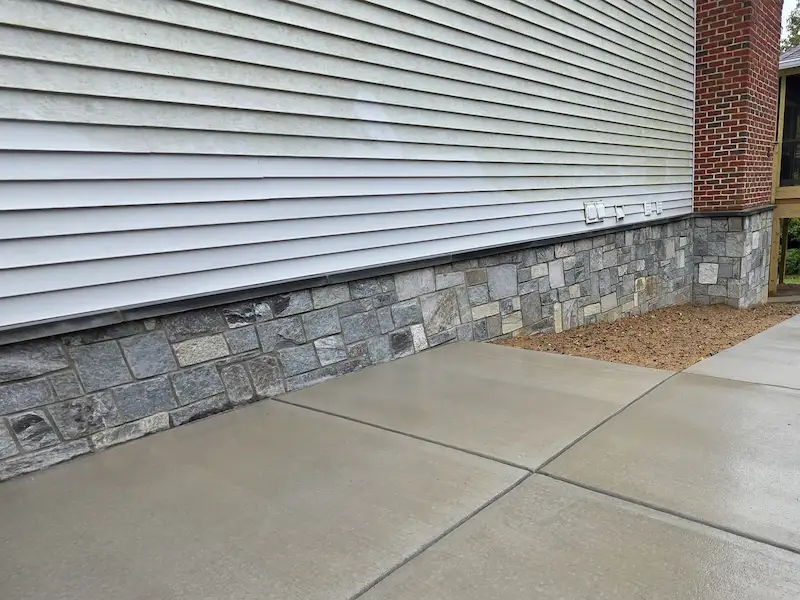
Hide the Gray Concrete
Foundation veneer and parging cover the exposed band of concrete or cinder block between your siding and the soil. On most Northern Virginia homes that band sits a few inches to several feet proud of grade, and over the years it picks up mud staining, frost cracks, and peeling exterior paint. The two proper ways to finish it are a mortared stone (or thin-brick) veneer over the wall, or a troweled cement parge coat. Tuck GC installs both, and which one fits your house depends on the look you want and the condition of the block underneath.
A natural stone veneer, often called a "skirt" or "water table," anchors the house visually to the ground. In neighborhoods across McLean, Vienna, and Arlington, a continuous stone foundation is a hallmark of custom architecture. For older block foundations that are spalling or stained, a cement parge coat restores a clean, smooth, breathable finish at far lower cost. Both finishes are above-grade cosmetic and protective work; neither is basement waterproofing, which happens below the dirt line and is a separate scope entirely.
1. The Diagnostic: Why Foundation Paint Fails
The most common DIY fix is painting the exposed concrete, and it is the one that fails fastest. Concrete and cinder block are porous; the wall constantly wicks ground moisture up from the soil and releases it as vapor through its face. A film-forming exterior paint seals that face. The vapor still arrives from behind, has nowhere to go, and pushes against the paint film from the inside until it blisters, bubbles, and sheets off. The result is a scrape-and-repaint cycle every two to three years that never actually ends.
On older cinder-block foundations in Alexandria and Falls Church, that same trapped moisture drives "spalling." Water absorbed into the block freezes, expands, and pops the face off the masonry one freeze-thaw cycle at a time, so the wall crumbles away each winter. The fix is a vapor-permeable finish—a thick parge coat or a mortared stone veneer over lath—that protects the block while still letting it dry to the outside. Breathability is the whole point: anything that seals the wall makes the spalling worse.
2. The Tuck Standard Protocol: Veneer & Parging
Because this work happens right at the dirt line, the order of operations and moisture detailing matter as much as the finish itself. Here is how we execute the restoration:
- Surface Prep & Paint Removal Mortar will not bond to failing paint, dust, or efflorescence. We grind and strip the foundation back to raw, sound concrete or block, cutting out any spalled or loose material, so the new scratch coat keys directly into solid masonry rather than sitting on a layer that is already letting go.
- Detailing the Transition at the Sill Where the wood framing meets the foundation, we detail the transition as the county's requirements call for, so water that gets behind the siding has a path out at the bottom of the wall instead of pooling against the sill plate. Skip that detail and the new veneer becomes a dam that holds water against the framing—a common failure on amateur installs.
- Metal Lath & Scratch Coat On concrete or block foundations — our usual case — we install the veneer or parge coat over metal lath fastened to the masonry, then trowel on a Type-S mortar scratch coat (our standard mix) that embeds the mesh. The lath gives the cement something to grip beyond surface adhesion alone. Where a wall is wood or plywood sheathing, we follow the county's requirements, which normally include a weather barrier.
- Natural Stone Skirting For the veneer finish, we hand-lay natural thin stone (or thin-brick sourced as the closest available match to an existing water table) in a mortar bed over the cured scratch coat, fitting the pieces tightly from the trench up to the base of the siding so no concrete shows. The skirt is capped with a sloped masonry sill that throws water away from the wall.
- Cement Parging For a clean, minimal look—popular on mid-century homes in Springfield and Burke—we skip the stone and float a parge coat of Portland cement and masonry sand over the lath. Worked smooth, it gives a uniform finish that shields the old block from weathering while still breathing.
3. Material Science: Finishing the Foundation
| Finish Type | Aesthetic Profile | Moisture Breathability | Ideal Application |
|---|---|---|---|
| Natural Stone Veneer | Heavy, luxurious, complements patios/chimneys. | Excellent. Mortar joints allow vapor transmission. | Custom homes, estate properties, high-visibility elevations. |
| Cement Parging | Smooth, uniform, clean utilitarian concrete. | Excellent. Protects old blocks while breathing. | Older cinder block homes, side/rear elevations, modern designs. |
| Elastomeric Paint | Flat color, shows all imperfections. | Poor. Traps hydrostatic pressure causing peeling. | Temporary DIY fix. Not recommended by Tuck GC. |
4. The Northern VA Factor: Tying the Hardscape Together
Once a homeowner in Great Falls or Clifton adds a new flagstone patio or composite deck, the gray concrete band below the siding stops blending in and starts standing out. We treat the foundation veneer as the tie-in point: wrapping the foundation in a stone veneer selected to complement the retaining walls or outdoor fireplace ties house and hardscape together so the whole elevation reads as one design rather than a set of separate projects (natural stone varies, so no match is warranted).
The effect is strongest where the foundation is tall. On sloped lots in Lorton, Woodbridge, and Manassas, the rear of a walk-out basement can leave eight to ten feet of bare concrete exposed. Veneering that wall breaks up the flat gray face, gives the elevation scale and texture, and turns the back of the house into a finished surface instead of an afterthought.
5. What Drives the Cost of Foundation Veneer & Parging in Northern Virginia
Foundation work is priced by the perimeter and its condition, not a flat rate. The main cost drivers are the linear footage being wrapped and how tall the exposed band is—a knee-high water table is a fraction of a ten-foot walk-out wall. The finish matters next: a smooth cement parge coat is more economical than hand-laid natural stone or thin-brick veneer. From there, cost tracks the surface prep needed to strip failing paint and cut out spalled block, the excavation to run the finish below grade, the transition and flashing detailing, and the access and grade around the house. Sourcing the closest available brick or stone to an existing profile can add to it as well.
Because every foundation is scoped to the length and height of the wall and the finish you select, we price each one individually rather than by a flat per-foot rate. Foundation veneer is also frequently bundled with a larger patio or driveway project, which is often the most economical way to have it done. You'll find our project minimum and a full breakdown of what different budgets cover on our contact page.
See Our Full Pricing Breakdown6. Foundation Veneer FAQ
No. Parging and stone veneer are above-grade exterior finishes. They protect the face of the block from weather and spalling, but they will not stop subterranean groundwater from penetrating your basement. Stopping groundwater takes below-grade work — excavating the foundation, rubberized membranes, and footing drains — and even that manages water rather than guaranteeing a dry basement.
We can come close. If your home has an existing brick water table on the front, but exposed concrete on the sides and rear (a common cost-saving tactic used by tract builders), we can source the closest commercially available thin-brick match to your original brick, extending the premium look around the house. New units read newer than weathered originals and won't be identical, and new mortar joints read brighter than aged ones at first (the difference typically softens as they weather); the match isn't warranted, mortar color is never tuned, and no mortar color match is guaranteed (see The Tuck Standard, Sections 8H and 8L).
We typically excavate a shallow trench and run the stone veneer or parge coat below the final grade of your soil or mulch, to the depth shown in your proposal. This ensures that even if the mulch washes away or the dirt settles slightly over time, you should not see a gap of exposed concrete at the bottom of the wall.
An above-grade veneer or parge coat applied to a sound, existing foundation is a finish and usually does not require structural work. If your project involves a load-bearing change such as a tall foundation wall, a new opening, or a footing, we pull the local county or city building permit and coordinate a licensed Virginia Professional Engineer (PE) for any PE-stamped drawings, then we build to the stamped design.
We focus on natural thin stone veneer such as fieldstone and ledgestone, and we can source a thin-brick water table in the closest commercially available match to your existing brick — new brick beside weathered brick reads newer until it weathers in. We frequently wrap the foundation in the same stone line used on your patio, retaining walls, or outdoor fireplace, selected to complement them so the house and hardscape read as one design; natural stone varies lot to lot, so no match is warranted (see The Tuck Standard, Section 8L).
7. Ground Your Architecture
The result is a foundation that protects the block underneath and finishes the bottom of the elevation—ending the scrape-and-repaint cycle. We do smooth parge restorations on historic Alexandria townhomes and wrap tall, multi-level walk-out foundations in fieldstone across Fairfax County, and everything in between.
Foundation veneer is one piece of our full masonry & structural program. Many homeowners pair it with full-wall stone veneer on the chimney or facade, or rebuild the front entry with coordinated brick & stone stoops so the entire elevation reads as one continuous design. Contact us to plan how the foundation ties into the rest of your home.