
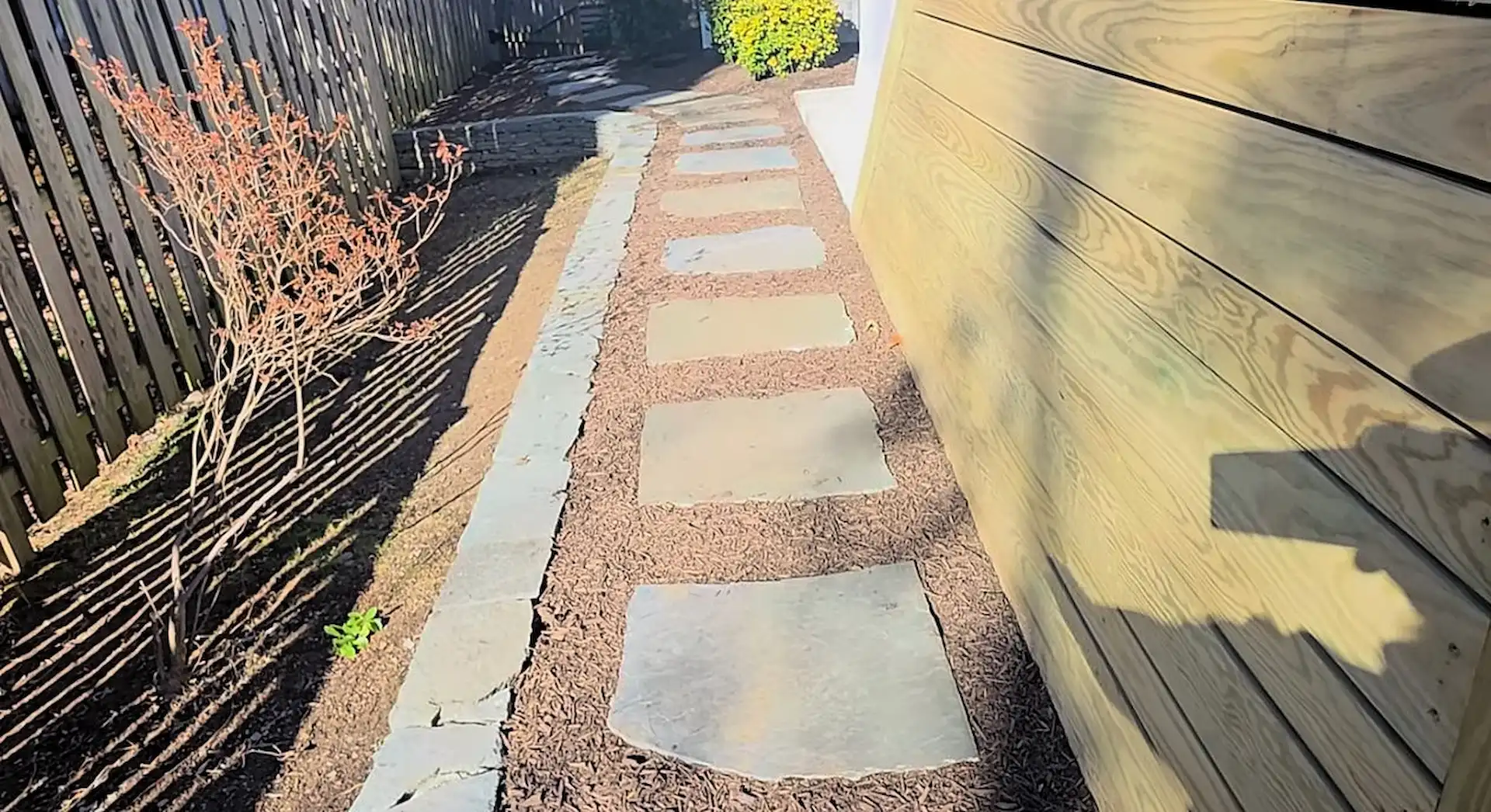
The Journey Through Your Garden
A garden pathway is the informal, organic alternative to a formal masonry walkway. For side yards, garden access, or a route from the patio to a fire pit, stepping-stone and gravel paths read softer and settle into the planting beds rather than commanding the yard. Tuck GC installs natural flagstone stepping stones, stabilized gravel paths held in by hidden edging, and rustic decomposed-stone walkways across Fairfax, Arlington, Alexandria, Springfield, Burke, and Annandale.
"Organic" does not mean un-engineered. A garden pathway in McLean, Vienna, or Fairfax Station still has to survive the freeze-thaw cycling that defines a Northern Virginia winter — water saturates the ground in the afternoon, freezes overnight, expands roughly 9% as it turns to ice, then thaws and repeats, prying any unsupported stone upward a little more each cycle. Build a path on bare topsoil and the result is predictable: heavy natural stone sinks and tilts into a trip hazard, gravel migrates out into the lawn, and weeds colonize every open joint. We apply the same subgrade discipline we use under structural masonry, which is what keeps a path level and the lines crisp over the long term.
1. The Diagnostic: Why Standard DIY Pathways Fail
The common mistake is treating a garden pathway as a surface-level project — buying good stone or gravel and laying it straight over topsoil or a thin scratch of sand. The pathway usually starts failing within a single season, and the reasons are mechanical, not cosmetic.
Topsoil is compressible and biologically active. Under rain and foot traffic it turns to mud, and mud behaves like a lubricant: heavy stone slips, rocks, and sinks unevenly into it. Without a geotextile separator, native weeds and roots colonize the joints between stepping stones and push up through gravel beds within weeks. And without buried edge restraint, loose aggregate has nowhere to be held — it spreads outward into the turf, the borders blur, and every mowing throws stone. A pathway that lasts needs a compacted, drained foundation hidden under the organic surface.
2. The Tuck Standard Protocol: Pathway Engineering
Keeping a pathway level, stable, and weed-resistant over the long term comes down to what happens below the stone. Tuck GC builds garden paths on a compacted aggregate base with fabric and edging as the path requires. The typical sequence:
- Excavation & Subgrade Compaction We don't lay stone on grass. We excavate the pathway footprint to the depth the path requires, stripping the organic topsoil and root matter that compress under traffic, then mechanically compact the exposed subgrade into a firm, uniform floor for the base to bear on.
- Geotextile Separation Layer Where the path requires it, geotextile fabric is laid across the compacted subgrade. Water passes through while the fabric helps keep the native soil from pumping up into the clean base aggregate and helps hold back the deep-rooted weeds that otherwise emerge through the joints.
- Angular Base Aggregate We install and compact a layer of crushed angular aggregate. Unlike rounded gravel, angular stone interlocks under compaction into a firm base that drains instead of trapping water against the stone.
- Edge Restraint & Setting Bed Where the path type calls for it, we install edge restraint to define the borders and limit material migrating. We then screed a fine setting bed to grade, which lets us individually seat and level each piece of stone.
- Joint Stabilization & Finishing On stepping-stone paths the joints are filled with planting soil, mulch, or polymeric sand depending on the look you want. On gravel paths we compact the surface so the aggregate stays put underfoot instead of scattering.
3. Material Science: The Tuck Pathway vs. Builder-Grade
| Specification | The Tuck Standard Pathway | Standard Landscaper / DIY |
|---|---|---|
| Foundation | Compacted angular aggregate base over subsoil, to the depth the path requires. | Laid directly on topsoil or 1 inch of loose play sand. |
| Weed Prevention | Geotextile fabric as the path requires. | Thin plastic landscape fabric (easily torn) or none at all. |
| Edge Integrity | Hidden edge restraint as the path requires. | No edging; stones shift and gravel migrates into the lawn. |
| Stone Selection | High-density natural flagstone, bluestone, or premium stabilized aggregates. | Thin, low-grade slate that cracks under foot traffic. |
| Drainage Profile | Built to let water percolate down into the sub-base. | Pools water on the surface, creating mud pits and slip hazards. |
4. The Northern VA Factor: Navigating Local Terrain
Building a pathway across Fairfax County, Arlington, Alexandria, and Prince William County means working with the soil and the code that come with each address. Northern Virginia is not one landscape, and the two variables that decide how a path is built are subsoil and stormwater rules.
Across much of Prince William County — Lake Ridge, Woodbridge, Manassas, Gainesville, Haymarket, and Bristow — the subsoil is expansive marine clay. Saturated, it swells; dried out, it shrinks and cracks, and the cycle repeats with every wet-dry and freeze-thaw swing. A path set straight on that clay gets heaved out of alignment by the first hard winter. The answer is the compacted aggregate base above it: a well-drained base spreads the load and reduces, but cannot eliminate, how much of the clay's movement telegraphs through to the stone (see The Tuck Standard, Section 5F). That is why our excavation goes to full design depth rather than stopping at a couple of inches.
In the closer-in, premium areas — McLean, Vienna, Clifton, Fairfax Station, Great Falls, and Lorton — the constraint is usually impervious-surface limits. Many jurisdictions and HOA architectural review boards cap how much of a lot can be covered in hard, water-shedding surface to control runoff, and a mortared concrete or stone path counts against that cap. Natural stepping stones set in soil and permeable gravel walkways let water percolate into the ground. Whether they count toward your lot's coverage or impervious limit depends on the jurisdiction and HOA — some count gravel the same as pavement — so we confirm how yours treats them before design. Where a path does interact with the right-of-way or a regulated surface, we coordinate the permitting — review runs on the jurisdiction's schedule, and in our experience it commonly takes 30 days or more, separate from the install itself, which is scheduled weather permitting.
5. What Drives the Cost of Garden Pathways in Northern Virginia
Every garden pathway is custom, so cost tracks the real scope of the work rather than a flat per-foot rate. The main drivers are the length and width of the run, the stone you choose (thick Pennsylvania flagstone, full-color bluestone, fieldstone, or stabilized gravel), and how much excavation and base work the soil demands — expansive marine clay in Manassas or Gainesville needs a deeper compacted base than a stable lot in Vienna or Burke. On top of that: site access for tight side yards, edge restraint and geotextile, any stepped risers the grade calls for, and the finishing you pick (open soil joints, polymeric sand, or compacted gravel). We scope and price each path individually.
Because every pathway is scoped to your property, we price each one individually rather than by a flat rate. You'll find our project minimum and a full breakdown of what different budgets cover on our contact page.
See Our Full Pricing Breakdown6. Pathway Engineering FAQ
No outdoor surface is fully immune to airborne seed, but two layers make weeds very hard to establish. Where the path calls for it, geotextile fabric at the base of the trench helps hold back the deep-rooted native weeds that come up from below. Then, depending on the pathway style, we fill the joints with compacted stone dust or polymeric sand, which sets up firm and denies surface seeds the open soil they need to take root.
Not when it is built correctly. We avoid smooth, rounded pea gravel that rolls underfoot like marbles. Instead we use angular aggregate that locks together once it is mechanically compacted, so the surface stays firm enough to walk on, roll a wheelbarrow over, or push a mower along without scattering much stone.
Sloped side yards are really a drainage problem. A single continuous ramp channels heavy rain straight downhill and scours the base out from under it. Instead we design the path in steps, using natural stone risers to create level landing pads for the stepping stones or gravel. The steps break the slope into short level runs, which slows runoff and keeps the base from eroding.
For Northern Virginia gardens we favor high-density natural stone that resists cracking under foot traffic and freeze-thaw stress. Thick, irregular Pennsylvania flagstone and full-color bluestone are the most popular choices for stepping stones, while granite and fieldstone work well for rustic, organic paths. We also install engineered concrete pavers when a homeowner wants a crisper, more uniform line, but the focus on a garden pathway is almost always the natural stone.
Every pathway is custom, so pricing depends on the length, the stone you select, site access, and how much excavation and base work the soil requires. As a design-build firm we focus on larger, fully engineered hardscape projects. For an exact figure tailored to your property, request a consultation and we will walk the site and prepare a detailed written estimate.
7. Secure Your Property's Navigation
A garden pathway is the connective tissue of a landscape — it is what ties the patio, the side yard, and the fire pit together into one route. Across the clay soils of Burke, Springfield, and Annandale and the tighter landscaping rules of Arlington, Alexandria, and Great Falls, Tuck GC builds these organic paths to the same standard as our structural work, so you are not back to muddy shoes, sinking stones, and gravel in the lawn a season later.
Want something more formal? Our mortared stone walkways handle a structured front-entry approach, or browse the full Patios & Hardscapes line to pair a pathway with a paver patio or fire pit.